


 Deutsch
 English
 Español
 Français
 Nederlands
 Português


 Share
Share




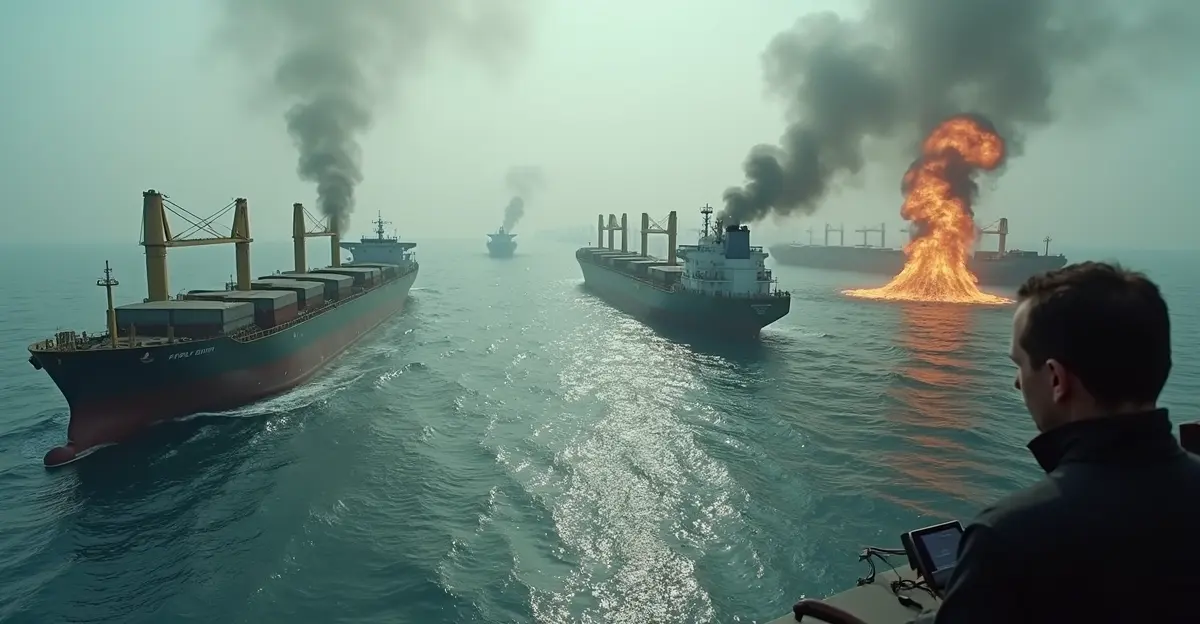
The closure of the Strait of Hormuz following the 2026 Iran conflict has removed nearly 20% of global oil supply from markets — a disruption three to five times larger than the 1973 oil shock. The International Monetary Fund's April 2026 World Economic Outlook projects global growth slowing to 3.1%, with oil prices potentially reaching $132 per barrel if the closure persists. This article examines how the energy shock, supply chain collapse, and surging defense spending are compounding into a systemic economic realignment, hitting developing economies hardest while triggering the largest European rearmament since the Cold War.
Context: The Strait of Hormuz and the 2026 Conflict
The Strait of Hormuz is a narrow waterway between Iran and Oman, connecting the Persian Gulf to the open ocean. Before the crisis, approximately 20% of the world's liquefied natural gas (LNG) and 25% of seaborne oil trade passed through the strait annually, making it the world's most strategically important energy chokepoint. On February 28, 2026, following US-Israeli strikes on Iran, the strait was effectively closed. Shipping traffic plummeted by over 95%, dropping from 130 ships daily to single digits, according to UNCTAD. The 2026 Iran war has thus created the largest oil market disruption in history.
Energy Shock: Oil Prices and Market Disruption
The Dallas Federal Reserve, in a March 2026 analysis, estimated that the closure has removed close to 20% of global oil supplies — three to five times larger than past geopolitical oil shocks such as the 1973 Yom Kippur War or the 1990 Gulf War. Using a formal economic model, the Dallas Fed projects that a one-quarter closure would raise WTI oil prices to $98 per barrel and lower global real GDP growth by an annualized 2.9 percentage points in Q2 2026. If the closure extends to two or three quarters, oil prices could spike to $115-$132 per barrel, with growth remaining negative through year-end 2026.
A significant divergence has emerged between Brent futures (trading around $97/bbl) and physical Dated Brent (reaching $132/bbl), reflecting genuine physical scarcity. Diesel trades near $200/bbl, jet fuel at $195/bbl, and urea fertilizer is up 50%, according to market analysis. Key oil producers like Iraq and Kuwait began curtailing production in early March as storage filled up, unable to export their crude.
Supply Chain Collapse: Fertilizers and Food Security
The disruption extends far beyond oil. Approximately 34% of globally traded urea and 23% of ammonia pass through the Strait of Hormuz, making it a critical chokepoint for fertilizer supply. The UN warns of a dire fertilizer shortage looming, with spring planting season already underway. Yara International's CEO Svein Tore Holsether warns that disruptions could constrain fertilizer availability, with severe knock-on effects for agriculture. The FAO notes that nearly 1.07 billion people rely on food produced from imported nitrogen fertilizers. Reduced fertilizer use could cut crop yields by up to 50% for some crops in the first season, potentially eliminating up to ten billion meals per week globally.
The global food security crisis is particularly acute for low-income countries, where food accounts for 43% of consumption. UNCTAD's Frida Youssef stated: 'The world's least developed economies, with the least capacity to absorb shocks, will be hit hardest by rising costs for fuel, food, fertilisers, and transport.'
IMF Projections: Global Growth and Inflation
The IMF's April 2026 World Economic Outlook, released during the IMF-World Bank spring meetings, projects global growth slowing to 3.1% in 2026 under the assumption of a limited conflict. Global headline inflation is expected to rise modestly in 2026, with pressures concentrated in emerging market and developing economies. The IMF identifies three main transmission channels: energy markets, supply chains, and financial conditions. Energy importers in Asia and Europe face higher costs, while exporters that can still reach markets may benefit. Financial markets have tightened with declining stock prices and rising bond yields.
A separate analysis by Solability models the economic impact under various scenarios. Under the most likely 'phantom ceasefire' scenario, global GDP loss is projected at $3.57 trillion (-3.24%), with inflation rising 2.13 percentage points. A prolonged closure risks $4.81 trillion in GDP losses, while full escalation could reach $6.95 trillion. The most exposed economies include Jordan (-6.35% GDP), Lebanon (-6.14%), and Singapore (-5.44%).
Defense Spending Surge: European Rearmament
The crisis is triggering the largest European rearmament since the Cold War. NATO allies agreed at the 2026 Hague Summit on a new benchmark of at least 3.5% of GDP for core defense spending. The European Union launched the ReArm Europe initiative, including a €150 billion SAFE fund, to accelerate military readiness. Global military spending jumped to $2.89 trillion in 2026, driven largely by European increases. This European defense spending surge represents a fundamental shift in fiscal priorities, with governments borrowing heavily to finance rearmament while simultaneously dealing with higher energy costs and slower growth.
Impact on Developing Economies
The IMF, Dallas Fed, and UNCTAD all agree that developing economies are bearing the heaviest burden. Higher energy import costs are straining current accounts, while fertilizer shortages threaten food production. Stock prices are falling, currencies weakening, and the cost of external debt rising. The IMF's Chapter 3 on the macroeconomics of conflicts notes that recovery from such shocks is typically slow and uneven, with conflict-affected economies suffering permanent output losses. The economic impact on developing nations is expected to persist long after the conflict ends.
Expert Perspectives
Alexander Silva, geopolitical analyst, notes: 'The simultaneous shocks to energy, food, and finance create a perfect storm that the global economy has not faced since the 1970s. But unlike the 1970s, today's highly interconnected supply chains amplify disruptions exponentially.' The IMF's blog post from March 30, 2026, emphasizes that 'the effects vary significantly by region, with poorer countries bearing the heaviest burden.' The Dallas Fed adds that 'the magnitude of this disruption dwarfs any previous geopolitical oil shock.'
Frequently Asked Questions
What caused the Strait of Hormuz closure in 2026?
The closure began on February 28, 2026, following US-Israeli military strikes on Iran. Iran responded by mining the strait and blocking shipping, effectively shutting down the waterway to commercial traffic.
How much oil passes through the Strait of Hormuz?
Before the crisis, approximately 20% of global oil supply and 25% of seaborne oil trade passed through the strait daily, along with 20% of LNG.
What is the IMF's growth forecast for 2026?
The IMF's April 2026 World Economic Outlook projects global growth slowing to 3.1% in 2026, down from pre-crisis trends, with significant downside risks if the conflict persists.
How high could oil prices go?
The Dallas Federal Reserve estimates that if the closure extends to two or three quarters, oil prices could reach $115-$132 per barrel. Physical Dated Brent has already hit $132/bbl.
Which countries are most affected?
Jordan, Lebanon, and Singapore face the largest GDP losses. Developing economies in Asia and Africa are particularly vulnerable due to higher energy and fertilizer costs.
Conclusion and Future Outlook
The Strait of Hormuz closure represents the most consequential global strategic development of the moment, with the IMF, Dallas Federal Reserve, and UNCTAD all releasing major assessments in April 2026 quantifying the fallout. The crisis is reshaping the global economy through higher energy prices, disrupted supply chains, surging defense spending, and heightened financial volatility. While a ceasefire could ease immediate pressures, the structural realignment — including European rearmament and shifts in energy trade routes — will persist for years. The world's poorest nations, already vulnerable, face the most severe and lasting damage.
Follow Discussion