


 Deutsch
 English
 Español
 Français
 Nederlands
 Português


 Share
Share




The February 2026 closure of the Strait of Hormuz following the US-Iran conflict has removed nearly 20% of global oil supplies from the market — three to five times larger than the 1973 oil embargo. Brent crude surged past $100 per barrel, Asian economies face acute energy disruption, and the Dallas Fed projects a 2.9 percentage point drag on global GDP growth. This event is accelerating a structural shift in which governments and corporations are reordering supply chains around energy security, critical mineral alliances, and regionalized production — marking the definitive end of the post-Cold War globalization era.
Context: The Largest Supply Shock in History
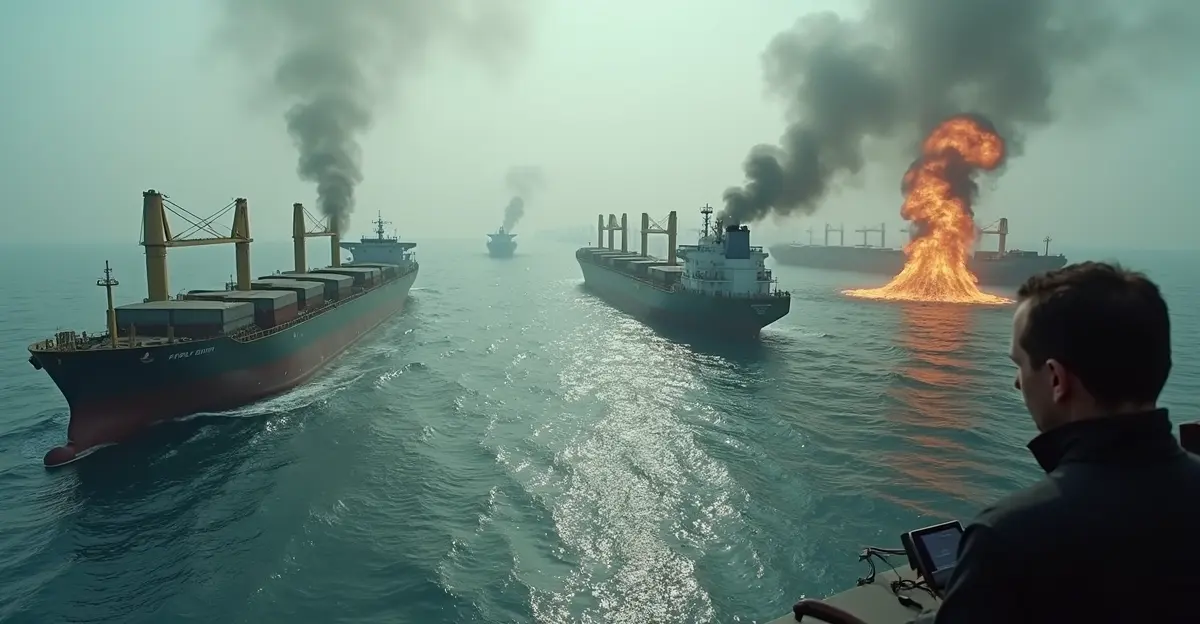
On February 28, 2026, the United States and Israel launched an air war against Iran, assassinating Supreme Leader Ali Khamenei. In retaliation, Iran's Revolutionary Guard issued warnings forbidding passage through the Strait of Hormuz, boarded merchant ships, and laid sea mines. Tanker traffic dropped by 70% within days, then to near zero. By March 27, the IRGC declared the strait closed to vessels going to and from US, Israeli, and allied ports. Approximately 20,000 mariners and 2,000 ships remain stranded in the Persian Gulf.
The scale of disruption dwarfs all previous oil crises. The 1973 Arab oil embargo removed about 4-6% of global supply; the 1979 Iranian Revolution removed roughly 5%. The Strait of Hormuz closure removes close to 20% of global oil supplies — making it three to five times larger than any prior event, according to the Dallas Federal Reserve. The International Energy Agency classified this as the largest supply shock in recorded history, estimating 15 to 17 million barrels per day disrupted.
The 2026 oil crisis timeline shows Brent crude oil prices surged from $61 per barrel at the start of 2026 to $118/b by the end of the first quarter — the largest inflation-adjusted quarterly increase since 1988, per the U.S. Energy Information Administration. At its peak on April 30, Brent briefly touched $126 per barrel.
Economic Fallout: GDP Drag and Inflation Spiral
The Dallas Fed's modeling estimates that a one-quarter closure would raise West Texas Intermediate oil prices to $98 per barrel and lower global real GDP growth by an annualized 2.9 percentage points in Q2 2026. If the closure extends to two quarters, oil prices could reach $115 per barrel, with longer durations pushing prices as high as $132 per barrel. Goldman Sachs warned that another month of Hormuz closure would keep Brent above $100 throughout 2026.
The impact is disproportionately felt in Asia. Approximately 80% of Persian Gulf oil is shipped to Asian markets. China receives a third of its oil via the strait; Japan and South Korea get 75% and 70% of their oil from the Middle East respectively. South Asia faces the most acute disruption: Qatar and the UAE supply 99% of Pakistan's LNG imports, 72% of Bangladesh's, and 53% of India's. India also gets 60% of its oil from the Middle East. Across Southeast Asia, Thailand is the most vulnerable due to net oil imports at 4.7% of GDP.
The energy security implications for Asia are profound. Several ASEAN countries are turning to Russian fuel — the Philippines received its first Russian crude shipment in five years (750,000 barrels) in March 2026, and Indonesia agreed to import about 150 million barrels of Russian crude this year. This shift risks deepening Moscow's geopolitical influence in Southeast Asia.
Strategic Reserve Drawdown: A Dangerous Precedent
In March 2026, the U.S. and IEA launched the largest emergency oil release in history — 400 million barrels — to combat prices surging past $100/barrel. The U.S. contributed 172 million barrels from its Strategic Petroleum Reserve (SPR), with Japan and the UK also participating. While prices initially retreated $12/barrel, the drawdown has depleted U.S. reserves to levels not seen since 1982. Analysts warn that without a resolution to the conflict, oil could test $150–$200/barrel, risking a global recession.
The IEA strategic reserve coordination raises questions about long-term energy security. The SPR is a finite buffer, and its depletion leaves the U.S. and its allies vulnerable to future shocks. The crisis has also exposed the inadequacy of commercial stockpiles and OPEC spare capacity as reliable buffers against determined geopolitical disruption.
War Risk Insurance and Shipping Costs
War risk insurance premiums for vessels transiting the Strait of Hormuz have surged to about 5% of a ship's value — roughly five times the level seen during the early days of the conflict. Insuring a $100 million oil tanker now costs approximately $5 million per transit, up from pre-crisis rates of 0.15%-0.25%. The Lloyd's Market Association expanded its high-risk area designation to the entire Persian Gulf, causing tanker traffic to collapse. By early April, premiums moderated to around 1% but remain several times higher than pre-crisis norms. The U.S. announced a $20 billion reinsurance plan through the International Development Finance Corporation, though details remain unclear.
These elevated costs add several dollars per barrel to crude grades originating from the Gulf, compounding the price shock for consumers worldwide.
Critical Minerals and Supply Chain Regionalization
The crisis is accelerating a structural shift in global supply chain strategy. On February 4, 2026 — just weeks before the Hormuz closure — the U.S. Department of State hosted the 2026 Critical Minerals Ministerial, with representatives from 54 countries. Secretary of State Marco Rubio announced FORGE (Forum on Resource Geostrategic Engagement) as the successor to the Minerals Security Partnership, and the U.S. mobilized over $30 billion in financing for critical minerals projects, including the $10 billion Project Vault domestic strategic reserve initiative via EXIM Bank.
This critical minerals supply chain realignment reflects a broader trend: governments and corporations are reordering supply chains around energy security and regionalized production. The McKinsey Global Institute's 2026 update on geopolitics and trade geometry describes a shift toward "reconfiguration rather than full deglobalization," with emerging trade blocs and regional supply ecosystems. The World Economic Forum notes that over 90% of executives expect AI to reshape supply chains by 2030, but only 8% have fully integrated AI-driven planning — suggesting the transition to resilient, regionalized supply chains is still in its early stages.
The crisis has also exposed the fragility of the "just-in-time" energy supply model for Asia. As one analysis put it, paper buffers — whether OPEC capacity estimates or commercial stockpiles — are insufficient against determined geopolitical disruption.
Ceasefire and Fragile Recovery
On April 7, 2026, a Pakistan-brokered two-week ceasefire was reached between the U.S. and Iran, conditional on Iran allowing safe passage through the Strait of Hormuz. However, implementation has been fraught. Iran initially shut off access following Israeli strikes on Lebanon, then began charging tolls of up to $2 million per vessel. The U.S. condemned the practice and continued its own blockade of Iranian ports, creating a "dual blockade" situation. Russia and China blocked a UN Security Council resolution calling for the strait's reopening.
Despite the ceasefire, global oil markets remain fragile. The IEA warns that strategic reserves are depleted, war-risk insurance remains elevated, and the underlying geopolitical tensions are unresolved. The crisis has fundamentally altered the calculus for energy importers and exporters alike.
Expert Perspectives
"This is not a temporary disruption — it is a structural break," said a senior analyst at the International Energy Forum. "The era of cheap, secure, and freely tradable energy is over. Governments and corporations must now build resilience into every link of the supply chain."
A Dallas Fed survey of oil and gas executives captured rising frustration with the Trump administration over uncertainty and increased shipping costs. One executive told the survey: "We are seeing a permanent shift in how energy is sourced, transported, and priced. The old model of globalized just-in-time supply chains is dead."
FAQ
What caused the Strait of Hormuz closure in 2026?
The closure was triggered by the US-Israeli air war against Iran on February 28, 2026, which included the assassination of Iran's Supreme Leader. In retaliation, Iran's Revolutionary Guard blocked the strait, attacked ships, and laid sea mines, effectively halting nearly all maritime traffic through the waterway.
How much oil passes through the Strait of Hormuz daily?
Approximately 20 million barrels of oil per day — roughly 20% of global seaborne oil trade and 25% of the world's seaborne oil trade — transits the strait. About 20% of global LNG exports also pass through it.
What is the economic impact of the closure?
The Dallas Fed estimates a 2.9 percentage point drag on global GDP growth in Q2 2026 if the closure lasts one quarter. Brent crude surged past $100/bbl, with a peak of $126/bbl. The IEA called it the largest supply shock in history, disrupting 15-17 million barrels per day.
How are Asian economies being affected?
Asian economies are the most acutely affected, receiving about 80% of Persian Gulf oil. China, Japan, South Korea, India, Pakistan, and Southeast Asian nations face severe energy disruption. Some ASEAN countries are turning to Russian oil as an alternative, risking deeper geopolitical entanglements.
What does this mean for global supply chains long-term?
The crisis is accelerating a shift toward regionalized production, energy security alliances, and critical mineral partnerships. The post-Cold War era of globalization is giving way to a more fragmented, security-driven trade architecture. Governments are investing in domestic strategic reserves, bilateral resource agreements, and supply chain diversification.
Conclusion: A Defining Pivot Point
The Strait of Hormuz crisis of 2026 is the defining economic event of the year and a strategic pivot point for global trade architecture. The ceasefire reached in April 2026 may have paused the immediate conflict, but the structural consequences will reverberate for decades. Depleted strategic reserves, surging insurance costs, and the fundamental reordering of supply chains around energy security mark the definitive end of the post-Cold War globalization era. Governments and corporations that fail to adapt to this new reality will find themselves dangerously exposed to the next shock.

Follow Discussion