


 Deutsch
 English
 Español
 Français
 Nederlands
 Português


 Share
Share




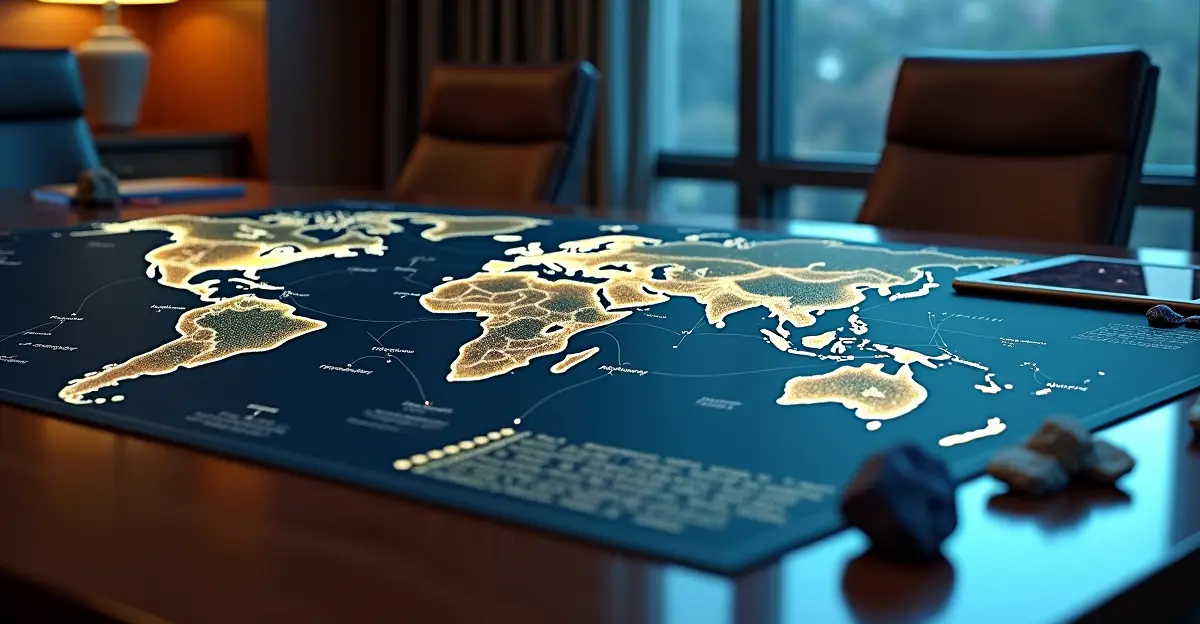
Riyadh and Abu Dhabi are deploying more than $100 billion in sovereign wealth fund capital to secure lithium, cobalt, and rare earth assets across Africa, Latin America, and Central Asia in 2026, positioning themselves as neutral intermediaries in the escalating US-China resource rivalry. This Gulf sovereign wealth funds critical minerals push is reshaping alliances in real time, as Western nations seek alternatives to Chinese processing dominance without simply trading one dependency for another.
What Is Driving the Gulf Critical Minerals Pivot?
Saudi Arabia's Vision 2030 has upgraded its mineral wealth estimate to $2.5 trillion, with a target of mobilizing $100 billion in mining investment by 2035. The pivot is partly a hedge: as the world electrifies, Gulf states want to remain indispensable to industrial supply chains, much as they did with petrochemicals. Abu Dhabi's Mubadala, Saudi Arabia's Public Investment Fund (PIF), and the Qatar Investment Authority are deploying patient, long-horizon capital across energy transition minerals, blending equity, royalties, and offtake agreements to secure preferential access to lithium, cobalt, nickel, copper, and rare earths.
The $100 Billion Deployment: Africa, Latin America, and Central Asia
The deployment spans three continents. Saudi Arabia's Manara Minerals—a PIF-Ma'aden joint venture—paid $2.5 billion for a 10% stake in Vale Base Metals and may be spun off as an independent vehicle. The UAE has invested over $110 billion in Africa during 2019–2023 alone, and Abu Dhabi's ADQ closed a $1.8 billion Orion Critical Minerals Consortium with the U.S. Development Finance Corporation and Orion Resource Partners in January 2026, with a target to expand to $5 billion. Mubadala joined U.S.-led efforts, including the Pax Silica coalition. Across lithium supply chains in Chile and Argentina, cobalt in the Democratic Republic of Congo, and rare earths in Central Asia, Gulf capital is now a defining feature of the 2026 resource map.
Neutral Intermediaries or Petrostate Leverage?
China still controls around 90% of rare earth processing and more than 60% of battery-grade lithium and cobalt processing. The U.S. and EU have responded: FORGE launched on February 4, 2026, with 54 countries and $30 billion in mobilized financing, including the $10 billion Project Vault strategic reserve, while the EU's Critical Raw Materials Act selected 60 Strategic Projects targeting 10% extraction, 40% processing, and 25% recycling by 2030. Gulf funds—worth $4–6 trillion, over 40% of global sovereign wealth—are stepping into the gap. ORF Middle East argues that Gulf states can gain global leverage in critical minerals—the 'new oil'—by coordinating their comparative advantages, much as they have through OPEC. But the same leverage raises a question: is the West trading Chinese control for a new dependency on petrostate financiers? The US-China critical minerals competition is now triangulated through Riyadh and Abu Dhabi.
Impact on US-China Resource Rivalry
China's 15th Five-Year Plan (2026–2030) prioritizes rare earths and extends export controls to processing technology, driving prices outside China up sixfold. In this environment, Gulf intermediaries offer Western allies alternative supply chains while maintaining ties with Beijing, their largest oil customer. The EU Critical Raw Materials Act and FORGE both depend on credible neutral partners; the Gulf's sovereign funds provide exactly that, but only if they can balance the two blocs. Analysts note that the UAE is most integrated into the U.S. framework, Qatar straddles both systems via a $500 million Ivanhoe Mines stake, and Saudi Arabia stays furthest from both, favoring minority stakes and using its own $2.5 trillion reserves as leverage. The China 15th Five-Year Plan has accelerated this positioning, as Western policymakers seek to de-risk without decoupling entirely.
FAQ: Gulf Sovereign Wealth Funds and Critical Minerals
How much are Gulf sovereign wealth funds investing in critical minerals?
Saudi Arabia and the UAE are deploying more than $100 billion in sovereign wealth fund capital, with Saudi Arabia targeting $100 billion in mining investment by 2035 and the UAE's Orion consortium starting at $1.8 billion and expanding to $5 billion.
Which critical minerals are Gulf funds acquiring?
Lithium, cobalt, nickel, copper, and rare earths, primarily across Africa, Latin America, and Central Asia.
Why are Gulf states positioning as neutral intermediaries?
They want to hedge against the hydrocarbon transition, gain leverage in the energy transition supply chain, and offer Western allies alternatives to China's processing dominance while retaining ties with Beijing.
What is FORGE and how does it relate to Gulf investments?
FORGE, launched February 4, 2026, is a U.S.-led plurilateral coalition with 54 countries and over $30 billion in financing. Gulf funds participate through vehicles like the Orion Critical Minerals Consortium and Pax Silica.
Does Gulf investment reduce dependence on China?
It diversifies supply chains, but some analysts warn it may create new dependencies on petrostate financiers rather than fully solving Western strategic leverage.
Future Outlook
As the rare earth processing dominance of China meets Western policy pushback, Gulf sovereign wealth funds are likely to deepen their role as swing investors. The question for 2027 is whether their neutrality survives the next escalation in the resource cold war.
Follow Discussion