


 Deutsch
 English
 Español
 Français
 Nederlands
 Português


 Share
Share




The World Economic Forum's Global Risks Report 2026 has elevated geoeconomic confrontation to the top risk likely to trigger a global crisis this year, and critical minerals have emerged as the central battleground. With China controlling over 90% of rare-earth processing and more than 60% of refined lithium and cobalt capacity, export controls imposed by Beijing in 2025-2026 have driven price spikes of up to sixfold outside China, exposing acute vulnerabilities in Western defense, green energy, and high-tech supply chains. In response, the United States, European Union, and Gulf states are racing to build alternative supply chains through bilateral deals, strategic reserves, and domestic processing capacity — but analysts warn of a narrow 12-to-18-month window before Western dependencies become structurally entrenched.
China's Stranglehold on Critical Minerals
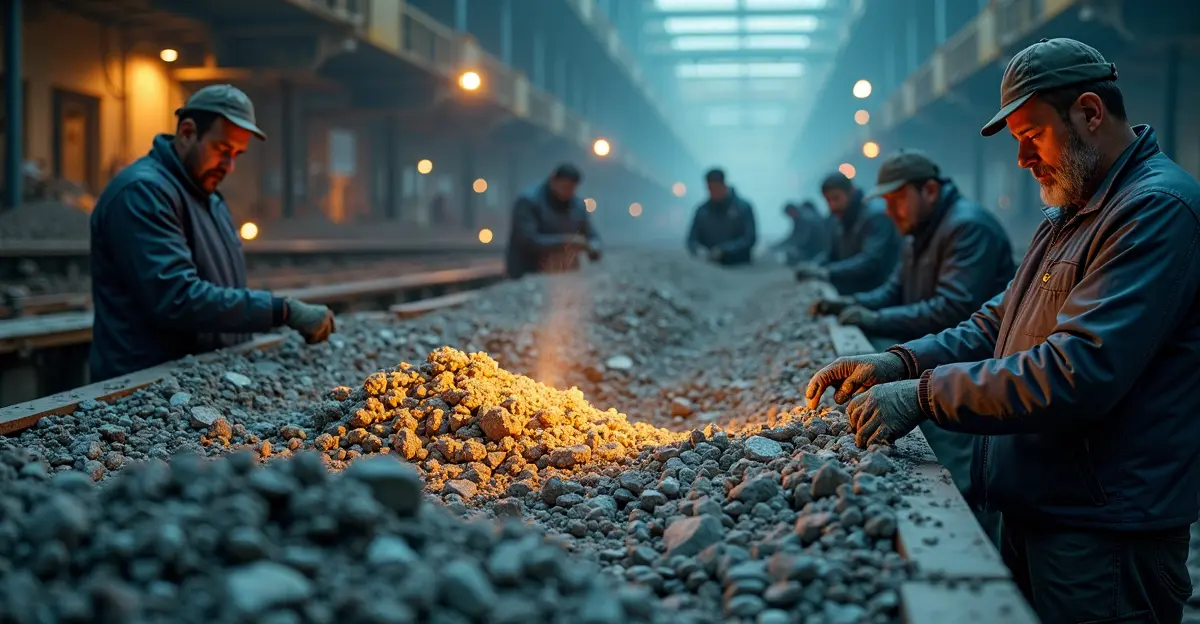
China's dominance in critical minerals is not accidental but the result of decades of strategic industrial policy. According to the U.S. Energy Information Administration, China processes over 90% of the world's graphite and accounted for more than two-thirds of global cobalt and lithium processing capacity as of 2022. Chinese companies also control 80% of cobalt production in the Democratic Republic of Congo, which supplies over half of global cobalt output. In rare earths, China's grip is even tighter: it controls roughly 90% of processing and 80% of tungsten and 60% of antimony processing.
Beginning in 2025 and intensifying in 2026, Beijing imposed a series of export controls on rare earths, tungsten, antimony, and advanced lithium materials. These measures require export licenses for high-performance lithium-ion batteries, cathode materials, and manufacturing equipment. Licensing approval rates for European firms have fallen below 25%, according to a multi-institutional analysis. The result has been dramatic: rare-earth prices outside China have surged sixfold, while European companies — over 80% of which depend on Chinese supply chains — face severe shortages. The geoeconomic confrontation between the US and China has thus moved from trade tariffs to the weaponization of mineral supply.
The Western Response: FORGE and the Critical Minerals Ministerial
On February 4, 2026, the U.S. Department of State hosted the 2026 Critical Minerals Ministerial in Washington, led by Secretary of State Marco Rubio and Vice President JD Vance, with representatives from 54 countries and the European Commission. The centerpiece of the event was the launch of FORGE — the Forum on Resource Geostrategic Engagement — chaired by the Republic of Korea, which succeeds the Minerals Security Partnership. FORGE aims to coordinate policy and investment among partner nations to build diversified, secure, and resilient end-to-end supply chains for technologies ranging from AI and robotics to electric vehicle batteries.
The Ministerial also saw the signing of 11 new bilateral critical minerals frameworks or memoranda of understanding with countries including Argentina, Morocco, the United Arab Emirates, and the Philippines. Crucially, the U.S. mobilized over $30 billion in letters of interest, investments, and loans for critical mineral projects over the preceding six months. This includes the Export-Import Bank's Project Vault, a $10 billion initiative to establish a U.S. Strategic Critical Minerals Reserve. The FORGE coordination body represents the most ambitious multilateral effort yet to counter China's dominance.
Europe's Critical Raw Materials Act and Strategic Projects
The European Union is pursuing its own parallel track under the Critical Raw Materials Act (CRMA). In early 2026, the European Commission selected its first 60 Strategic Projects — 47 within the EU and 13 in third countries — covering extraction, processing, and recycling of strategic raw materials. The Commission has also committed up to €3 billion (US$3.5 billion) in funding for 2026 under the ReSourceEU Action Plan, alongside regulatory fast-tracking for approved projects. A second call for applications closed on January 15, 2026, indicating sustained momentum.
However, European efforts face significant hurdles. Most of the selected projects focus on extraction and processing, with only ten in the recycling category. Moreover, the EU's reliance on Chinese supply remains deep: over 80% of European companies depend on Chinese critical mineral supply chains. The EU Critical Raw Materials Act aims to reduce this dependency, but analysts caution that building new mines and processing facilities typically takes 10-15 years — far longer than the 12-18 month window of vulnerability.
Gulf States: The New Geopolitical Pivot
Saudi Arabia and the United Arab Emirates are emerging as unexpected but decisive forces in the critical minerals race. Under Vision 2030, Saudi Arabia has upgraded its estimated mineral wealth to $2.5 trillion and aims to mobilize $100 billion in mining investments by 2035 through its sovereign fund vehicle Manara Minerals. The UAE is deploying sovereign wealth funds as global intermediaries, including ADQ's $1.8 billion Orion Critical Mineral Consortium and Mubadala's direct investments in lithium and copper projects across Africa and Latin America.
The Gulf states offer Western markets an alternative supply route to China's dominance, leveraging financial capital, geographic location, and diplomatic agility. However, they must navigate a delicate balancing act: China remains the Gulf's largest oil customer, and any overt alignment with Western de-risking efforts risks antagonizing Beijing. The Gulf states critical minerals pivot thus adds a layer of complexity to the global resource landscape.
Impact and Implications
The weaponization of critical minerals has profound implications for global power dynamics. Defense systems, electric vehicles, wind turbines, and advanced electronics all depend on a handful of minerals — rare earths, lithium, cobalt, graphite, and tungsten — that China dominates. The 12-to-18-month window identified by analysts reflects the time needed to bring new processing capacity online, but also the risk that China could further tighten export controls or use its leverage for political coercion.
For the United States, the $30 billion mobilization and FORGE initiative represent a significant step, but domestic mining and processing face regulatory hurdles and community opposition. The EU's Strategic Projects are a start, but funding and execution timelines remain uncertain. The Gulf states offer hope but also geopolitical complications. As the WEF Global Risks Report 2026 makes clear, geoeconomic confrontation is now the defining risk of our time — and critical minerals are its sharpest edge.
Expert Perspectives
"The critical minerals crisis is not a future risk — it is a present emergency," said Evelyn Nakamura, a geopolitical analyst specializing in resource security. "China's export controls have demonstrated that supply chain concentration is a national security vulnerability. The 12-18 month window is real: if we don't build alternative processing capacity by late 2027, Western industries will face structural dependency for a generation."
Analysts at the Swedish Institute of International Affairs, in a March 2026 brief, noted that the Gulf states' pivot could fundamentally alter the resource landscape, but warned that their dual alignment with China and the West creates inherent instability. The race is on — and the stakes could not be higher.
Frequently Asked Questions
What is FORGE?
FORGE (Forum on Resource Geostrategic Engagement) is a U.S.-led plurilateral initiative launched in February 2026 to coordinate policy and investment in critical mineral supply chains among 54 partner nations and the European Commission. It succeeds the Minerals Security Partnership and is chaired by the Republic of Korea.
How much of the world's rare earth processing does China control?
China controls over 90% of global rare-earth processing, along with dominant shares of tungsten (80%), antimony (60%), and more than 60% of refined lithium and cobalt capacity.
What are the EU's Strategic Projects under the Critical Raw Materials Act?
The EU's Critical Raw Materials Act designates Strategic Projects to strengthen European capacity for extracting, processing, and recycling strategic raw materials. The first 60 projects were selected in early 2026, with €3 billion in funding committed for the year.
Why is there a 12-to-18-month window?
Analysts estimate that Western nations have 12-18 months to build alternative processing capacity before China's structural advantages become entrenched. Beyond that window, new mines and processing facilities would take too long to come online, leaving the West dependent on Chinese supply for a generation.
What role are Gulf states playing in critical minerals?
Saudi Arabia and the UAE are investing heavily in mining and processing capacity, leveraging sovereign wealth funds to secure supplies from Africa and Latin America. They offer Western markets an alternative to Chinese dominance, but must balance ties with Beijing.
Conclusion and Future Outlook
The race to break China's critical minerals stranglehold is the defining geostrategic story of early 2026. With FORGE, the EU's Strategic Projects, and Gulf state investments, the West is mobilizing unprecedented resources. But time is short, and the window for action is narrowing. The outcome will shape not just the energy transition and defense industries, but the global balance of power for decades to come.



Follow Discussion