


 Deutsch
 English
 Español
 Français
 Nederlands
 Português


 Share
Share




What is the FORGE Alliance?
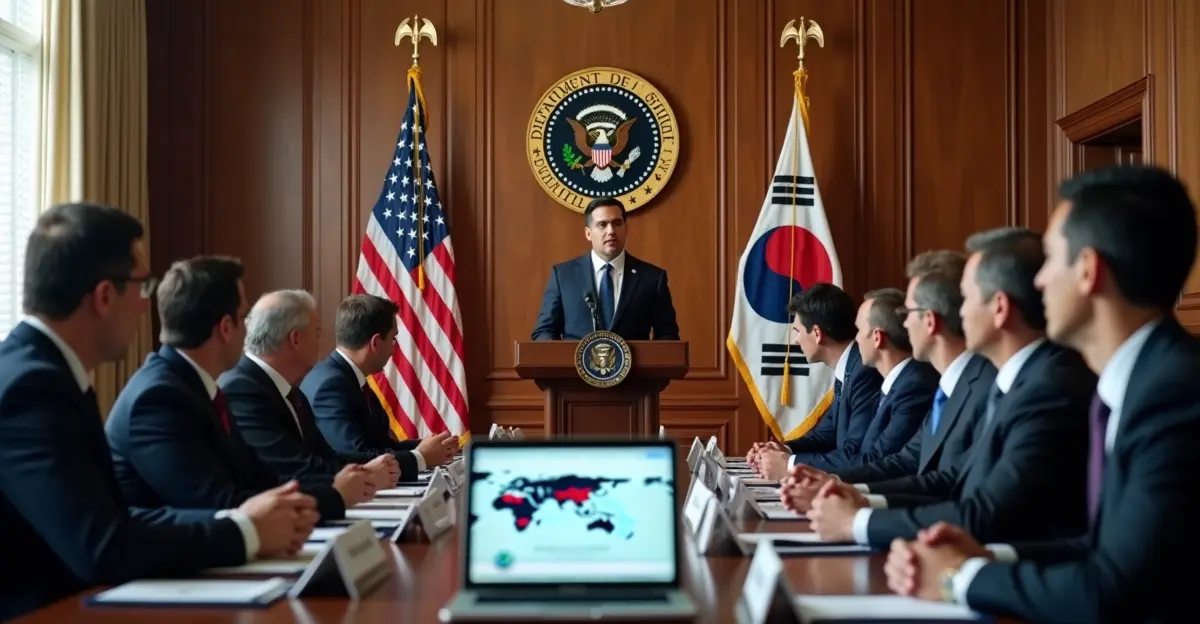
On February 4, 2026, the United States launched the Forum on Resource Geostrategic Engagement (FORGE) at the inaugural Critical Minerals Ministerial in Washington, D.C. This plurilateral coalition brings together 54 countries to create a preferential trade-and-investment zone for critical minerals, backed by coordinated price floors and adjustable tariffs. FORGE represents a fundamental shift from the Biden-era Minerals Security Partnership toward active market intervention, with over $30 billion in mobilized capital and 21 bilateral framework agreements already signed. The alliance directly challenges China's near-total dominance of critical mineral refining, which currently stands at roughly 90% of global capacity.
Background: The Critical Minerals Race
Critical minerals—including rare earth elements, lithium, cobalt, graphite, and nickel—are essential for electric vehicle batteries, wind turbines, defense systems, AI hardware, and consumer electronics. China has leveraged decades of strategic state investment to control approximately 60-70% of global rare earth mining and an even higher share of processing capacity. According to the Institute for Energy Research, China will maintain over 80% of the market in synthetic graphite and rare earths through 2030. This concentration has allowed Beijing to weaponize supply chains, restricting exports of germanium, tungsten, antimony, and silver during trade disputes. The US-China technology war has made critical mineral independence a national security priority.
How FORGE Works: Key Mechanisms
Preferential Trade-and-Investment Zone
FORGE establishes a plurilateral system linking bilateral agreements into a functioning network covering two-thirds of the global economy. Member countries benefit from reduced tariffs, streamlined investment rules, and coordinated standards for extraction, processing, and recycling. The alliance is chaired by South Korea through June 2026, signaling Asia-Pacific leadership in the initiative.
Reference Prices and Adjustable Tariffs
Vice President JD Vance described the use of 'reference prices for critical minerals at each stage of production,' maintained through adjustable tariffs. This mechanism aims to prevent price dumping by adversarial states and ensure stable returns for producers. If a non-member country sells below the reference price, FORGE members can impose compensating tariffs, effectively creating a price floor across the bloc.
Project Vault: $10 Billion Strategic Reserve
Announced alongside FORGE, Project Vault is a $10 billion public-private partnership backed by the Export-Import Bank and nearly $2 billion in private capital. Companies can lock in fixed prices for minerals, submit their needs, and draw from the stockpile while paying upfront costs and replenishment fees. This strategic reserve protects the private sector from supply disruptions and price volatility, mirroring the Strategic Petroleum Reserve model but for critical minerals.
Impact on Global Supply Chains
Energy Transition Timelines
The International Energy Agency projects that demand for critical minerals will quadruple by 2040 under net-zero scenarios. FORGE aims to accelerate mining and processing projects in member countries, reducing reliance on Chinese refineries. However, new mines take 7-15 years to reach production, meaning near-term dependence on China will persist. The global energy transition supply chain faces significant bottlenecks without diversified sources.
AI Hardware and Defense Supply Chains
Advanced AI chips require rare earth magnets and specialty metals. China's dominance in processing gallium, germanium, and rare earths poses direct risks to semiconductor fabrication and defense systems. FORGE's focus on 'each stage of production' aims to secure upstream inputs for allies like Taiwan and South Korea, critical nodes in the global AI hardware supply chain. The AI chip export controls debate has highlighted these vulnerabilities.
Gulf States as Mineral Financiers
A notable development is the emerging role of Gulf states, particularly the United Arab Emirates and Saudi Arabia, as financiers of critical mineral projects. The UAE signed a bilateral framework agreement at the ministerial, and Gulf sovereign wealth funds are increasingly investing in African and South American mining ventures. This shift diversifies funding sources away from Chinese state-owned enterprises and aligns with the Gulf states' economic diversification strategies.
Expert Perspectives
FORGE represents a fundamental shift from passive partnership to active market intervention. By linking trade policy, price signals, and strategic reserves, the US is finally treating critical minerals as a geostrategic asset rather than a commercial commodity. — Atlantic Council analyst.
China will remain the world's dominant processor through 2030. FORGE is a long-term play, not a quick fix. The real test will be whether member countries can build processing capacity at scale and at competitive costs. — Institute for Energy Research report.
Challenges and Criticisms
FORGE faces several hurdles. First, storage infrastructure for physical stockpiles under Project Vault is limited, and market distortion risks are real if price floors are set too high. Second, many critical mineral concentrates still flow to Chinese refineries because of cheap coal power and lax environmental standards. Third, the US holds only 2% of global rare earth reserves, limiting domestic supply potential. Finally, the WTO legality of adjustable tariffs may be challenged by China and other non-members.
FAQ
What is FORGE?
FORGE (Forum on Resource Geostrategic Engagement) is a US-led plurilateral coalition of 54 countries launched in February 2026 to create a preferential trade-and-investment zone for critical minerals with coordinated price floors.
How does FORGE differ from the Minerals Security Partnership?
FORGE succeeds the MSP with sharper teeth: it includes adjustable tariffs to enforce reference prices, a $10 billion strategic reserve (Project Vault), and over $30 billion in mobilized capital, representing active market intervention rather than voluntary cooperation.
Which countries are part of FORGE?
54 countries and the European Commission attended the inaugural ministerial. Key bilateral agreements were signed with Argentina, Morocco, Peru, the Philippines, the UAE, and the UK. South Korea chairs the alliance through June 2026.
What is Project Vault?
Project Vault is a $10 billion public-private partnership creating a strategic stockpile of critical minerals. Companies can lock in fixed prices and draw from the reserve during disruptions, paying upfront costs and replenishment fees.
Can FORGE break China's dominance?
FORGE is a long-term strategy. China controls ~90% of refining capacity and will maintain dominance through 2030. However, by diversifying sources, enforcing price floors, and building strategic reserves, FORGE reduces vulnerability to supply coercion over time.
Conclusion
The FORGE alliance marks a watershed moment in US-China resource competition. By combining trade policy, strategic reserves, and multilateral coordination, the US is moving beyond rhetoric to active market intervention. Success will depend on execution: building processing capacity, managing costs, and maintaining political will across 54 diverse economies. For energy transition timelines, AI hardware supply chains, and global geopolitical stability, the stakes could not be higher.

Follow Discussion