


 Deutsch
 English
 Español
 Français
 Nederlands
 Português


 Share
Share




The New Economic Iron Curtain: How Critical Mineral Supply Chains Are Reshaping Global Alignments in 2026
In 2026, the global order is being redrawn not by military force, but by the strategic control of lithium, cobalt, rare earths, and other critical minerals. The World Economic Forum's Global Risks Report 2026 ranks geoeconomic confrontation as the number-one short-term risk, reflecting a world where supply chains have become weapons and traditional trade frameworks are fracturing into competing blocs. With the United States, European Union, and China each racing to secure critical mineral supply chains through friend-shoring, stockpile funds, and bilateral deals, a new multipolar economic order is emerging — one that bypasses the rules-based system that governed global commerce for decades.
Context: The Weaponization of Mineral Dependence
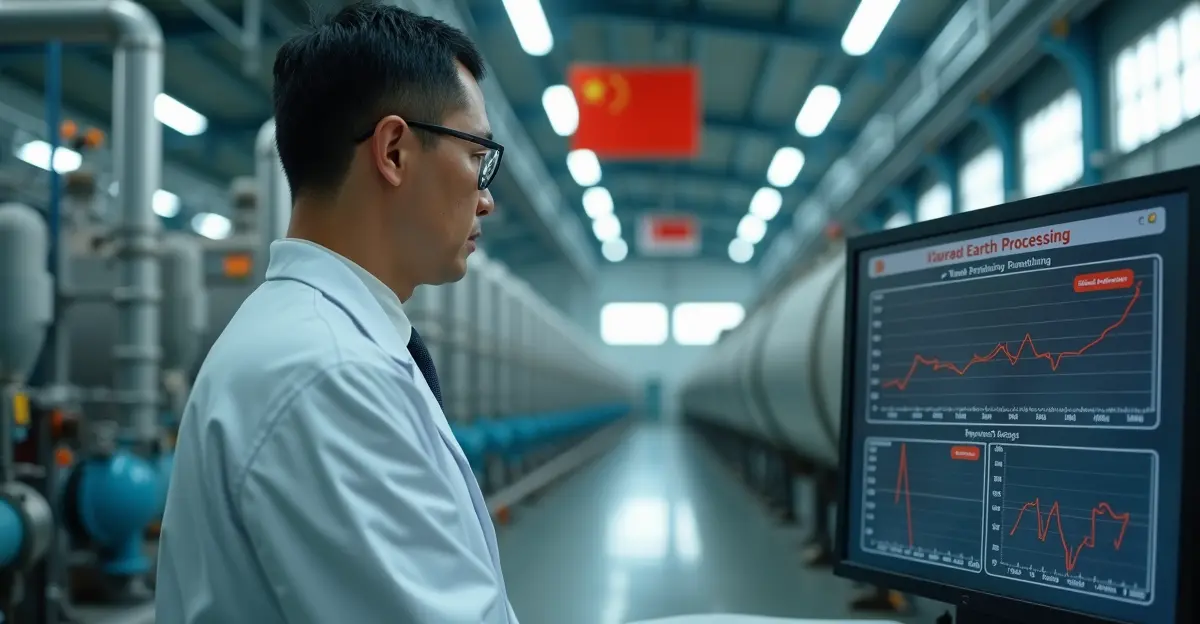
Critical minerals — defined by governments as raw materials essential for economic and national security with vulnerable supply chains — have become the new strategic frontier. China currently controls approximately 70% of global rare earth mining, 90% of refining capacity, and 94% of permanent magnet production. In 2025 and 2026, Beijing imposed escalating export controls on rare earth elements, tungsten, and antimony, triggering price spikes of up to sixfold outside China. Licensing approvals for European firms dropped below 25%, exposing the depth of Western dependence on Chinese supply chains.
The weaponization is deliberate. According to a multi-institutional analysis published in early 2026, China is using temporary, reversible restrictions to maintain pricing power and extract strategic concessions while preventing large-scale Western investment in alternatives. The result is a structural vulnerability that threatens defense production, electric vehicle manufacturing, and renewable energy deployment across the West.
US Strategy: Project Vault and the Friend-Shoring Offensive
The United States has responded with unprecedented mobilization. In February 2026, President Donald Trump announced Project Vault, a $10 billion Export-Import Bank-backed strategic critical mineral reserve, supplemented by $2 billion in private funds — totaling $12 billion. The initiative is designed to shield American manufacturers from supply shocks and strengthen domestic processing capacity. This builds on the earlier FORGE (Forum on Resource Geostrategic Engagement) initiative, launched at the 2026 Critical Minerals Ministerial on February 4, which brought together 54 countries and the European Commission.
At that ministerial, the U.S. signed 11 new bilateral critical minerals frameworks or MOUs with countries including Argentina, Morocco, the Philippines, the UAE, and the UK. In total, Washington has mobilized over $30 billion in government support through loans, investments, and letters of interest. The strategy is explicitly based on friend-shoring — reorganizing supply chains to run through politically allied nations rather than geopolitical competitors. This marks a fundamental departure from the efficiency-optimized, hyper-globalized model of the post-Cold War era.
The Limits of US Action
Despite the scale of investment, experts warn that rebuilding independent processing capacity outside China could take 20 to 30 years. The Atlantic Council notes that Project Vault's success hinges on governance choices: holding processed materials rather than raw ore, avoiding bidding wars between reserves, and defining clear release triggers for gray zone conflicts. Without careful design, the initiative risks becoming just another bureaucratic program. The challenges of strategic mineral stockpiling are immense, but the alternative — continued vulnerability — is untenable.
EU Strategy: Strategic Projects and the Autonomy Gap
The European Union has pursued its own path under the Critical Raw Materials Act (CRMA), which came into effect in May 2024. By early 2026, the European Commission had approved 60 Strategic Projects aimed at boosting EU capacity in extraction, processing, and recycling of critical minerals. The second application cut-off closed on January 15, 2026, and the list includes projects focused on lithium, graphite, and rare earths essential for the green and digital transitions.
However, the EU faces significant hurdles. According to a January 2026 analysis by Hatch, only 5 of the initial 47 strategic projects are fully funded, with 25 still in pilot or demonstration phases. Technologies remain immature, and permitting timelines — though streamlined to 27 months for extraction and 15 for processing — still lag behind the urgency of the moment. Europe's ReSourceEU Action Plan allocated €3 billion, a fraction of the U.S. commitment and dwarfed by China's state-backed investments.
The EU's challenge is compounded by its deep dependence on Chinese supply chains: over 80% of European companies rely on Chinese sources for critical minerals. The EU's critical raw materials strategy aims to reduce this dependency, but the gap between ambition and industrial reality remains wide.
China's Dominance and the 15th Five-Year Plan
China is not standing still. Its 15th Five-Year Plan, expected to be finalized in 2026, is projected to reinforce its dominance across the critical mineral value chain. By 2035, China is expected to supply over 60% of refined lithium and cobalt and approximately 80% of battery-grade graphite and rare earths. Beijing's strategy combines state-owned enterprise consolidation, overseas mining investments — particularly in Africa and Latin America — and export controls that function as geopolitical leverage.
China's approach has been described as an 'electrostate' model, where the state orchestrates the entire supply chain from extraction to end-use manufacturing. This contrasts with the U.S. 'petrostate' model, which relies on private capital and market mechanisms, and the EU's regulatory-driven approach. The result is a fragmented global landscape where each bloc operates under different rules, incentives, and strategic logics.
Impact: Fragmentation, Inflation, and Energy Transition Delays
The weaponization of mineral supply chains is already producing real-world consequences. The IMF has warned that geopolitical fragmentation of critical mineral markets poses significant downside risks to global growth. Price volatility has increased: rare earth prices outside China surged sixfold in 2025-2026, raising costs for EV batteries, wind turbines, and defense electronics. The F-35 fighter jet program has been delivered without next-generation radars due to gallium shortages — a direct consequence of Chinese export controls.
Resource nationalism is also on the rise. Countries like Indonesia, Chile, and Zimbabwe are demanding greater control over their mineral resources, imposing export taxes, local processing requirements, and renegotiating contracts. This further complicates the efforts of Western nations to secure supply, as resource nationalism and critical mineral supply create new barriers to investment.
The energy transition timeline is at risk. The IEA has repeatedly stressed that achieving net-zero emissions by 2050 requires a rapid scale-up of mineral supply. Fragmentation slows investment, raises costs, and creates uncertainty — all of which delay the deployment of clean energy technologies. In a worst-case scenario, the world could face a 'green iron curtain' where access to critical minerals determines which nations can decarbonize and which cannot.
Expert Perspectives
'We are witnessing the most significant restructuring of global supply chains since the end of the Cold War,' says Dr. Elena Paltseva, a researcher at the Stockholm Institute of Transition Economics. 'The challenge is not just finding minerals, but creating economically viable, environmentally credible, and politically acceptable supply chains.'
Secretary of State Marco Rubio, speaking at the February 2026 Critical Minerals Ministerial, framed the issue in stark terms: 'We must reduce market concentration and counter political coercion in supply chains. This is not just an economic imperative — it is a national security necessity.'
FAQ: Critical Mineral Supply Chains in 2026
What are critical minerals?
Critical minerals are raw materials designated by governments as essential for economic and national security, with vulnerable supply chains. They include rare earth elements, lithium, cobalt, graphite, and others needed for clean energy, defense, and advanced manufacturing.
Why are critical minerals a geopolitical issue in 2026?
China controls the majority of global processing capacity for rare earths, lithium, and cobalt, and has imposed export controls that have caused price spikes and supply disruptions. This has triggered a race among the US, EU, and allies to secure alternative supply chains through stockpiles, bilateral deals, and domestic production incentives.
What is Project Vault?
Project Vault is a $12 billion US strategic critical mineral reserve announced in February 2026, backed by the Export-Import Bank and private funds. It aims to shield American manufacturers from supply shocks and strengthen domestic processing capacity.
How is the EU responding?
The EU has approved 60 Strategic Projects under the Critical Raw Materials Act, focusing on extraction, processing, and recycling. However, only a fraction are fully funded, and the EU faces challenges in scaling financing and technology to compete with China and the US.
What does this mean for the energy transition?
Fragmentation of critical mineral supply chains risks delaying the deployment of clean energy technologies by raising costs and creating investment uncertainty. Achieving net-zero emissions by 2050 requires rapid scaling of mineral supply, which geopolitical competition now threatens.
Conclusion: A Fractured Future
The battle for critical minerals is reshaping global alignments in 2026, creating a new economic iron curtain that divides the world into competing blocs. The US, EU, and China are each pursuing distinct strategies — friend-shoring, strategic autonomy, and state-led dominance — with no single framework to govern the competition. The window for decisive Western action is narrow: experts estimate 12 to 18 months to make meaningful progress before dependence becomes entrenched for decades. The outcome will determine not only the shape of the global economy but the feasibility of the energy transition itself.


Follow Discussion