


 Deutsch
 English
 Español
 Français
 Nederlands
 Português


 Share
Share




The global race for critical minerals—lithium, cobalt, rare earths, and other materials essential to the energy transition—has intensified dramatically in 2026, reshaping geopolitical alliances, industrial policy, and national security strategies. With China controlling over 60% of rare earth processing and the United States, European Union, and allied nations scrambling to build alternative supply chains, the contest for these resources has become the defining economic and strategic struggle of the decade. This article examines who is winning the resource race, the risks of cartelization, and what it means for global energy security.
China's Dominance and the Weaponization of Supply
China's grip on critical mineral supply chains remains formidable. According to a multi-institutional analysis published in early 2026, Beijing controls approximately 90% of global rare earth processing, 80% of tungsten, and 60% of antimony. The 15th Five-Year Plan, approved in March 2026, explicitly calls for preserving competitive advantages in rare earths, rare metals, and superhard materials while improving efficient use of strategic mineral resources. Projections indicate China will maintain over 60% of refined lithium and cobalt, roughly 80% of battery-grade graphite and rare earths, and about 70% of battery-grade manganese by 2035.
China's export controls introduced in 2025-2026 have fundamentally redrawn global supply chains. Restrictions on elements like samarium, dysprosium, and terbium triggered price spikes of up to sixfold, while licensing approvals for European firms fell below 25%. Over 80% of European companies depend on Chinese supply chains for materials essential to defense, electric vehicles, and renewable energy. Experts argue Beijing is weaponizing control rather than scarcity—using temporary, reversible restrictions to maintain pricing power, extract concessions, and prevent large-scale Western investment in alternatives.
The U.S. Response: FORGE and Project Vault
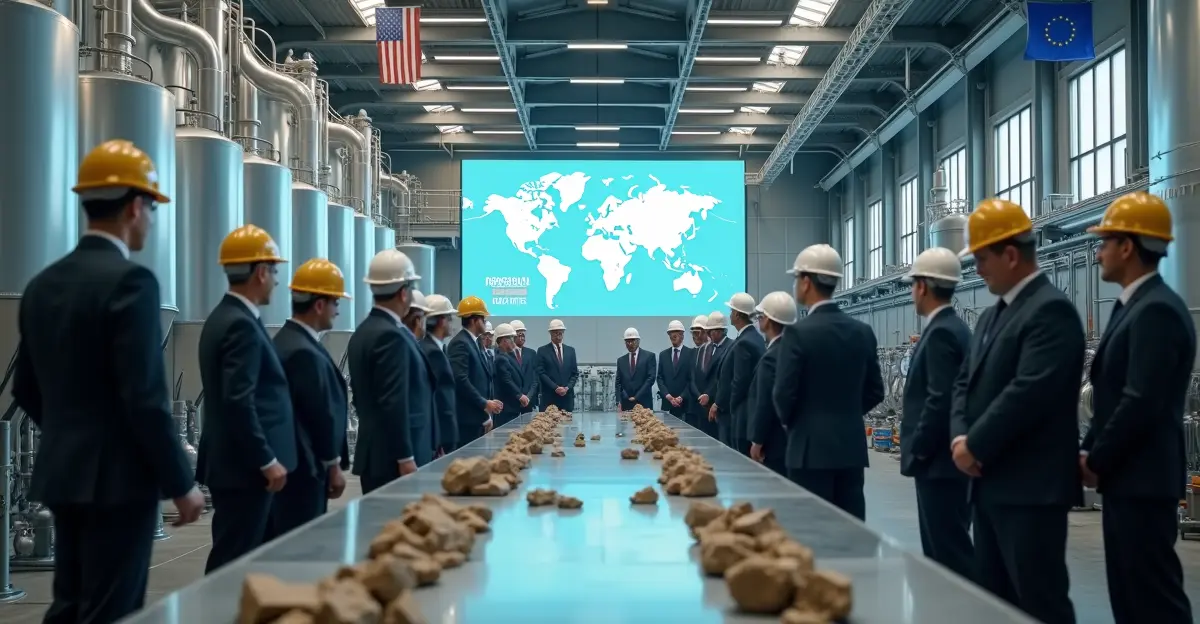
In February 2026, the United States hosted the Critical Minerals Ministerial in Washington, bringing together representatives from 54 countries and the European Commission. Led by Secretary of State Marco Rubio and Vice President JD Vance, the ministerial produced 11 new bilateral critical minerals frameworks or memoranda of understanding with countries including Argentina, Morocco, the Philippines, and the United Arab Emirates.
The centerpiece of the U.S. strategy is the launch of FORGE (Forum on Resource Geostrategic Engagement), which succeeds the Minerals Security Partnership as a plurilateral coalition creating a preferential trade-and-investment zone for critical minerals. FORGE introduces coordinated price floors to counter adversarial market manipulation, with Vice President Vance outlining "reference prices for critical minerals at each stage of production" maintained through adjustable tariffs. South Korea chairs FORGE through June 2026, with the goal of linking bilateral deals into a functioning system covering two-thirds of the global economy.
Simultaneously, the U.S. mobilized over $30 billion in letters of interest, loans, and investments for critical mineral supply chain projects. President Trump announced Project Vault, a $10 billion EXIM-backed initiative to establish a domestic strategic reserve for critical minerals. The Pax Silica initiative provides $250 million for semiconductor supply chain resilience. These moves represent the most aggressive U.S. response yet to China's projected dominance.
The EU's Critical Raw Materials Act and ReSourceEU Plan
The European Union has responded with its own ambitious framework. The Critical Raw Materials Act, which entered into force in May 2024, has been reinforced by the ReSourceEU Action Plan announced in 2026, allocating up to €3 billion in funding to secure critical raw materials for Europe. On March 4, 2026, EU Member States adopted their negotiating mandate for revising the regulation, transferring responsibility to identify large companies using critical raw materials and empowering the Commission to propose risk mitigation measures—such as limiting dependence on single suppliers.
Key measures include regulatory fast-tracking for strategic CRM projects, €250 million in EIB support for Vulcan Energy's lithium project in Germany, backing for Greenland Resources' molybdenum mine, new export restrictions on scrap permanent magnets and aluminium, and a prohibition on waste lithium-ion battery exports to non-OECD countries from September 2026. The plan also calls for establishing a European Critical Raw Materials Centre modeled on Japan's JOGMEC, deepening partnerships with resource-rich nations including South Africa and Brazil, and developing integrated CRM value chains in Ukraine, the Western Balkans, and North Africa.
Despite these efforts, the EU faces challenges scaling financing amid competition from China, the UAE, and Saudi Arabia. While 60 strategic projects have been selected under the CRM Act, current investment volumes fall short of needs. The EU's dependency on Chinese rare earths remains acute, with Europe relying on China for 98% of its rare earth needs as recently as 2023.
Africa: The New Battleground for Critical Minerals
Africa has emerged as a central theater in the critical minerals scramble. The Democratic Republic of Congo produces 73% of global cobalt, with 3.5 million metric tons in reserves, while Zimbabwe holds Africa's largest lithium deposits. Chinese companies invested $12.1 billion in African mining between 2022 and 2025, controlling 60% of the DRC's industrial cobalt and securing long-term offtake deals.
In response, the U.S.-backed Lobito Corridor—a $2.6 billion initiative connecting Angola to the DRC and Zambia—aims to counter Chinese logistical dominance. By March 2026, 71% of the corridor had been completed. However, environmental and labor abuses persist: over 40,000 children work in the DRC's artisanal cobalt mines, while Zimbabwe's lithium extraction caused a 47% rise in water pollution incidents in 2025. Australia, the EU, and the UK have launched parallel mineral diplomacy efforts across the continent, intensifying competition for Africa's resource wealth.
Risks of Cartelization and Supply Chain Vulnerabilities
The concentration of supply chains poses significant risks. China's dominance in processing means that even if mining is diversified, the refining bottleneck remains. Rebuilding independent processing capacity could take 20-30 years, far exceeding the current geopolitical window. Western nations face a narrowing 12-18 month window to act decisively or accept prolonged vulnerability, according to experts.
Price volatility adds another layer of risk. Following price collapses of lithium and rare earths in 2024 and 2025, Western policymakers have recognized that conventional subsidies alone are insufficient to counter Chinese state-backed pricing power. The FORGE price floor mechanism represents an attempt to stabilize markets, but its effectiveness remains unproven. The risk of critical mineral cartelization



Follow Discussion