


 Deutsch
 English
 Español
 Français
 Nederlands
 Português


 Share
Share




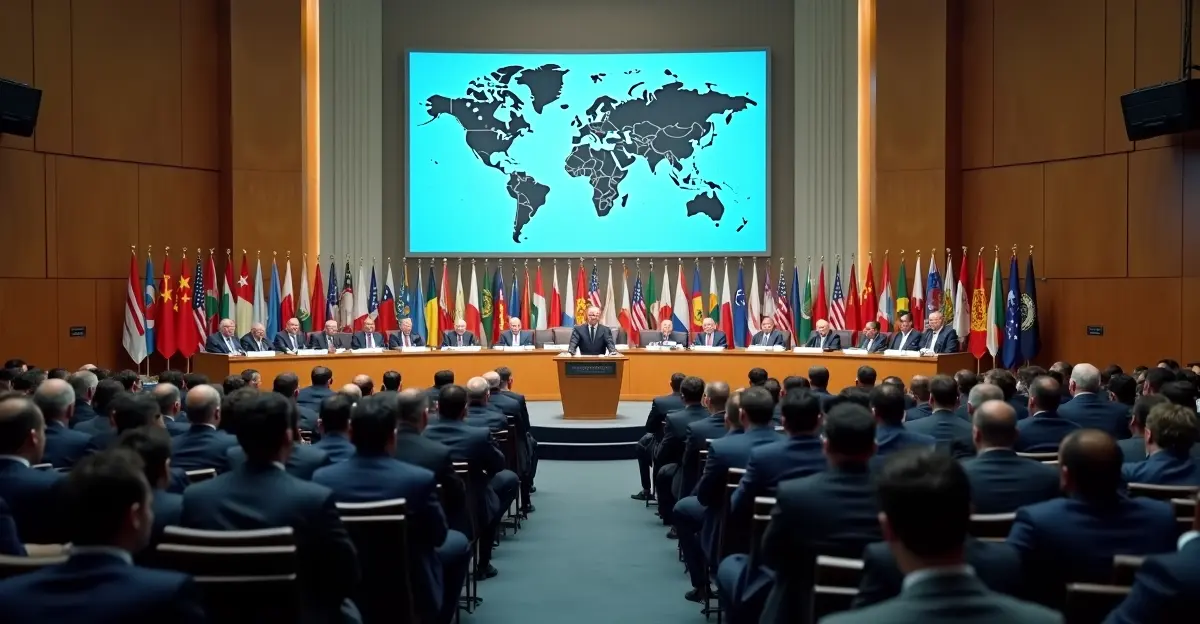
In February 2026, the United States hosted the inaugural Critical Minerals Ministerial in Washington, D.C., bringing together 54 nations to confront a stark reality: China's tightened export controls on rare earths, tungsten, and antimony have triggered price spikes of up to sixfold and slashed licensing approval rates for European firms below 25%. The rare earth supply chain crisis has exposed a critical vulnerability in Western defense and green energy sectors, forcing policymakers to scramble for alternatives. Beijing now controls roughly 90% of global rare earth processing, 80% of tungsten refining, and 60% of antimony production — materials essential for everything from F-35 fighter jets and precision-guided munitions to electric vehicle motors and wind turbines.
China's Strategic Leverage: Processing Dominance as a Weapon
China's dominance is not rooted in resource scarcity — the country holds only about 35% of global rare earth reserves — but in its near-total control over the complex, capital-intensive processing stage. Since the 1980s, Beijing has invested billions in subsidies and strategic planning to build a vertically integrated supply chain encompassing mining, chemical separation, and magnet production. According to a 2026 study from Concordia University, China controls over 90% of global rare earth refining and chemical separation capacity, with heavy rare earths like dysprosium and terbium — critical for EV motors, wind turbines, and missile guidance systems — particularly concentrated in Chinese facilities.
The export controls introduced in 2025 and tightened in January 2026 are not about scarcity but about leverage. As a multi-institutional analysis published by Rare Earth Exchanges notes, Beijing is weaponizing control through temporary, reversible restrictions that maintain pricing power and extract strategic concessions while discouraging large-scale Western alternative investment. The controls include categorical prohibitions on exports to U.S. military end-users and a whitelist system for tungsten, antimony, and silver that restricts supply to just 15–44 approved companies per mineral. Over 80% of European firms now depend on Chinese supply chains for these critical materials.
The West's Countermeasures: FORGE and Project Vault
In response, the U.S. Department of State launched the Forum on Resource Geostrategic Engagement (FORGE) on February 4, 2026, as a successor to the Minerals Security Partnership. Chaired by South Korea, FORGE aims to create a plurilateral coalition forming a preferential trade-and-investment zone for critical minerals with coordinated price floors to counter adversarial market manipulation. The ministerial produced 11 new bilateral framework agreements — with Argentina, Cook Islands, Ecuador, Guinea, Morocco, Paraguay, Peru, Philippines, UAE, UK, and Uzbekistan — bringing the total to 21 deals in five months. Over $30 billion in U.S. government support has been mobilized, including Export-Import Bank loans and private investment.
Central to this effort is Project Vault, a $10 billion public-private initiative (backed by a $12 billion total commitment including nearly $2 billion in private investment) to establish the U.S. Strategic Critical Minerals Reserve. Announced by EXIM Chairman Jovanovic on February 2, 2026, the independently governed reserve will store essential raw materials in secure facilities across the United States, modeled after the Strategic Petroleum Reserve. The initiative aims to protect American manufacturers from supply shocks and ensure that critical mineral stockpiling strategies are robust enough to withstand geopolitical disruptions.
Bilateral Deals and Price Floor Mechanisms
Vice President JD Vance proposed a preferential trade zone with enforceable price floors to protect investments from market manipulation. The U.S.-Mexico agreement was notably trade-centered, signed by trade officials rather than the State Department, signaling a shift toward a plurilateral strategy complementing bilateral engagements. The U.S. Department of Defense has also entered a floor-price arrangement with MP Materials, guaranteeing $110/kg for neodymium-praseodymium (NdPr) oxide with profit-sharing — a first step toward price independence from Chinese reference indices.
The Gap: 5–7 Years to Independence, 6–9 Months of Stockpiles
Despite these ambitious initiatives, analysts warn that full supply chain independence remains 5–7 years away. Western competitors face significant barriers including 2–4x cost disadvantages ($40–60/kg vs. $15–25/kg in China), 5–7 year facility development timelines, and lost processing knowledge from facility closures in the 2000s. NATO officials acknowledge that defense stockpiles cover only 6–9 months of high-intensity conflict — a dangerously narrow margin given the complexity of rebuilding midstream separation capacity.
The Western rare earth processing gap is most acute in heavy rare earth separation, where China controls 99% of capacity for elements like dysprosium and terbium. While mining is diversifying across the U.S., Australia, and Brazil, without restoring domestic refining and magnet production, China's strategic chokehold over clean energy and defense supply chains will remain unchallenged. The EU's Critical Raw Materials Act (2024) and the U.S.-Australia rare earth pact ($8.5 billion) represent progress, but specialized processing technology remains concentrated in China.
Impact on Defense and Green Energy Sectors
The price spikes are already reverberating through key industries. Rare earth magnets for precision-guided munitions and radar systems face cost increases of up to 500%, while EV manufacturers report an added $500 per vehicle in material costs. The electronics sector, reliant on rare earths for semiconductors and consumer devices, is experiencing supply delays. The defense supply chain vulnerability has prompted NATO to officially recognize rare earth elements as a critical defense security variable, with twelve allied nations launching a High Visibility Project for joint acquisition and management of defense-critical materials at the June 2025 NATO Summit Defence Industry Forum.
Expert Perspectives: A Narrow Window of Opportunity
We are facing a strategic trilemma, said Dr. Sarah Chen, a critical minerals analyst at the Center for Strategic and International Studies (CSIS). We can accept managed dependence on China, pursue costly independence at $30–50 billion over 5–7 years, or adopt a hybrid resilience model combining stockpiling, diversification, and innovation. The 12–18 month decision window for the West to act may already be closing.
Henry Coetzee, geopolitical analyst and author of this report, notes: February 2026 marks the defining strategic resource confrontation of the decade. The U.S. Critical Minerals Ministerial and China's tightened export licensing regime have made this the central front in the global trade realignment. The question is whether the West's countermeasures can close the gap before the next crisis.
FAQ: Rare Earth Export Controls and Western Response
What are rare earth elements and why are they important?
Rare earth elements (REEs) are a set of 17 metals essential for modern technologies including electric vehicles, wind turbines, defense systems (F-35 jets, missile guidance), smartphones, and semiconductors. Despite their name, they are relatively abundant but difficult to extract and process.
How much control does China have over rare earth processing?
China controls approximately 90% of global rare earth processing capacity, 80% of tungsten refining, 60% of antimony production, and 99% of heavy rare earth separation for elements like dysprosium and terbium.
What is FORGE and what does it aim to achieve?
FORGE (Forum on Resource Geostrategic Engagement) is a 54-nation alliance launched in February 2026 to create a preferential trade-and-investment zone for critical minerals with coordinated price floors. It succeeds the Minerals Security Partnership and is chaired by South Korea.
What is Project Vault?
Project Vault is a $10 billion U.S. public-private initiative (backed by a $12 billion total commitment) to establish the U.S. Strategic Critical Minerals Reserve, storing essential raw materials in secure facilities to protect manufacturers from supply shocks.
How long will it take for the West to achieve rare earth independence?
Analysts estimate 5–7 years to build meaningful alternative processing capacity, with a 12–18 month window to begin diversification. NATO defense stockpiles currently cover only 6–9 months of high-intensity conflict.
Conclusion: The Race Against Time
The rare earth reckoning of 2026 has laid bare the West's strategic vulnerability to China's mineral processing monopoly. While FORGE and Project Vault represent unprecedented multilateral coordination, the gap between ambition and execution remains wide. The next 12–18 months will determine whether Western nations can break China's entrenched grip on critical mineral supply chains — or whether they will remain dependent on a rival that has proven willing to weaponize that dependence. The stakes could not be higher: the future of defense readiness, green energy transition, and technological sovereignty hangs in the balance.


Follow Discussion