


 Deutsch
 English
 Español
 Français
 Nederlands
 Português


 Share
Share




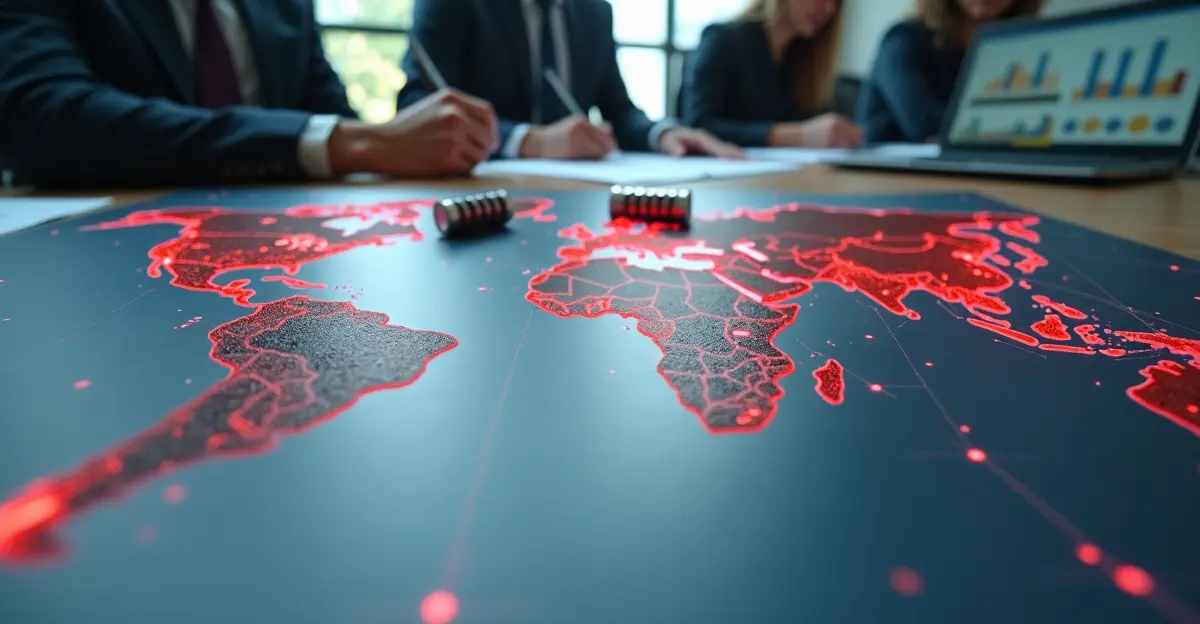
Critical minerals 2026 has become the defining strategic contest between the United States, China, and the European Union. As Beijing tightens export controls on rare earths and consolidates its dominance over lithium and cobalt processing, allied nations are racing to build alternative supply chains through bilateral mining partnerships, strategic stockpiles, and new multilateral coalitions.
Why critical minerals now decide economic security
Critical raw materials are essential to energy transition, defense, and digital infrastructure, but supply chains remain dangerously concentrated. According to the IEA Global Critical Minerals Outlook 2026, refining concentration averaged 72% for the top country, excluding rare earths. China controls roughly 90% of rare earth processing, 94% of permanent magnet output, 80% of tungsten, and 60% of antimony, while projected to refine more than 60% of global lithium and cobalt by 2035. The Minerals Security Partnership and its successor coalition reflect how Western governments now treat minerals as a national security priority.
China's 15th Five-Year Plan tightens the grip
China's 15th Five-Year Plan (2026–2030) elevates strategic minerals to a core industrial priority. The plan calls for a new round of mineral exploration breakthroughs and greater control over refining, processing, advanced materials, and high-end manufacturing, according to Metalnomist analysis. Since 2023, Chinese export restrictions have tripled, and in October 2025 MOFCOM Notice No. 61 expanded controls to products containing Chinese-sourced materials across energy, defense, automotive, semiconductor, and AI sectors.
The result has been severe. Neodymium-praseodymium (NdPr) oxide jumped from about $80 per kilogram in 2024 to over $480 per kilogram in 2026, with European licensing approval rates falling below 25%. Analysts say China is weaponizing reversible controls to extract concessions without harming its own industry. The IEA estimates rare earth controls alone threaten $6.5 trillion of annual downstream production, while graphite disruption would hit more than $300 billion.
FORGE, Project Vault, and the Western counterattack
Washington responded in February 2026 by launching the Forum on Resource Geostrategic Engagement (FORGE) as the successor to the Minerals Security Partnership, bringing together 54 nations and signing 21 bilateral minerals deals in five months. The US also created Project Vault, a $12 billion strategic reserve, expanded the National Defense Stockpile, and allocated $2 billion for stockpiles, $5 billion for the Industrial Base Fund, and $500 million for Defense Credit Programmes, according to ODI analysis.
The European Union has designated 60 Strategic Projects under its Critical Raw Materials Act, 47 internal and 13 external, but financing remains weak, with only up to €3 billion targeted by 2029 through RESourceEU. Europe still imports 100% of heavy rare earths and 97% of magnesium from China.
What this means for EVs, defense, and clean energy
The scramble is already distorting prices and timelines. Lithium prices more than doubled and cobalt rose about 130% after the Democratic Republic of Congo imposed export restrictions, while tungsten surged sixfold. EV costs have risen by about $500 per vehicle, and defense systems such as missile guidance and F-35 magnets face supply risk. The IEA warns that copper's projected 2035 deficit has narrowed but remains significant, while a cobalt shortfall has emerged from DRC quotas.
Western officials face three paths: managed dependence, costly independence, or a hybrid strategy of stockpiling, recycling, and diversification with Brazil, India, Vietnam, and Australia. Rebuilding Western processing capacity could take 20–30 years, with a geopolitical window of only 12–18 months, analysts warn.
Frequently Asked Questions
What are critical minerals?
Critical minerals are non-fuel materials essential to modern economies, especially energy, defense, and technology, whose supply is at risk due to limited availability or geopolitical factors.
Why is China's rare earth dominance important in 2026?
China controls roughly 90% of rare earth refining and 94% of permanent magnet production, giving it leverage over EV motors, wind turbines, defense systems, and electronics.
What is FORGE?
FORGE, or the Forum on Resource Geostrategic Engagement, is a plurilateral coalition launched in February 2026 to diversify and secure critical minerals supply chains, succeeding the Minerals Security Partnership.
How much did rare earth prices rise in 2026?
NdPr oxide rose from about $80 per kilogram in 2024 to over $480 per kilogram in 2026, with some prices outside China increasing up to sixfold.
Can the West replace Chinese processing quickly?
Most analysts say no: rebuilding Western processing capacity could take 20–30 years, although stockpiling and recycling can provide a bridge.
Future outlook
The critical minerals axis is no longer a trade dispute but a strategic contest. As the IEA Global Critical Minerals Outlook 2026 puts it, strategic stockpiles offer a cheap buffer costing under $900 million annually, but without faster permitting and financing, Western dependency could become permanent.
Follow Discussion