


 Deutsch
 English
 Español
 Français
 Nederlands
 Português


 Share
Share




The global race for critical minerals—lithium, cobalt, rare earths, and copper—has escalated into a defining geopolitical struggle of the energy transition. With lithium demand projected to surge 353% by 2040 and over 100 new export restrictions on critical raw materials enacted since 2020, the competition for supply is redrawing alliances, supplanting traditional oil-driven partnerships, and creating new risks of fragmentation into rival blocs. In 2026, as the EU's Critical Raw Materials Act enters enforcement, China's 15th Five-Year Plan doubles down on mineral dominance, and the United States under the second Trump administration pursues bilateral equity stakes and price supports, the critical minerals landscape has become the defining strategic battleground of the decade.
Context: The Strategic Scramble for Critical Minerals
Critical minerals—including lithium, cobalt, nickel, graphite, and rare earth elements—are essential for electric vehicle batteries, wind turbines, solar panels, semiconductors, and defense technologies. The International Energy Agency (IEA) projects that total lithium demand will grow from 205 kilotonnes in 2024 to 928 kilotonnes by 2040, driven overwhelmingly by clean energy technologies. The OECD reports that export restrictions on critical raw materials have reached an all-time high, with roughly 70% of global cobalt and manganese exports subject to at least one restriction between 2022 and 2024. The geopolitics of critical minerals has shifted from a niche concern to a central pillar of national security strategy.
China currently controls approximately 70% of global cobalt refining, 60% of lithium processing, and over 80% of graphite and rare earth production—a dominance projected to persist or even grow by 2035. This concentration has spurred a wave of countermeasures from Western economies and new entrants alike.
United States: Bilateral Equity Stakes and the FORGE Initiative
The second Trump administration has adopted an aggressive, transaction-oriented approach to securing critical minerals. Rather than relying solely on grants, Washington is taking direct equity stakes in strategic projects. Key investments include a 10% stake in Korea Zinc for a $7.4 billion Tennessee smelter, a 10% stake in Trilogy Metals for Alaska's Upper Kobuk mineral project, and discussions for an 8% stake in Critical Metals' Tanbreez rare earths project in Greenland. The administration also holds about a 15% stake in MP Materials' Mountain Pass rare earth mine and a 5% stake in Lithium Americas' Thacker Pass lithium mine.
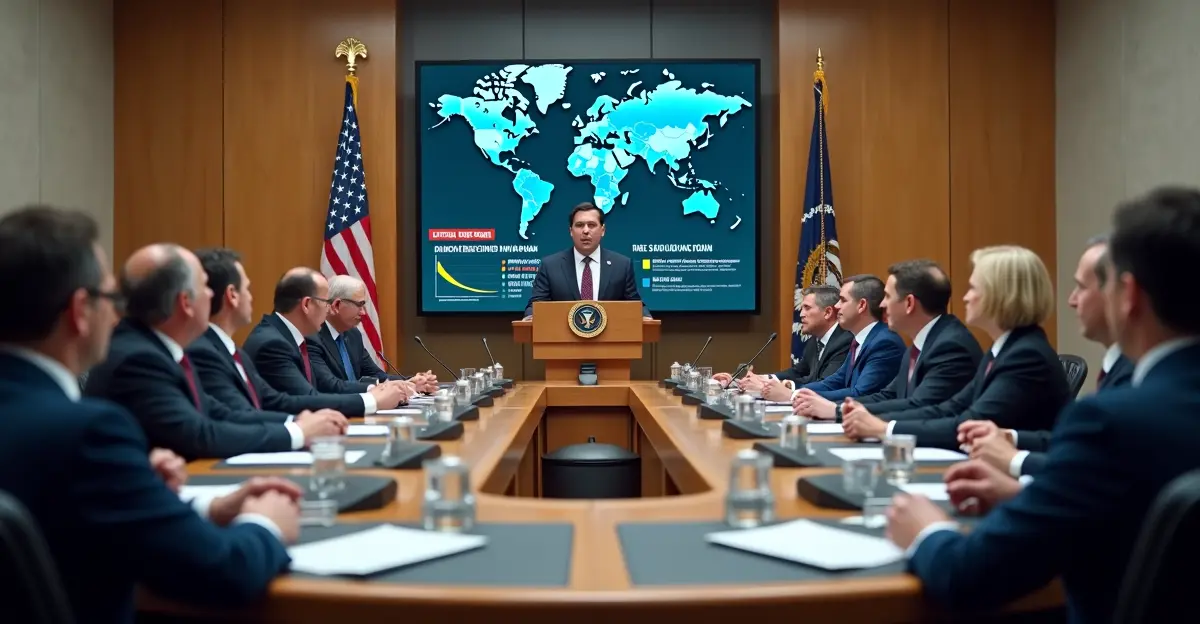
On February 4, 2026, the United States hosted the 2026 Critical Minerals Ministerial, bringing together 54 countries and the European Commission. Secretary of State Marco Rubio announced the launch of FORGE (Forum on Resource Geostrategic Engagement), chaired by South Korea, as the successor to the Minerals Security Partnership. The U.S. is mobilizing over $30 billion in support for critical mineral projects, including Project Vault—a $10 billion Export-Import Bank initiative to establish a U.S. Strategic Critical Minerals Reserve. The US critical minerals strategy reflects a broader shift toward supply chain resilience through direct government involvement.
European Union: Ambition Meets Financing Gaps
The EU's Critical Raw Materials Act, which entered into force in May 2024, sets ambitious 2030 benchmarks: extracting 10%, processing 40%, and recycling 25% of strategic raw materials domestically, while ensuring no more than 65% dependency on any single country. The Act has selected 60 Strategic Projects to fast-track permitting and investment. In December 2025, the European Commission adopted the ReSourceEU Action Plan, committing €3 billion to accelerate critical raw material projects and establishing a European Critical Raw Materials Centre modeled on Japan's JOGMEC.
However, investment needs exceed €100 billion by 2030, meaning ReSourceEU covers only 3% of requirements. The EU faces severe competition from China's massive state-backed investments and Gulf sovereign wealth funds deploying patient capital. New emergency powers under the Internal Market Emergency and Resilience Act (IMERA), effective May 2026, enable stockpile coordination during crises, but experts warn these address symptoms rather than structural underinvestment. The EU Critical Raw Materials Act challenges highlight the difficulty of matching ambition with financial firepower.
China: Reinforcing Dominance Through the 15th Five-Year Plan
China's 15th Five-Year Plan (2026-2030) explicitly emphasizes global leadership in rare earth elements and pledges to strengthen export controls and domestic processing capabilities. The plan calls for expanded domestic exploration of strategic minerals, technological innovation in extraction and processing, and comprehensive utilization of hard-to-exploit deposits. China's Ministry of Natural Resources has outlined priorities including strengthening basic geological surveys and advancing green exploration methods.
According to the Climate Energy Finance think tank, China has locked in its leading position through a $120 billion surge in outbound investment, securing supply chains for lithium, cobalt, nickel, and rare earth elements globally. Projections show China will supply over 60% of refined lithium and cobalt, and roughly 80% of battery-grade graphite and rare earths by 2035. The China critical minerals dominance is reinforced by the Belt and Road Initiative, which has already secured many partner country resources.
New Entrants: Saudi Arabia and the UAE as Emerging Poles
Saudi Arabia and the United Arab Emirates are executing a historic pivot from oil dependency to critical minerals leverage. Saudi Arabia's Manara Minerals—a joint venture between the Public Investment Fund (PIF) and Ma'aden—has built a $25 billion-plus mining portfolio, including a $2.5 billion stake in Vale Base Metals and a rare earth refining plant partnership with MP Materials and the U.S. Department of War. The kingdom estimates its mineral wealth at $2.5 trillion and aims to mobilize $100 billion in mining investments by 2035 through Vision 2030.
The UAE's Orion Critical Mineral Consortium, launched with $1.8 billion from ADQ and the U.S. International Development Finance Corporation, positions Abu Dhabi as a geopolitically neutral processing hub. Mubadala also joined a $250 million U.S.-backed initiative. This dual strategy—acquire globally, refine locally—positions the Gulf states as a potential third pole in the U.S.-China rivalry, offering Western markets alternatives to Chinese-dominated processing. The Gulf states critical minerals strategy leverages patient capital, strategic geography, and diplomatic agility.
Impact: Supply-Chain Fragmentation and New Geopolitical Fault Lines
The intensifying competition is driving fragmentation of global supply chains into rival blocs. The OECD warns that export restrictions can increase supply chain vulnerabilities and drive up prices. India, China, Argentina, Vietnam, and Burundi accounted for over half of all new measures since 2009. Waste and scrap materials remain the most frequently restricted category, while export prohibitions and quotas now account for more than one-third of new measures.
The Council on Foreign Relations (CFR) argues that the United States cannot out-mine or out-process China and should instead pursue an innovation-centered strategy to "leapfrog" Chinese dominance—developing substitute materials like rare-earth-free magnets, scaling waste-based recovery, and closing the financing gap for frontier mineral technologies. However, building processing capacity takes 5-7 years and costs $500 million to $1 billion per plant, while China's head start grows.
Expert Perspectives
"The critical minerals landscape in 2026 is not just about supply chains—it's about the architecture of global power in the 21st century," says Daniel Takahashi, geopolitical analyst. "Countries that control processing will control the energy transition, and China has a commanding lead. The question is whether the U.S., EU, and Gulf states can build viable alternatives before dependence becomes irreversible."
Heidi Crebo-Rediker and Mahnaz Khan of CFR emphasize that breakthroughs in AI-enabled materials science, bioengineered mining, and waste recovery offer faster, cheaper, and cleaner alternatives to traditional mining, potentially insulating the U.S. from Chinese supply coercion. The International Institute for Strategic Studies (IISS) notes that Gulf states' patient capital, geography, and diplomatic agility give them unique advantages in this geopolitical landscape.
FAQ: Critical Minerals and Geopolitics in 2026
What are critical minerals and why do they matter?
Critical minerals are non-fuel materials essential for energy, defense, and technology industries, with vulnerable supply chains. They include lithium, cobalt, rare earths, graphite, and copper—key inputs for EV batteries, wind turbines, semiconductors, and defense systems.
How much does China dominate critical mineral processing?
China controls roughly 70% of global cobalt refining, 60% of lithium processing, and over 80% of graphite and rare earth production. This dominance is projected to persist through 2035, reinforced by the 15th Five-Year Plan and $120 billion in outbound investment.
What is the U.S. doing to secure critical minerals?
The U.S. under the second Trump administration is taking direct equity stakes in mining and processing projects, launching the FORGE initiative with 54 partner countries, and mobilizing over $30 billion in financing, including a $10 billion Strategic Critical Minerals Reserve (Project Vault).
Can the EU meet its Critical Raw Materials Act targets?
The EU faces a significant financing gap: ReSourceEU provides €3 billion against estimated needs exceeding €100 billion by 2030. While 60 Strategic Projects have been selected, permitting delays, lack of price guarantees, and competition from China and Gulf states pose major challenges.
What role are Saudi Arabia and the UAE playing?
Gulf states are emerging as a potential third pole, deploying over $100 billion through sovereign wealth funds to acquire global mineral assets and build domestic processing capacity, offering Western allies alternatives to Chinese-dominated supply chains.
Conclusion: The New Resource War's Defining Decade
The competition for critical minerals in 2026 is reshaping global alliances in ways not seen since the oil shocks of the 1970s. Unlike oil, which could be traded on open markets, critical minerals are geographically concentrated and strategically vital for both the energy transition and advanced manufacturing. The risk of supply-chain fragmentation into rival blocs—a Western-led bloc, a Chinese-dominated sphere, and emerging Gulf and Global South players—is real and growing. The future of critical mineral supply chains will depend on whether the U.S., EU, and their allies can accelerate investment, innovation, and cooperation fast enough to counterbalance China's entrenched advantages. The next five years will determine whether the energy transition becomes a source of geopolitical stability or a new arena of great-power conflict.



Follow Discussion