

 Deutsch
 English
 Español
 Français
 Nederlands
 Português







The global scramble for critical minerals—lithium, cobalt, rare earths, and graphite—has entered a decisive new phase in 2026. With the U.S.-led Critical Minerals Ministerial in February launching the FORGE initiative and mobilizing over $30 billion in project financing, China cementing its dominance under the 15th Five-Year Plan, and new state-backed entrants like Saudi Arabia and the UAE joining the fray, the geopolitics of critical minerals is reshaping alliances, trade flows, and the pace of the global energy transition. Demand for these minerals is projected to multiply four to six times by 2040, driven by electric vehicles, AI data centers, and defense modernization, making supply chain security a top national priority.
Context: Why Critical Minerals Matter in 2026
Critical minerals are the building blocks of modern technology. Lithium and cobalt power EV batteries; rare earths are essential for permanent magnets in wind turbines, robotics, and precision weapons; graphite is the dominant anode material in lithium-ion batteries. The International Energy Agency projects that under current policies, lithium demand will grow fivefold by 2040, while graphite and nickel demand will double. Copper, the most widely used conductive metal, is expected to see demand nearly double as well. This surging demand collides with highly concentrated supply chains: China controls roughly 90% of rare earth refining, 60% of lithium processing, and over 95% of battery-grade graphite production. The energy transition supply chain risks are now front and center for policymakers worldwide.
The U.S. Pivot: FORGE and the $30 Billion Offensive
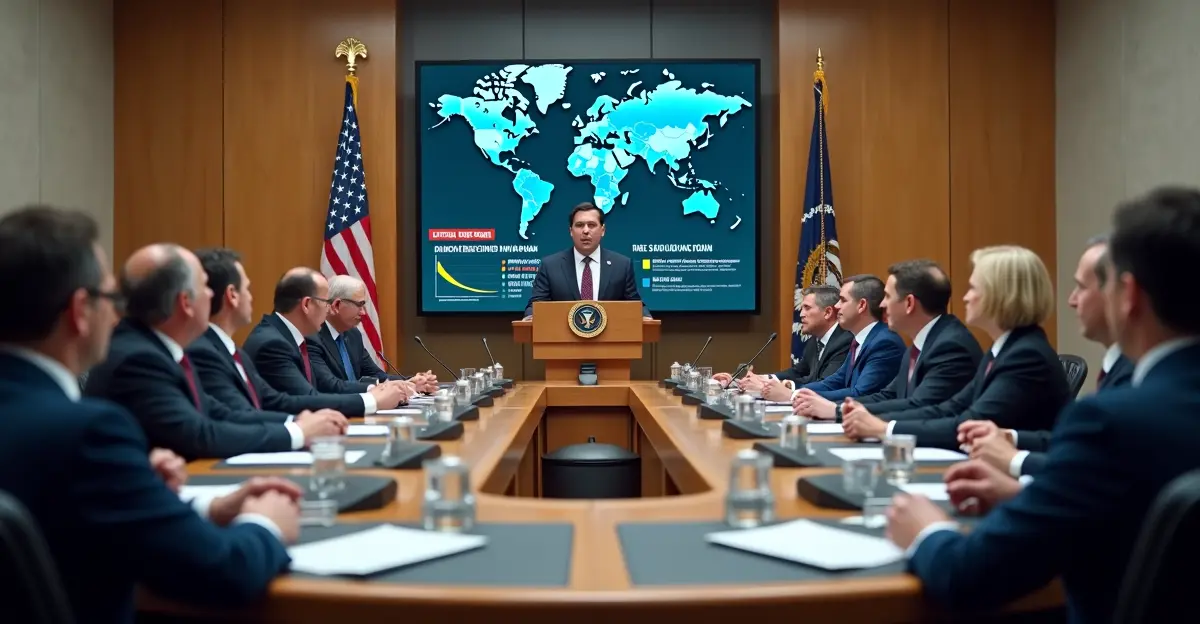
On February 4, 2026, the U.S. Department of State hosted the inaugural Critical Minerals Ministerial, convening 54 countries and the European Commission. Led by Secretary of State Marco Rubio and Vice President JD Vance, the event marked a structural shift in U.S. resource strategy. The centerpiece was the launch of FORGE (Forum on Resource Geostrategic Engagement), chaired by South Korea, which replaces the Minerals Security Partnership with a more ambitious plurilateral framework. FORGE aims to create a preferential trade-and-investment zone with coordinated price floors, shared stockpiles, and unified tariff defenses against non-market practices.
Project Vault and Price Floors
A key announcement was Project Vault, a $10 billion Export-Import Bank initiative to establish a U.S. Strategic Critical Minerals Reserve, complemented by $2 billion in private capital. Vice President Vance announced state-backed minimum reference prices for critical minerals: cobalt at $25.20/lb, lithium at $15,200/tonne, copper at $5.10/lb, and neodymium at $95,000/tonne. These price floors are designed to end China's market flooding tactics and provide investment certainty for new mines and refineries. Of take partners include Boeing, GE Vernova, and General Motors. Over 30 countries have expressed interest in joining the preferential trade zone.
Bilateral Frameworks
The U.S. signed 11 new bilateral critical minerals frameworks with countries including Argentina, Morocco, the Philippines, the UAE, the UK, and Uzbekistan, bringing total deals to 21. These agreements cover joint exploration, processing technology transfer, and investment facilitation. The U.S. critical minerals strategy 2026 emphasizes ethical sourcing and transparency, aiming to differentiate Western supply chains from Chinese state-directed approaches.
China's 15th Five-Year Plan: Cementing Upstream Dominance
China's 15th Five-Year Plan (2026-2030) prioritizes energy and resource security, doubling down on critical minerals processing dominance. Beijing controls 85-90% of global rare earth processing, 99% of heavy rare earth refining, and roughly the same share of permanent magnet production. In October 2025, China imposed export controls covering 12 of 17 rare earth elements, finished magnets, and processing technologies, creating a licensing system where supply risk follows political alignment rather than market signals.
China is projected to supply 80% of battery-grade graphite by 2035 and over 60% of refined lithium and cobalt. The country has invested $57 billion in critical mineral supply chains since 2000 and continues expanding. Domestic EV and wind energy demand will absorb a rising share of production, reducing exports from roughly 50% to perhaps 25% by 2030, further tightening global availability. Western projects are not expected to reach meaningful scale until around 2035, leaving a decade-long window of structural dependency.
The EU's Struggle: Ambition vs. Reality
The European Union's Critical Raw Materials Act (CRMA) sets ambitious 2030 benchmarks: 10% of annual needs from domestic extraction, 40% from processing, and 25% from recycling, with no more than 65% of any strategic raw material from a single third country. However, a February 2026 report from the European Court of Auditors warns that the EU is falling short. Permitting delays, high energy costs, and competition from China hinder progress. The EU remains heavily dependent on imports from a limited number of countries.
In response, the European Commission launched ReSourceEU in 2026, a plan to spend up to €3 billion ($3.5 billion) on critical raw materials. Measures include regulatory fast-tracking for strategic projects, support for Vulcan Energy's German lithium project (€250 million from the EIB), and new international partnerships (15 concluded so far). The EU also introduced export restrictions on scrapped permanent magnets and banned waste lithium-ion battery exports to non-OECD countries. A European Critical Raw Materials Centre, modeled on Japan's JOGMEC, is planned to finance projects and stockpile materials. Yet the EU Critical Raw Materials Act financing gap remains a critical challenge, as private capital flows are insufficient to meet the scale required.
New Entrants: Saudi Arabia and the UAE
The Gulf states are emerging as pivotal players. Saudi Arabia, under Vision 2030, has upgraded its estimated mineral wealth to $2.5 trillion and plans $100 billion in mining investments by 2035. The sovereign wealth fund PIF, through Manara Minerals (a joint venture with Ma'aden), is acquiring global stakes in copper, nickel, lithium, and rare earth assets. The UAE deploys funds like ADQ and Mubadala, including the $1.8 billion Orion Critical Mineral Consortium launched in 2025. At the Future Minerals Forum in Riyadh in January 2026, Gulf leaders positioned themselves as neutral brokers offering patient capital and geographic advantages. However, they face the delicate task of balancing ties with China—their largest oil customer—while aligning with Western de-risking efforts.
Impact on Global Economic Stability and Decarbonization
The critical minerals race has profound implications. Supply concentration creates vulnerability to price shocks and geopolitical leverage. China's export controls on rare earths and gallium in 2025 demonstrated how quickly supply chains can be disrupted. For the energy transition, the pace of EV adoption and renewable energy deployment depends on affordable, reliable mineral supplies. If Western projects cannot scale quickly, the transition may slow or become more expensive. The critical minerals price volatility 2026 could deter investment and delay decarbonization targets.
On the other hand, the new multilateral frameworks and price floors could stabilize markets and attract long-term capital. The FORGE initiative's preferential trade zone may create a parallel market that reduces dependence on Chinese processing. However, the risk of fragmentation—where the world splits into competing blocs with different standards and supply chains—could raise costs and complicate global climate cooperation.
Expert Perspectives
"The Critical Minerals Ministerial marks a turning point. For the first time, we have a coordinated Western strategy with real financial backing and a clear institutional framework," said Dr. Sarah O. Connors, a senior fellow at the Center for Strategic and International Studies. "But China's head start is enormous. The question is whether FORGE can accelerate project timelines enough to close the gap before 2035."
"The Gulf states are playing a smart game," noted Dr. Karim Elgendy, an associate fellow at Chatham House. "They offer an alternative to both Chinese and Western-dominated channels, leveraging their hydrocarbon expertise and sovereign wealth. But their balancing act with Beijing will be tested as the competition intensifies."
FAQ
What are critical minerals?
Critical minerals are metals and non-metallic elements essential for modern technologies, including lithium, cobalt, rare earth elements, graphite, nickel, and copper. They are used in EV batteries, wind turbines, solar panels, defense systems, and electronics.
Why is China dominant in critical minerals?
China has invested heavily for decades in mining, refining, and processing capacity. It controls roughly 90% of rare earth refining, 60% of lithium processing, and over 95% of battery-grade graphite production, giving it significant leverage over global supply chains.
What is FORGE?
FORGE (Forum on Resource Geostrategic Engagement) is a U.S.-led plurilateral initiative launched in February 2026 to coordinate critical minerals supply chain diversification among allied countries. It includes price floors, shared stockpiles, and a preferential trade zone.
How much is the U.S. investing in critical minerals?
The U.S. has mobilized over $30 billion in project financing, including the $10 billion Project Vault for a strategic reserve, plus additional EXIM loans and private capital. The goal is to build domestic and allied processing capacity.
What are the EU's targets under the Critical Raw Materials Act?
The EU aims to source 10% of annual needs from domestic extraction, 40% from domestic processing, and 25% from recycling by 2030, with no more than 65% of any strategic material from a single third country.
Conclusion and Future Outlook
The critical minerals landscape in 2026 is defined by a three-way competition: the U.S.-led Western bloc under FORGE, China's entrenched dominance under the 15th Five-Year Plan, and emerging players like Saudi Arabia and the UAE offering alternative pathways. The outcome will shape not only the pace of the energy transition but also the broader geopolitical order. Success will depend on whether Western initiatives can translate financial commitments into operational projects quickly enough to reduce dependency. The next five years are critical: if new mines and refineries do not come online by 2030, the window for diversification may close, leaving global supply chains vulnerable for decades.
Sources
- U.S. Department of State: 2026 Critical Minerals Ministerial
- CSIS: Critical Minerals Ministerial Analysis
- European Commission: Critical Raw Materials Act
- Mining Magazine: EU ReSourceEU Plan
- Informed Clearly: Gulf Critical Minerals Pivot
- IEA: Global Critical Minerals Outlook 2025
- Rare Earth Exchanges: China's 15th Five-Year Plan
- CFO Times: Critical Minerals Price Floor



Follow Discussion