


 Deutsch
 English
 Español
 Français
 Nederlands
 Português


 Share
Share




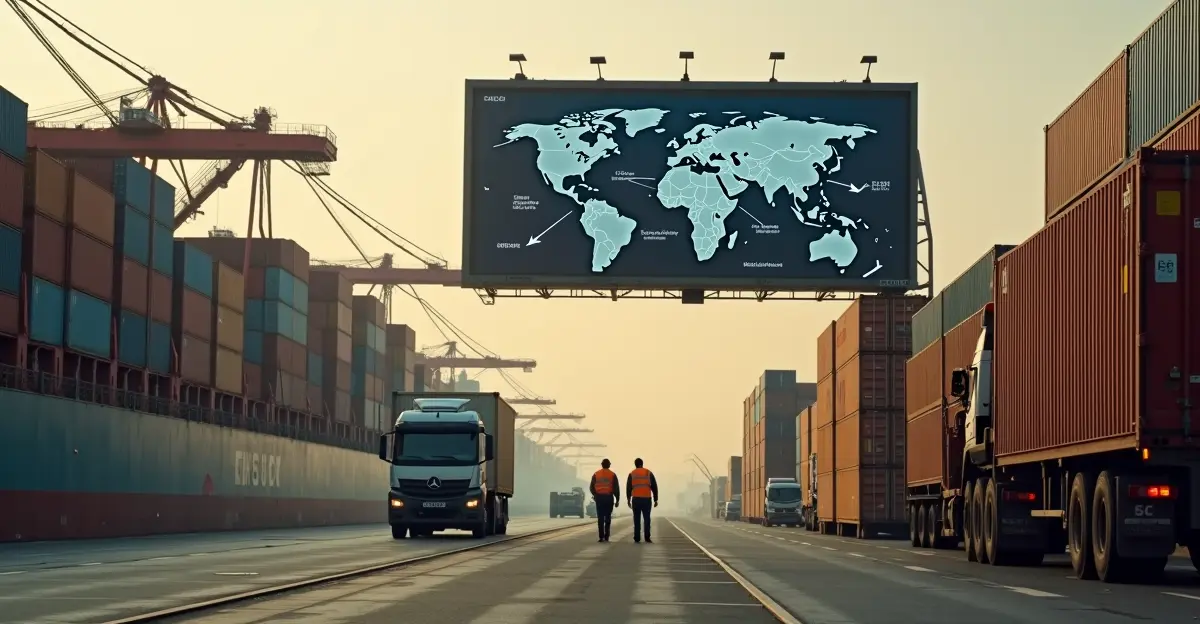
The World Economic Forum's 2026 Global Risks Report, released in January 2026, identifies geoeconomic confrontation as the top risk facing the global economy, with nearly 18,000 discriminatory trade measures enacted worldwide since 2020. The McKinsey Global Institute's updated analysis on the geometry of global trade confirms that supply chains are being rewired along geopolitical lines, creating parallel semiconductor, energy, and critical mineral ecosystems within US-led, EU-led, and China-led blocs. This structural shift marks the most significant reconfiguration of global commerce since the end of the Cold War, with profound implications for multinational corporations, middle powers, and the rules-based trading system.
Geoeconomic Confrontation: The New Normal
The WEF Global Risks Report 2026, based on surveys of over 1,300 global leaders, finds that 50% of respondents expect a turbulent or stormy short-term outlook over the next two years, rising to 57% over the next decade. Geoeconomic confrontation — fueled by tariffs, supply chain weaponization, and capital constraints — has become the top risk most likely to trigger a global crisis, cited by 18% of respondents. State-based armed conflict follows at 14%, while economic downturn and inflation have risen sharply in the rankings.
According to UNCTAD's January 2026 Global Trade Update, approximately 18,000 new discriminatory trade measures have been implemented globally since 2020, disproportionately harming developing nations. US tariffs have increased sixfold since 2016, and the US-China trade corridor has shrunk by roughly 30%, with over $165 billion in trade redirected to alternative routes. The WTO reform at a crossroads is a key concern, as the dispute settlement mechanism remains paralyzed.
The Geometry of Global Trade: Three Competing Blocs
McKinsey's 2026 update reveals that geopolitical alignment has become a supply chain design criterion. Three distinct trading blocs are emerging, each developing parallel ecosystems in critical sectors.
The US-Led Bloc
The United States, through initiatives like the CHIPS and Science Act, the Inflation Reduction Act, and the newly launched FORGE (Federal Order for Resilient and Green Energy) program, is building a self-sufficient supply chain for semiconductors, critical minerals, and clean energy. The US-EU Critical Minerals Action Plan, backed by over $30 billion, aims to break China's near-monopoly on rare earth processing, which currently stands at 90% of global capacity. The US-led semiconductor decoupling has accelerated, with the Bureau of Industry and Services revising export controls on advanced chips in January 2026.
The EU-Led Bloc
The European Union is pursuing strategic autonomy through the European Chips Act, the Critical Raw Materials Act, and the Carbon Border Adjustment Mechanism (CBAM). However, the EU faces a structural squeeze: it added less semiconductor capacity than either the US or China, and its exports — particularly extreme ultraviolet lithography machines from ASML — remain critical to leading-edge chipmaking in Taiwan and South Korea. CBAM, while designed to level the carbon playing field, risks becoming another layer of regulatory fragmentation that forces smaller economies to choose sides.
The China-Led Bloc
China is pivoting from 'factory to the world' to 'factory to the factories,' supplying intermediate components to emerging manufacturing hubs in Southeast Asia and beyond. SMIC achieved 5nm manufacturing in early 2026, signaling China's growing self-sufficiency in semiconductors. China's 15th Five-Year Plan prioritizes critical mineral supply chains, rare earth processing, and AI infrastructure. The China-led trade network expansion is deepening ties with the Global South through Belt and Road initiatives and BRICS+ frameworks.
Strategic Implications for Multinational Corporations
Multinational corporations are being forced to redesign their supply chains for resilience rather than pure efficiency. McKinsey warns that most organizations remain structurally under-equipped, with static contracts and fragmented ownership, losing an average of 9% of contract value due to governance weaknesses. The emergence of parallel ecosystems means companies must maintain dual supply chains for semiconductors, batteries, and critical minerals — a costly but necessary hedge against geopolitical disruption.
AI hardware has become a strategic flashpoint. According to McKinsey, AI-related trade — semiconductors, servers, networking equipment — accounted for roughly one-third of all global trade growth in 2025. Global semiconductor sales are projected to reach $975 billion in 2026. The concentration of advanced chip manufacturing in Taiwan and South Korea creates acute vulnerability, as these supply chains carry strategic dependency risks comparable to energy sourcing a decade ago.
The multinational corporation supply chain adaptation is driving investment in nearshoring and friend-shoring. Mexico has become the top US trading partner, while Vietnam's exports surged to $440 billion. India now supplies 40% of US smartphone imports previously sourced from China. Southeast Asia (ASEAN) saw 14% export growth as a primary beneficiary of trade diversion.
Middle Powers as Connectors
India, Vietnam, Brazil, and other middle powers are positioning themselves as connectors between rival blocs, pursuing multi-alignment strategies to maximize their strategic autonomy. India participates in both the Quad alliance and BRICS, while deepening trade ties with the EU through a proposed free trade agreement. India-Brazil bilateral trade grew by over 25% in 2025, reaching $15.21 billion.
South-South trade has accelerated dramatically, growing from $0.5 trillion in 1995 to $6.8 trillion in 2025, as emerging markets deepen regional integration through blocs like ASEAN, Mercosur, and the African Continental Free Trade Area. These middle powers are leveraging their positions to attract investment in semiconductor assembly, battery manufacturing, and renewable energy infrastructure. However, a $60 billion infrastructure gap in Southeast Asia constrains the region's ability to absorb redirected supply chains.
The middle powers trade connectors role is reshaping global governance. New multilateral frameworks — including the Indo-Pacific Economic Framework, the Comprehensive and Progressive Agreement for Trans-Pacific Partnership, and the BRICS+ expansion — are creating overlapping, often competing, trade architectures that replace the post-1945 rules-based order with a more pragmatic, multipolar system.
Expert Perspectives
"We are entering an age of competition where multilateralism is retreating and geoeconomic confrontation is the defining risk," said John Doyle, CEO of Marsh, commenting on the WEF report. "This is a moment of poly-crises — trade wars, culture wars, technological revolution, and extreme weather — all converging at once."
McKinsey's analysis concludes that the structural shift in global trade appears durable. "Geopolitical alignment is now a permanent supply chain design criterion," the report states. "Companies that fail to build optionality into their networks will face repeated disruptions."
FAQ
What is geoeconomic confrontation?
Geoeconomic confrontation refers to the use of economic tools — tariffs, export controls, sanctions, and investment restrictions — as instruments of geopolitical competition between nations or blocs. The WEF 2026 Global Risks Report ranks it as the top short-term risk.
How many discriminatory trade measures have been enacted since 2020?
According to UNCTAD, nearly 18,000 discriminatory trade measures have been implemented globally since 2020, including tariffs, non-tariff barriers, and local content requirements.
What are the three main trade blocs emerging in 2026?
The three main blocs are the US-led bloc (including allies like Japan, South Korea, and Australia), the EU-led bloc pursuing strategic autonomy, and the China-led bloc (including Russia, parts of Southeast Asia, and BRICS+ partners). Each is developing parallel semiconductor, energy, and critical mineral supply chains.
How are middle powers like India and Brazil responding?
Middle powers are pursuing multi-alignment strategies, maintaining relationships with multiple great powers while avoiding exclusive alignment. They are attracting redirected supply chains, deepening South-South trade, and shaping new multilateral frameworks.
What does this mean for global trade growth?
Global trade growth is projected at 2.6% for 2026, down from historical averages. While goods trade grew 6.5% in 2025, the fragmentation into rival blocs is increasing costs, reducing efficiency, and creating parallel infrastructure that raises long-term inflationary pressures.
Conclusion: A More Fragmented but Interconnected World
The great fragmentation of global trade into rival blocs represents a structural shift that will define the global economy for years to come. While the US-China trade corridor shrinks and parallel ecosystems emerge, total trade volumes continue to grow — reconfigured rather than reduced. For multinational corporations, the imperative is clear: build resilience through diversification, invest in regional hubs, and prepare for a world where supply chain decisions are geopolitical choices. The future of global trade governance will depend on whether middle powers can bridge the divides and whether the WTO can be reformed to prevent a complete breakdown of the rules-based system.




Follow Discussion