


 Deutsch
 English
 Español
 Français
 Nederlands
 Português


 Share
Share




The World Economic Forum's Global Risks Report 2026 has ranked geoeconomic confrontation as the number one short-term risk facing the world, surpassing even interstate armed conflict. This dramatic shift reflects a global trading system fracturing into three competing regional blocs anchored by the United States, China, and the European Union. With 72% of trade professionals citing US tariff volatility as the most impactful regulatory shift and 65% of companies altering sourcing patterns, the 'efficiency-first' paradigm is giving way to a 'resilience-first' approach. This article analyzes how semiconductor export controls, critical mineral supply chains, and clean-energy overcapacity disputes are driving the most significant restructuring of global trade since World War II.
Why Geoeconomic Confrontation Topped the WEF Risk List
The WEF's 2026 report, based on surveys of nearly 1,300 global leaders, found that geoeconomic confrontation climbed eight positions in the two-year outlook to claim the top spot. Half of respondents expect turbulent times ahead, while only 1% anticipate calm. The report warns that a 'retreat from multilateralism' threatens cooperation on climate change, pandemics, and other global challenges. Economic risks such as downturn and inflation also surged eight positions year-on-year, underscoring the interconnected nature of trade fragmentation and macroeconomic instability. The WEF Global Risks Report 2026 highlights that adverse outcomes of artificial intelligence soared from 30th to 5th place among long-term risks, adding another layer of complexity to the geoeconomic landscape.
The Three-Bloc World: US, China, and EU
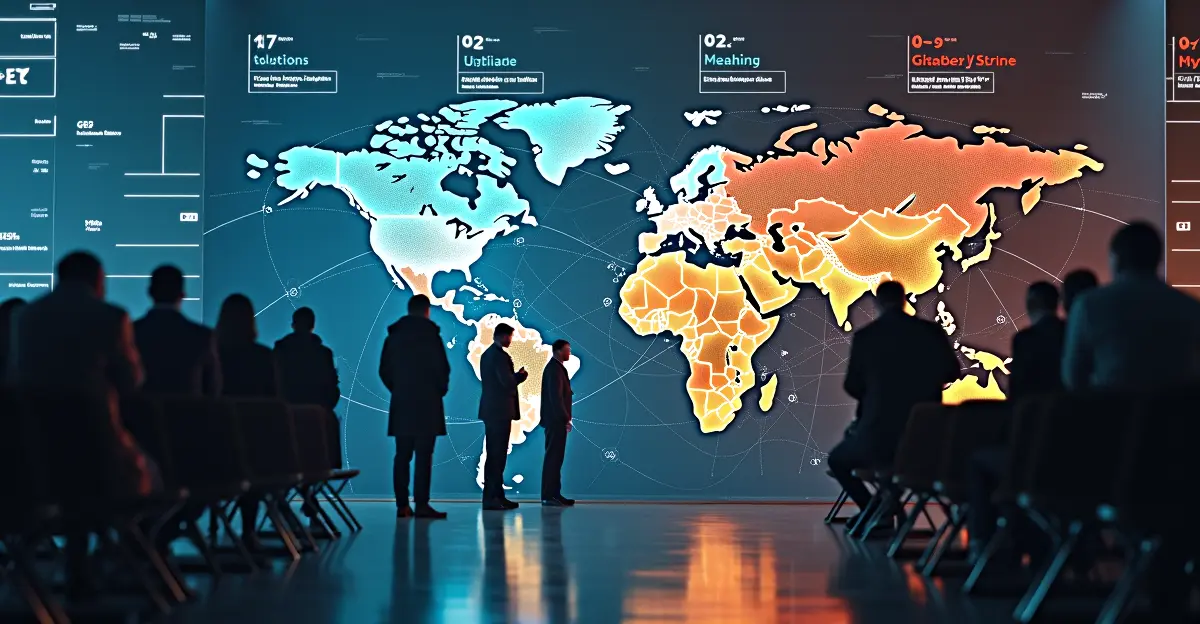
Global trade is reorganizing around three major poles. The US-led bloc is leveraging tariffs and export controls to reshore critical industries. China is deepening ties with the Global South and ASEAN nations, while the EU is pursuing new trade agreements with India and Mercosur to diversify its partners. McKinsey's March 2026 report found that US–China trade fell by about 30% in 2025, though the US replaced two-thirds of the gap with imports from other sellers. Chinese exporters cut prices by an average of 8% to find new markets, particularly in Southeast Asia and Latin America. The McKinsey global trade geometry 2026 study notes that AI-related trade — semiconductors and data-center equipment — accounted for one-third of global trade growth, with Asian hubs like Taiwan and South Korea supplying markets worldwide.
Semiconductor Export Controls and Supply Chain Realignment
Semiconductors have become the frontline of geoeconomic confrontation. The US has expanded export controls on advanced chips and chipmaking equipment to China, while China retaliates with export restrictions on critical minerals used in semiconductor manufacturing. A 2026 analysis by SupplyICs notes that these controls are forcing companies to redesign supply chains, creating new procurement challenges and driving up costs. The semiconductor supply chain restructuring 2026 is particularly acute for advanced logic and memory chips, where a handful of firms in Taiwan, South Korea, and the US dominate production. The US CHIPS Act and similar initiatives in Europe and Japan aim to build domestic capacity, but full self-sufficiency remains years away.
Critical Mineral Supply Chains Under Pressure
China's October 2025 announcement of major export controls on lithium-ion battery supply chains — covering materials, technologies, and equipment — sent shockwaves through global markets. The International Energy Agency (IEA) warned that supply concentration risks have become reality, as China controls over 60% of global processing for lithium, cobalt, and rare earths. In response, the US and EU are accelerating mining projects in Australia, Canada, and Africa, while also investing in recycling technologies. The critical mineral supply chain risks 2026 are driving a 'friend-shoring' strategy, where countries prioritize trade with allies over cost efficiency.
Clean-Energy Overcapacity Disputes
China's massive overcapacity in solar panels, wind turbines, and electric vehicles has become a flashpoint. The EU has launched anti-subsidy investigations and imposed tariffs on Chinese EVs, while the US has maintained tariffs on Chinese solar products. Chinese exports of clean-energy goods have surged, depressing global prices and threatening domestic industries in Europe and North America. The EU China clean energy trade dispute reflects a broader tension: while the world needs cheap green technology to meet climate goals, governments are unwilling to cede strategic industries to a single supplier. The WEF report notes that environmental risks like extreme weather remain the top decade-long concern, but leaders have 'deprioritized' climate issues amid immediate geopolitical pressures.
Impact on Businesses and Global Economy
The shift from efficiency to resilience is reshaping corporate strategy. McKinsey reports that US effective tariff rates hit their highest since WWII, peaking at ~22% before settling to ~15% by end of 2025. Companies are building buffer inventories, dual-sourcing critical components, and relocating production to 'safe' jurisdictions. UNCTAD's Global Trade Update (January 2026) confirms that trade fragmentation is now a measurable economic reality, with trade growth slowing in goods while services trade — particularly digital services — expands. The trade fragmentation economic impact 2026 is uneven: Southeast Asia and India are gaining manufacturing share, while the EU faces a double squeeze from more Chinese imports and higher US tariffs.
Expert Perspectives
Saadia Zahidi, Managing Director of the World Economic Forum, warned: 'A retreat from multilateralism threatens the cooperation needed to address global challenges like climate change and future pandemics.' Meanwhile, trade analysts at KPMG note that the EU has signed trade agreements with India and tentatively joined the South American Mercosur bloc, while Asia is solidifying regional trade ties. The fragmentation is not total — trade grew faster than the global economy in 2025, according to McKinsey — but the direction of travel is clear: the world is dividing into spheres of influence, and businesses must navigate a more complex, politicized trading environment.
Frequently Asked Questions
What is geoeconomic confrontation?
Geoeconomic confrontation refers to the use of economic tools — tariffs, export controls, sanctions, and investment restrictions — by countries to achieve strategic objectives, often at the expense of multilateral trade rules.
Why is geoeconomic confrontation the top risk in 2026?
The WEF Global Risks Report 2026 ranks it first because trade fragmentation into US, China, and EU blocs is accelerating, with 72% of trade professionals citing tariff volatility as the most impactful regulatory shift.
How are companies responding to trade fragmentation?
65% of companies are altering sourcing patterns, adopting 'resilience-first' strategies such as dual-sourcing, inventory buffers, and relocating production to allied countries.
What role do semiconductors play in this confrontation?
Semiconductors are a critical battleground, with US export controls on advanced chips to China and Chinese restrictions on critical minerals, forcing a restructuring of global supply chains.
Is global trade actually declining?
No — trade grew faster than GDP in 2025, but its composition is shifting. US–China trade fell ~30%, while AI-related trade (semiconductors, data-center equipment) surged, accounting for one-third of global trade growth.
Conclusion: A New Geoeconomic Era
The WEF's 2026 report makes clear that geoeconomic confrontation is not a temporary disruption but a structural shift. The multilateral trading system that has governed global commerce since WWII is giving way to a fragmented order of competing blocs. For businesses, governments, and investors, the imperative is clear: adapt to a world where resilience trumps efficiency, and where trade is increasingly an instrument of geopolitical strategy. The coming years will test whether the global economy can manage this transition without descending into a full-blown trade war that harms growth and prosperity worldwide.



Follow Discussion