


 Deutsch
 English
 Español
 Français
 Nederlands
 Português


 Share
Share




Global data center electricity consumption surged past 480 TWh in 2025 and is on track to approach 1,000 TWh by 2030, driven overwhelmingly by AI workloads. In 2026, hyperscalers alone are deploying $660–725 billion in capital expenditure — roughly 75% tied to AI infrastructure — while 56% of data center power still comes from fossil fuels. This is the defining inflection point for AI data center energy demand and its collision with national grids and the clean energy transition. Power availability has become the single most important factor in data center site selection, reshaping energy policy from nuclear revival to utility-scale renewables.
The Scale of the Surge: Numbers Behind the AI Power Crunch
According to the International Energy Agency (IEA), data centers consumed approximately 485 terawatt-hours (TWh) of electricity in 2025, representing 1.5% of global electricity consumption. The IEA's base case projects that figure will nearly double to 950 TWh by 2030, growing about 15% per year — four times faster than all other sectors combined. Gartner's November 2025 forecast is even more aggressive, expecting 980 TWh by 2030, with AI-optimized servers accounting for 44% of data center power consumption by that year. Some analysts warn that AI data centers could match Japan's entire annual electricity use as early as 2026, underscoring the scale of the grid capacity constraints facing utilities worldwide.
Why Power Has Become the Site Selection Bottleneck
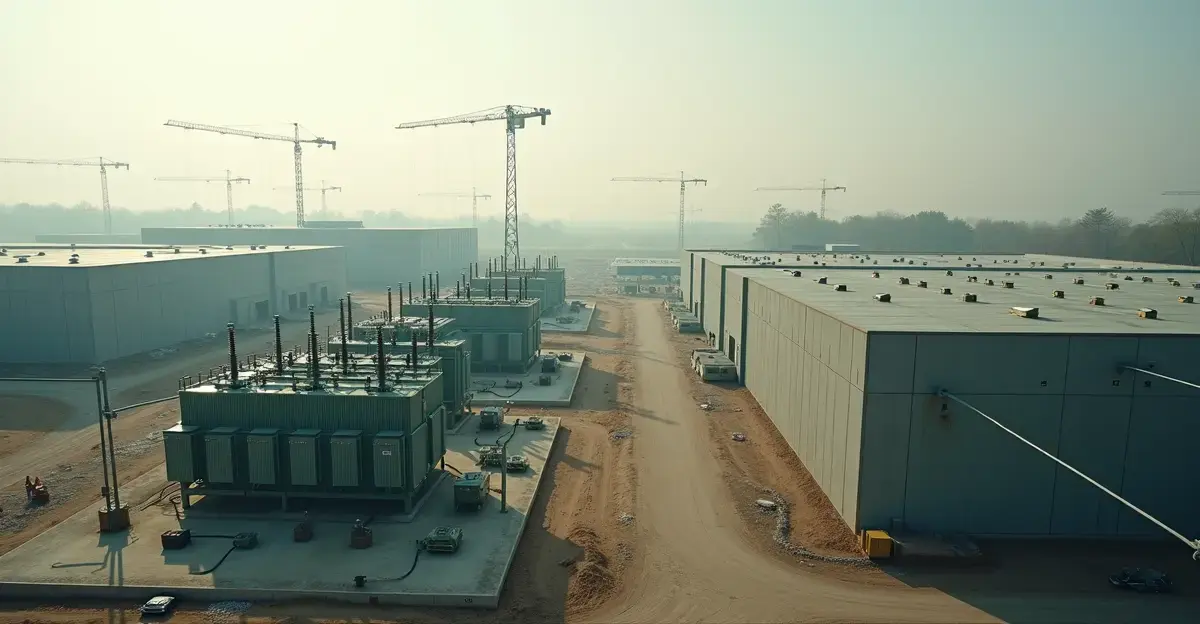
Forget cheap land and tax incentives. In 2026, electricity access is the first question every hyperscaler asks. U.S. interconnection queues have ballooned to 2,600 gigawatts, with five-year delays stalling nearly half of planned AI data centers and bottlenecking an estimated $650 billion in hyperscaler capex. A projected 49 GW U.S. generation shortfall looms by 2028, according to industry analysts. As a result, data center site selection has shifted dramatically: sites within 20 miles of operating or restarting nuclear plants now command 15–25% lease premiums because lenders require demonstrated power access. Power purchase agreements, colocation with existing generation, and behind-the-meter arrangements are now the primary determinants of where AI infrastructure gets built.
Nuclear Revival and the Clean Energy Tightrope
The collision between AI's 24/7 power needs and net-zero pledges has triggered an unprecedented nuclear revival. Microsoft signed a 20-year, $16 billion deal with Constellation Energy to restart Three Mile Island Unit 1 — renamed Crane Clean Energy Center — targeting 835 MW of carbon-free power by 2027. Amazon invested $700 million in X-energy for up to 12 small modular reactors (SMRs) and secured 1.92 GW from the Susquehanna nuclear plant. Google committed to 500 MW from Kairos Power's SMRs by 2030, while Meta signed deals for up to 6.6 GW across TerraPower, Oklo, Vistra, and Constellation. In total, thirteen announced projects commit over 9.8 GW of nuclear capacity to AI infrastructure. Yet the broader picture remains sobering: 56% of U.S. data center electricity still comes from fossil fuels, and near-term load growth is likely to be met by natural gas because it can be built faster than renewables or nuclear. This tension between nuclear revival and utility-scale renewables is now the central debate in energy policy.
Policy Shifts and the Ratepayer Backlash
As data centers strain grids, regulators are moving from incentives to accountability. In February 2026, U.S. Senators introduced the GRID Act, which would require new facilities of 20 MW or more to source all energy off-grid, with civil penalties up to $1 million per day. The FERC December 2025 colocation ruling created three transmission options for data centers, favoring point-to-point service. Meanwhile, electricity costs have risen 42% since 2019, and utilities requested $31 billion in rate hikes in 2025, sparking a ratepayer revolt. State regulators in Ohio, Georgia, and elsewhere have paused new data center hookups. This energy policy shift reflects a growing recognition that AI's power appetite cannot be subsidized by households.
Expert Perspectives
“The IEA projects AI data centers will consume over 1,000 TWh by year-end, matching Japan's electricity use,” the agency warned in its 2026 outlook. “Electricity, not chips, is now AI's binding constraint,” added one senior energy analyst tracking hyperscaler deployments. The consensus is clear: without massive investment in firm, carbon-free generation and grid upgrades, AI's growth trajectory will be throttled by physics, not software.
FAQ
What is driving data center electricity demand in 2026?
AI workloads, especially accelerated servers, are the primary driver. AI-optimized servers are projected to account for 44% of data center power consumption by 2030, growing 30% annually.
How much electricity do data centers consume globally?
Data centers consumed about 485 TWh in 2025 (1.5% of global electricity). The IEA forecasts this will nearly double to 950 TWh by 2030, while Gartner expects 980 TWh.
Why are hyperscalers investing in nuclear power?
Nuclear provides 24/7, carbon-free baseload power with 90%+ capacity factors, which intermittent solar and wind cannot deliver reliably at the scale AI requires. This has led to over 9.8 GW of announced nuclear deals.
What does this mean for electricity prices?
Wholesale prices near hyperscale sites have surged 267% since 2020, and U.S. household electricity rates rose 5.2% year-over-year, raising affordability concerns and prompting regulatory action.
Conclusion: A Defining Inflection Point
The year 2026 marks the moment when AI's energy appetite stopped being a technology story and became a global power market story. With hyperscaler capex at historic highs and grids straining, the choices made this year — nuclear restarts, SMR commitments, grid upgrades, and regulatory frameworks — will determine whether the AI boom is sustainable or constrained. Power availability is now the ultimate bottleneck, and the race to secure it is reshaping the energy landscape for decades.


Follow Discussion