


 Deutsch
 English
 Español
 Français
 Nederlands
 Português


 Share
Share




The February 2026 closure of the Strait of Hormuz following coordinated US-Israeli strikes on Iran has removed nearly 20% of global oil supplies from the market—a disruption three to five times larger than the 1973 Arab oil embargo. With Brent crude prices spiking from $61 to over $118 per barrel and the Dallas Federal Reserve estimating a 2.9 percentage point hit to global GDP growth, this event is forcing a fundamental reassessment of energy security, strategic petroleum reserves, and the pace of the energy transition. The crisis exposes the structural vulnerability of Asian economies dependent on Gulf oil and accelerates nearshoring, alternative supply routes, and investment in non-fossil energy as strategic imperatives rather than environmental choices.
What Happened: The February 2026 Closure
On February 28, 2026, the United States and Israel launched a major strike campaign against Iran under the name Operation Epic Fury. President Donald Trump announced combat operations, calling on Iranians to rise up, while Israel conducted decapitation strikes targeting the entire Iranian leadership, including Supreme Leader Ali Khamenei, whose condition remains unclear. Israeli officials assess they killed Defense Council Secretary Ali Shamkhani, IRGC Commander Major General Mohammad Pakpour, Defense Minister Brigadier General Aziz Nasir Zadeh, and Iran's intelligence chief. The IDF struck hundreds of military targets, including missile launchers in western Iran, to disrupt retaliation capabilities.
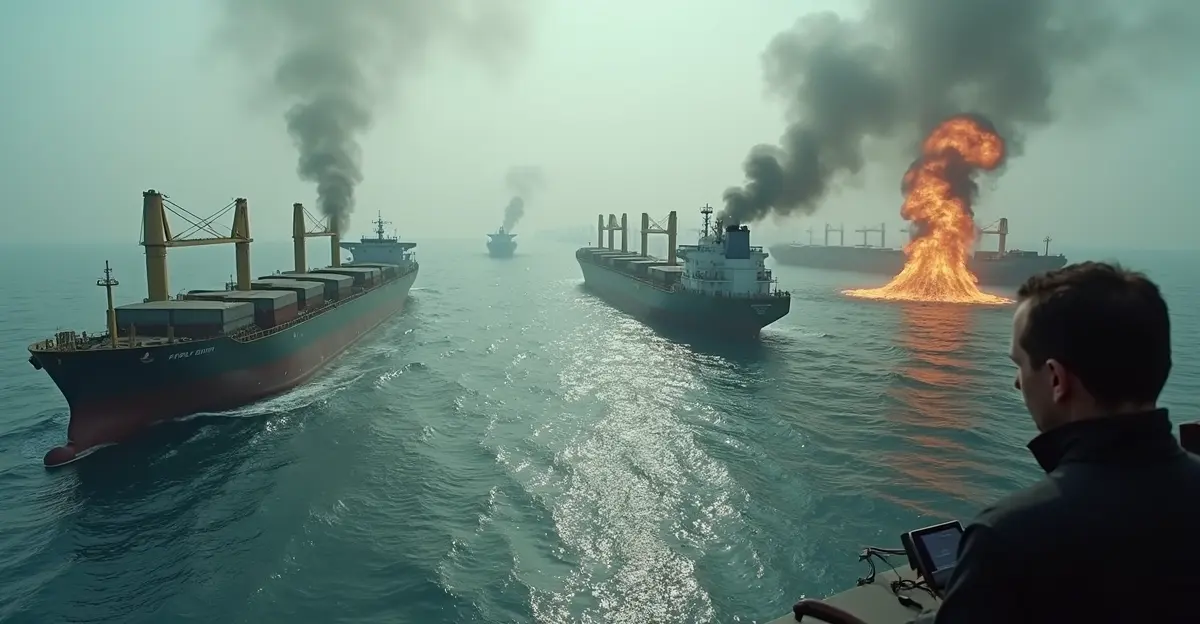
Iran retaliated immediately, launching approximately 170 ballistic missiles toward Israel and Gulf states, striking a US naval base in Bahrain and civilian areas in Haifa and Tel Aviv. The IRGC announced the closure of the Strait of Hormuz on March 2, 2026, effectively blocking the waterway that carries about 20 million barrels per day of oil and petroleum products—roughly 25% of global seaborne oil trade. Transit volume dropped to 14 ships per day (23% of the normal 60/day). The 2026 Iran war had begun in earnest, and with it, the most severe energy supply disruption in modern history.
The Scale of the Disruption
Oil Market Shock
The Dallas Federal Reserve's research quantifies the impact: a complete cessation of oil exports from the Persian Gulf removes nearly 20% of global oil supplies from the market—three to five times larger than past disruptions like the Yom Kippur War (1973) or the Persian Gulf War (1990). If the Strait remains closed for one quarter, the average WTI oil price could rise to $98 per barrel, and global real GDP growth could decline by an annualized 2.9 percentage points in Q2 2026. Longer closures could push oil prices as high as $132 per barrel and prolong negative growth impacts through year-end 2026.
The World Bank reported that by end of March, Brent oil prices surged ~65% ($46/bbl) to a record monthly high amid pronounced volatility. Global oil supply crashed by 10.1 million barrels per day (mb/d) in March due to attacks on infrastructure and tanker restrictions, marking the largest disruption ever. Global oil output is projected to fall 6.9 mb/d year-on-year in Q2 2026. Demand destruction is emerging, with consumption falling 0.8 mb/d in March and forecast to drop another 1.5 mb/d in Q2 2026. The market faces a 3.7 mb/d deficit.
Beyond Oil: Nine Critical Commodities Hit
The crisis extends far beyond crude oil. Nine non-oil commodities were severely impacted, including fertilizers (urea up 80% to $850/ton), sulfur, methanol, helium (one-third of global supply trapped), and aluminium (production down 38%). Gulf countries account for approximately 43% of global urea exports, and fertilizer cost spikes threaten 45 million people with food insecurity. Qatar, supplying 80% of its LNG to Asia, declared force majeure after strikes on Ras Laffan. The global energy transition faces a dual shock: short-term fossil fuel price spikes and long-term supply chain disruptions for critical minerals.
Emergency Response: Strategic Petroleum Reserves
The International Energy Agency (IEA) announced the largest coordinated emergency oil stockpile release in history—400 million barrels from 32 member countries, with the U.S. contributing 172 million barrels from its Strategic Petroleum Reserve. The unprecedented move signaled that energy markets expect the Middle East conflict to last for months, not weeks. Despite the release, crude prices surged over 8%, with Brent hitting $100/barrel and WTI reaching $95, as traders calculated the release covers only a fraction of the roughly 15 million barrels per day lost from halted Strait of Hormuz transits. The U.S. Strategic Petroleum Reserve was drawn down to its lowest level since 1982 (243 million barrels). Analysts warn prices could surge toward $120–$150/barrel if physical shortages emerge, forcing demand destruction in developing economies.
Impact on Asian Economies
Approximately 84% of crude oil transiting the Strait flows to Asia, with China, India, Japan, and South Korea accounting for nearly 70% of those volumes. The crisis propagates through four channels: petroleum products, LNG, industrial chemicals, and fertilizers. Countries like Bangladesh, India, Pakistan, Thailand, Myanmar, the Philippines, and Indonesia face fuel shortages, power rationing, industrial output cuts, and rising political instability as they compete with European buyers for alternative supplies. The IEA's Southeast Asia Energy Outlook 2026 highlights that the region's energy import bill could surge from USD 80 billion (2024) to USD 245 billion by 2035 without structural change. The Asian energy security dilemma is now a central geopolitical concern.
Reshaping Global Supply Chains
The crisis is forcing a permanent structural shift in global trade. According to recent analysis, 51% of companies are accelerating nearshoring, with Mexico emerging as North America's manufacturing hub ($40+ billion FDI, surpassing China as top U.S. trade partner). South-South trade corridors are displacing traditional Western hub-and-spoke models, now accounting for 57% of developing-country exports. The FORGE Alliance—a 54-nation coalition for critical minerals security—was catalyzed by the crisis. Major container lines (Maersk, CMA CGM, Hapag-Lloyd) rerouted via Cape of Good Hope, adding 10-14 days and ~$40-50M weekly in added costs. Container spot rates rose ~150%.
The nearshoring trends 2026 are accelerating as companies seek to reduce dependence on vulnerable chokepoints. Gulf states themselves are prioritizing permanent diversification away from the Hormuz chokepoint through pipelines and strategic reserves.
Expert Perspectives
This crisis is three times the severity of the 1970s Arab oil embargo, warned analysts tracking the disruption. IEA Executive Director Fatih Birol called the scale of challenges unprecedented during the extraordinary meeting that authorized the 400-million-barrel release. The Institute for the Study of War noted that the conflict is rapidly evolving, with multiple fronts including the Strait of Hormuz crisis, escalation of the Israel-Hezbollah conflict, and global economic disruption.
FAQ
What caused the Strait of Hormuz closure in 2026?
The closure was triggered by US-Israeli airstrikes on Iran on February 28, 2026 (Operation Epic Fury), which targeted Iranian leadership and military infrastructure. Iran retaliated by blocking the Strait of Hormuz, a critical maritime chokepoint for global oil trade.
How much oil passes through the Strait of Hormuz daily?
Approximately 20 million barrels per day of oil and petroleum products transit the strait, representing about 25% of global seaborne oil trade and 20% of total global oil consumption.
What was the impact on oil prices?
Brent crude surged from around $61 per barrel before the crisis to over $118 per barrel by late March 2026, a spike of approximately 65%. The Dallas Fed estimated prices could reach $132 per barrel if the closure persists.
How did the IEA respond?
The IEA coordinated the largest emergency oil stockpile release in history—400 million barrels from 32 member countries, including 172 million barrels from the U.S. Strategic Petroleum Reserve.
What are the long-term implications for energy security?
The crisis is accelerating nearshoring, diversification of supply routes, investment in renewable energy, and the formation of new alliances like the FORGE coalition for critical minerals security. Asian economies are particularly vulnerable and are reassessing their energy strategies.
Conclusion
The Strait of Hormuz crisis of 2026 marks a watershed moment in global energy security. The unprecedented scale of the disruption—combined with Iran's imposition of transit fees, the withdrawal of private insurance, and the record release of strategic reserves—has exposed the fragility of a global energy system still heavily dependent on a single maritime chokepoint. A fragile Pakistan-brokered ceasefire in April 2026 cooled oil prices below $100, but analysts warn of deep trust deficits and potential reignition of conflict. The crisis is structurally altering global trade resilience and accelerating regionalized supply chains, with implications that will be felt for decades.



Follow Discussion