


 Deutsch
 English
 Español
 Français
 Nederlands
 Português


 Share
Share




The AI Power Crisis: When Electricity Replaces Silicon as the Constraint
The global artificial intelligence boom is colliding with a stark physical reality: there isn't enough electricity to power the next generation of data centers. By 2026, AI data centers are projected to consume nearly 1,000 TWh of electricity annually — roughly equivalent to Japan's entire power demand — and account for 6–12% of total U.S. electricity consumption, according to the International Energy Agency (IEA) and Morgan Stanley. This AI data center power crunch has transformed electricity availability from a utility concern into the single most critical constraint on AI expansion, reshaping where, how, and at what cost computing infrastructure gets built.
Why the Grid Cannot Keep Up
The scale of the demand surge is unprecedented. Morgan Stanley's 2026 energy market outlook projects data center power demand will rise by 126 GW through 2028, with a 49 GW shortfall expected in the United States alone. The global energy transition is already straining grids, and AI's insatiable appetite is pushing systems past their breaking point.
Transformer Lead Times Stretch to Five Years
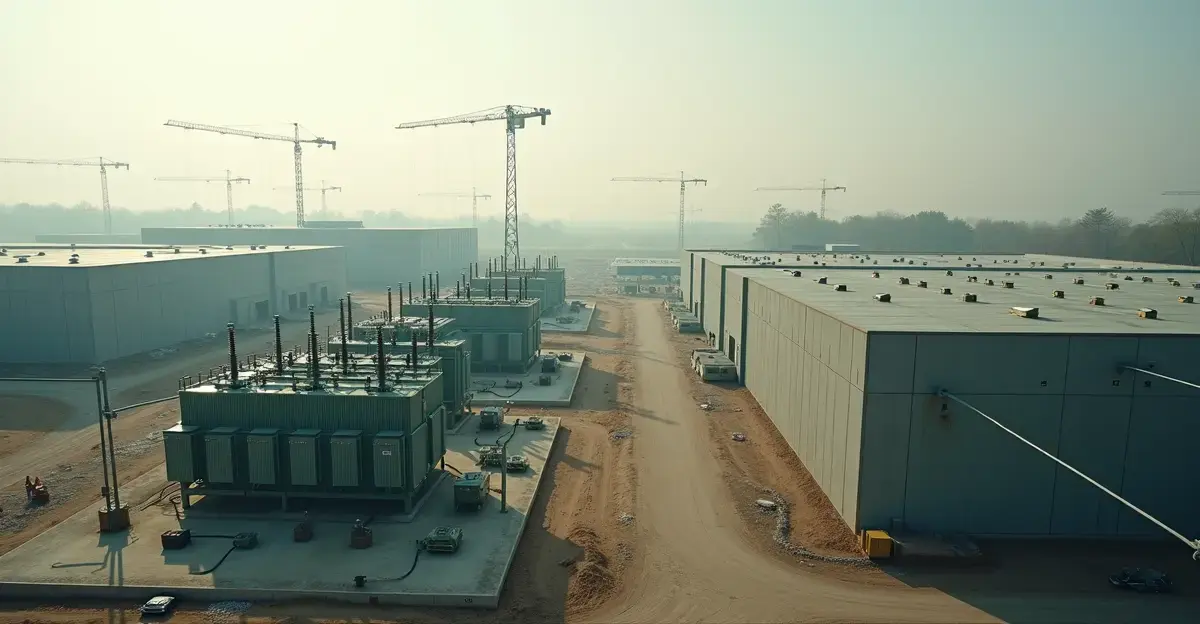
High-power grid transformers — essential components for connecting data centers to the electrical grid — now require lead times of 128 to 144 weeks, up from roughly 30 months just two years ago. This bottleneck alone threatens to delay 30–50% of the 11 GW of planned 2026 data center capacity, according to grid analysts. The shortage stems from limited global manufacturing capacity and surging demand from both AI infrastructure and broader electrification efforts.
Interconnection Queues Explode
In ERCOT, Texas's grid operator, the large-load interconnection queue surged from 63 GW to 226 GW in a single year. Dominion Energy in Virginia has stated it cannot accommodate additional large-load requests through 2030. Northern Virginia, the world's largest data center market, now has a vacancy rate of just 0.72%, with 87% of 2025–2026 inventory already preleased. Utilities like AEP Ohio have paused new data center interconnections entirely.
The PJM Price Shock: A Tenfold Spike
Perhaps the clearest signal of the crisis comes from PJM Interconnection, the grid operator serving 65 million people across 13 mid-Atlantic and Midwestern states. In its 2025/2026 capacity auction, prices skyrocketed from $28.92/MW-day to $329.17/MW-day — an 833% increase. The PJM capacity market crisis has direct consequences for consumers: data centers were responsible for 63% of the price increase, translating to $9.3 billion in additional costs passed to ratepayers. Residential customers face bill increases of $16–$21 per month, with cumulative costs through 2033 projected to reach $100–163 billion.
Big Tech's Nuclear Pivot
Facing grid constraints and soaring prices, technology giants are pursuing unprecedented energy deals — led by the revival of nuclear power plants that were retired for economic reasons.
Three Mile Island: A Symbolic Restart
In the most emblematic deal, Microsoft signed a 20-year power purchase agreement with Constellation Energy to restart Three Mile Island Unit 1 — renamed the Crane Clean Energy Center. The plant, which operated safely from 1978 until its 2019 economic shutdown, will undergo $1.6 billion in upgrades including new turbines and control systems, targeting 837 MW of carbon-free baseload power by 2027. A $1 billion Department of Energy loan, approved in November 2025, accelerated the timeline. The restart is expected to create 3,400 jobs and contribute $16 billion to Pennsylvania's economy. The plant is one of three shuttered U.S. nuclear facilities aiming to restart this decade, alongside Holtec's Palisades plant in Michigan and NextEra's Duane Arnold in Iowa.
The SMR Race
Beyond restarts, tech companies have committed over 9.8 GW across 13 announced small modular reactor (SMR) projects involving seven buyers. Amazon invested $700 million in X-energy for up to 12 Xe-100 SMRs (960 MW) plus a $20 billion+ Susquehanna AI campus. Google secured the first SMR construction permit in 50 years with Kairos Power. Meta leads with up to 6.6 GW across TerraPower, Oklo, Vistra, and Constellation. The small modular reactor market growth is projected to reach $13.8 billion by 2032, up from $6.9 billion in 2025. However, first commercial SMRs are not expected until 2028–2030, and fuel supply constraints — particularly limited HALEU availability — remain significant hurdles.
Geothermal and Gas: Bridging the Gap
While nuclear dominates headlines, other solutions are emerging. Fervo Energy announced the Uinta-Piceance-Intermountain Power and AI (UIPA) Corridor in Utah, a large-scale enhanced geothermal system designed to deliver 24/7 clean power to AI data centers. Meta has also pivoted to geothermal for its 2025 data center power needs. Meanwhile, grid constraints are driving a 70% surge in gas turbine orders, with developers turning to onsite natural gas generation as a faster alternative to grid interconnection.
Community Pushback and Policy Shifts
The cost of the AI power boom is sparking political backlash. Over 238 data center-related bills have been introduced across all 50 states in 2025. Oregon passed the POWER Act creating a dedicated data center rate class. Virginia's SB 253 would shift distribution and capacity costs from households to data centers. At least six states have introduced construction moratoriums, and seven have moved to repeal or restrict data center tax incentives. The data center regulation 2025 landscape is reshaping the economics of AI infrastructure.
Expert Perspectives
The bottleneck for AI infrastructure has shifted from silicon and real estate to the electrical grid itself, notes a January 2026 analysis from MGrid. Regulatory queue capacity, not just hardware, is the core constraint. Cathy Kunkel of the Institute for Energy Economics and Financial Analysis (IEEFA) warns that PJM's 20-year forecasts of data center growth may be inflated, but markets are responding as if they will materialize, driving up costs for everyone.
FAQ: AI Data Center Power Crunch
How much electricity will AI data centers consume by 2026?
AI data centers are projected to consume nearly 1,000 TWh globally by 2026, accounting for 6–12% of total U.S. electricity consumption, according to the IEA and Morgan Stanley.
Why are transformer lead times so long?
High-power grid transformer lead times have stretched to 128–144 weeks due to limited global manufacturing capacity, surging demand from AI data centers, and broader electrification trends.
What is PJM and why did its capacity prices spike?
PJM Interconnection is the grid operator for 65 million people across 13 U.S. states. Its capacity auction prices rose 833% in 2025/2026, with data centers responsible for 63% of the increase, adding $9.3 billion in costs to ratepayers.
Which nuclear plants are being restarted for AI?
Three Mile Island Unit 1 (Pennsylvania), Palisades (Michigan), and Duane Arnold (Iowa) are all aiming to restart this decade, with Microsoft's Three Mile Island deal being the largest at 837 MW.
Are small modular reactors commercially available?
Not yet. First commercial SMRs are expected between 2028 and 2030. Tech companies have signed over 9.8 GW in offtake agreements, but regulatory approvals and fuel supply remain challenges.
Conclusion: The New Infrastructure Reality
The AI data center power crunch represents a fundamental inflection point for global energy markets and technology competition. Electricity availability has replaced silicon fabrication capacity as the primary constraint on AI expansion. The decisions made in 2026 — on nuclear restarts, SMR licensing, grid modernization, and ratepayer protections — will determine not only the pace of AI development but the shape of energy systems for decades to come. As one industry analyst put it, the new gold rush isn't about finding compute — it's about finding power.

Follow Discussion