


 Deutsch
 English
 Español
 Français
 Nederlands
 Português


 Share
Share




The US dollar's share of global foreign exchange reserves has fallen below 57% for the first time in 30 years, marking a historic milestone in the accelerating de-dollarization trend. According to the latest IMF COFER data from early 2026, the dollar's share stood at 56.3% in Q1 2026, down from 71% in 2000 and 59% in 2020. This eight-quarter consecutive decline reflects a structural shift driven by BRICS+ nations, which now conduct 67% of intra-bloc trade in local currencies and have launched new financial infrastructure including BRICS Pay and a gold-backed digital settlement token called 'The Unit.'
What Is Driving the Dollar's Decline?
Three key factors are accelerating the erosion of dollar hegemony. First, the weaponization of financial sanctions—particularly the freezing of $300 billion in Russian central bank reserves in 2022—has prompted non-aligned nations to seek alternatives. Second, US fiscal deterioration, with national debt exceeding $39 trillion, has undermined confidence in dollar-denominated assets. Third, the BRICS+ expansion has created a bloc representing over 40% of global GDP (PPP) and 48.5% of the world's population, with economic growth rates outpacing the G7 by more than threefold.
BRICS Pay: A Dollar-Free Settlement System
In 2026, the BRICS+ alliance launched BRICS Pay, a cross-border settlement platform designed to bypass SWIFT and reduce dollar dependency. The platform integrates existing national payment systems—Brazil's Pix, Russia's SPFS, China's CIPS, and India's UPI—along with central bank digital currencies (CBDCs). A key feature is the Decentralized Cross-border Messaging System (DCMS), which operates without a central hub, making it resistant to external interference. The system is expected to cut transaction costs by 30-40% compared to SWIFT and is positioned as a parallel option rather than an immediate dollar replacement.
The Unit: Gold-Backed Digital Settlement Token
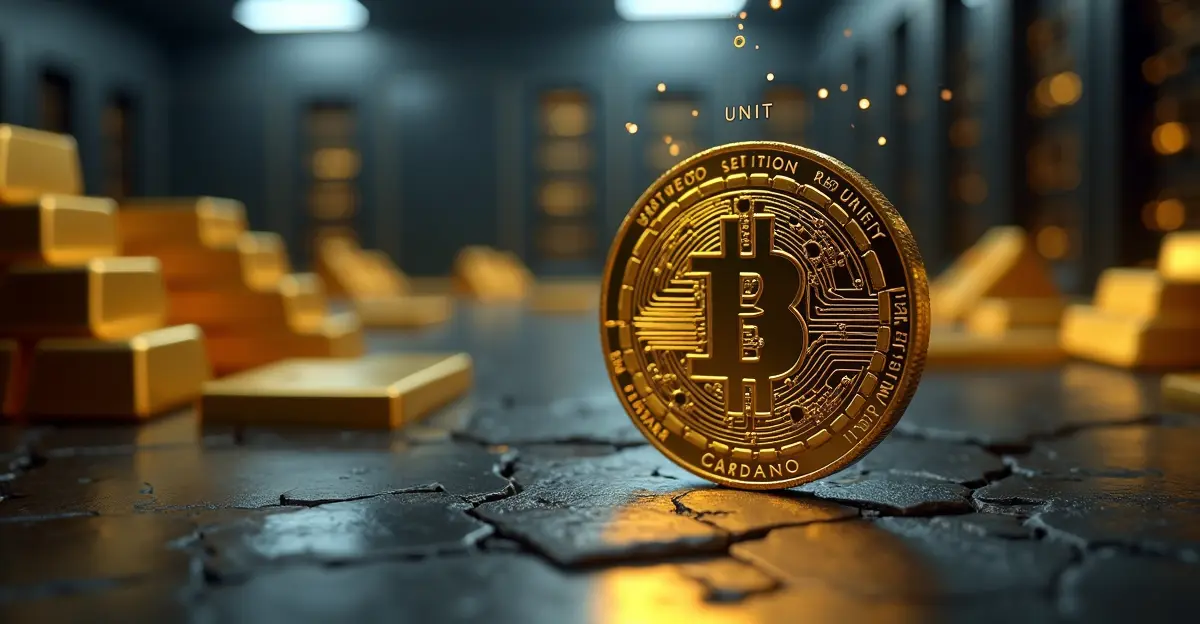
Alongside BRICS Pay, the bloc launched 'The Unit,' a gold-backed digital settlement token designed to facilitate intra-bloc trade in local currencies. Backed 40% by physical gold and 60% by a basket of five BRICS currencies (Brazilian real, Chinese yuan, Indian rupee, Russian ruble, South African rand), The Unit operates on a permissioned Cardano-based blockchain, enabling near-instant settlement (under 10 seconds) for energy and commodity transactions. As of early 2026, the system processes approximately $2.5 billion in monthly trade volume. The token is an institutional-grade instrument for central banks, not available for retail use.
China's CIPS Network and CBDC Progress
China's Cross-Border Interbank Payment System (CIPS) processed over ¥180 trillion ($24.5 trillion) in 2025, up 43% year-on-year, connecting more than 1,500 institutions across 117 countries. Meanwhile, Project mBridge, a China-led CBDC platform involving the central banks of China, Hong Kong, Thailand, and the UAE, has processed over $55 billion in transactions by early 2026. These CBDC interoperability frameworks are creating a parallel financial infrastructure that reduces reliance on dollar-based systems.
Record Central Bank Gold Purchases
Central banks purchased 1,237 tonnes of gold in 2025—the third consecutive year above 1,000 tonnes—with China (est. 290t), India (82t), Turkey (74t), Poland (69t), and Singapore (45t) leading the buying. Over 40 central banks participated, driven by the de-dollarization thesis triggered by the 2022 Russia sanctions. BRICS+ nations now hold 17.4% of global gold reserves, up from 11.2% in 2019. Gold has surged past $3,500 per ounce, now representing approximately 30% of global reserve assets.
Petrodollar System Under Pressure
The petrodollar system is also eroding. Saudi Arabia's yuan-priced crude exports to China have risen to an estimated 22% of sales, and nearly 20% of global oil trades are now conducted in non-USD currencies. The dollar's share of SWIFT payment messages has dipped to 49.7%, while intra-BRICS local currency settlement has reached 67% in some corridors. However, the dollar still settles 88% of global forex transactions and 58% of global trade, underscoring that the transition is gradual.
Implications for Global Finance and Geopolitics
The gradual erosion of dollar hegemony has profound implications. For the US, declining reserve share could add 10-15 basis points to long-term interest rates per percentage point drop, increasing borrowing costs. For emerging markets, the multipolar monetary architecture offers greater financial sovereignty and reduced exposure to sanctions. However, experts caution that the transition will be uneven, with internal divisions within BRICS+ on the pace of de-dollarization and US threats of 100% tariffs on nations working to replace the dollar.
Expert Perspectives
"We are witnessing the most significant monetary transformation since Bretton Woods," says Dr. Elena Moretti, a senior fellow at the Global Financial Institute. "The dollar's dominance is not ending overnight, but the infrastructure for a multipolar system is now operational. BRICS Pay and The Unit represent concrete alternatives that were mere concepts five years ago."
However, not all analysts agree on the speed of change. "The dollar still dominates 88% of forex transactions and remains the primary reserve currency," notes James Henderson, chief currency strategist at Atlantic Capital. "What we are seeing is a gradual diversification, not a collapse. The dollar's role will diminish, but it will remain central for decades."
Frequently Asked Questions
What is the current US dollar share of global reserves?
As of Q1 2026, the US dollar's share of global foreign exchange reserves stands at approximately 56.3%, the lowest level since 1995.
What is BRICS Pay?
BRICS Pay is a cross-border settlement platform launched in 2026 that integrates national payment systems of BRICS+ members to bypass SWIFT and reduce dollar dependency in intra-bloc trade.
What is 'The Unit'?
'The Unit' is a gold-backed digital settlement token launched by BRICS+ in 2026, backed 40% by physical gold and 60% by a basket of member currencies, operating on a Cardano-based blockchain for instant trade settlement.
How much intra-BRICS trade is in local currencies?
Approximately 67% of intra-BRICS+ trade is now settled in local currencies, up from under 20% a decade ago.
Is the dollar's dominance ending?
Most experts agree that the dollar's dominance is gradually eroding toward a multipolar system, but it remains the dominant reserve currency for the foreseeable future, still accounting for 88% of global forex transactions.
Conclusion: A Multipolar Future
The developments of 2026 mark a turning point in the de-dollarization trend. With operational alternatives like BRICS Pay and The Unit, record central bank gold purchases, and the expansion of China's CIPS network, the infrastructure for a multipolar monetary system is now in place. While the dollar will not disappear overnight, its monopoly on global finance is over. The future of global reserve currencies will be defined by competition, diversification, and the gradual emergence of a new financial order.





Follow Discussion