


 Deutsch
 English
 Español
 Français
 Nederlands
 Português


 Share
Share




The US dollar's share of global foreign exchange reserves has fallen below 57% for the first time in three decades, reaching 56.3% in early 2026 according to IMF data. As the dollar's grip loosens, BRICS nations are preparing to launch a gold-backed digital settlement instrument known as 'The Unit' alongside the BRICS Pay alternative to SWIFT, slated for rollout in 2026. With intra-bloc trade in local currencies now at 67% and yuan-denominated oil contracts approaching a quarter of Brent crude volumes, the architecture of global finance is quietly undergoing its most significant multipolar shift since the Bretton Woods system was established in 1944.
What Is the BRICS Gold-Backed 'Unit'?
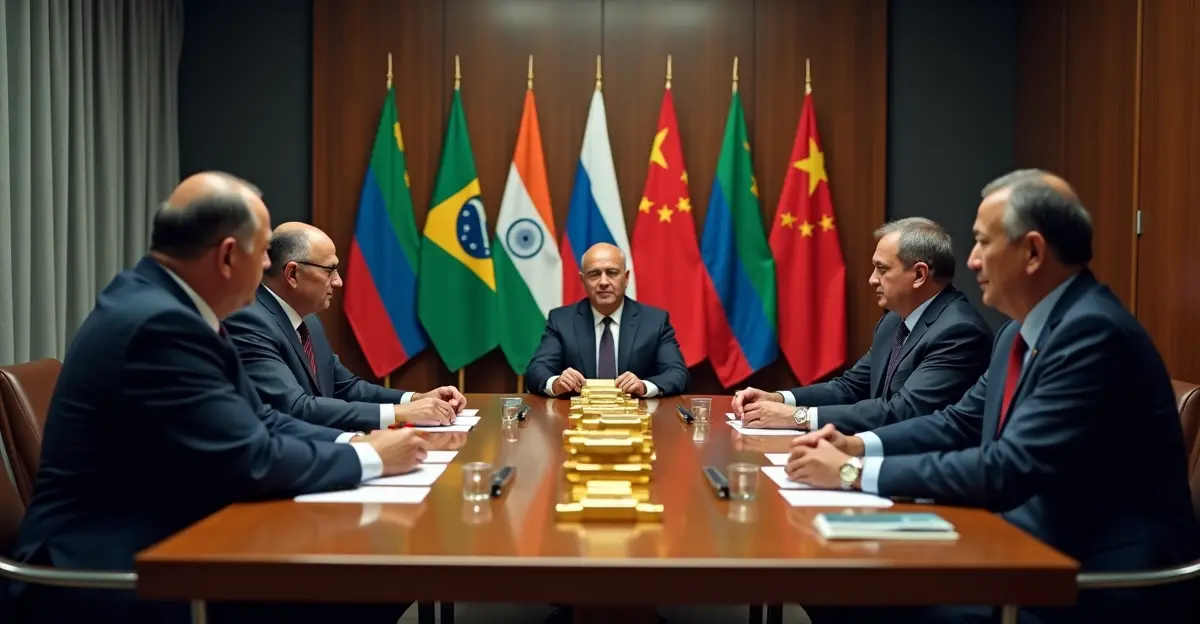
The Unit is a digital settlement token backed 40% by physical gold and 60% by a basket of member currencies, including the Brazilian real, Chinese yuan, Indian rupee, Russian ruble, and South African rand. Operating on a permissioned Cardano blockchain, it enables instant cross-border settlement without relying on SWIFT or the US dollar. The BRICS New Development Bank has been instrumental in developing the infrastructure. JP Morgan has called it 'perhaps the most thoroughly developed de-dollarization proposal' for BRICS+ cross-border transactions.
The Dollar's Declining Reserve Status
The dollar's share of global reserves has fallen from 71% at the turn of the millennium to 56.3% today—a decline of nearly 15 percentage points. Key drivers include the weaponization of financial sanctions after the freezing of Russia's $300 billion in reserves in 2022, the US national debt surpassing $39 trillion, and central banks diversifying into gold with over 1,000 tonnes purchased annually for three consecutive years. The de-dollarization trend among central banks shows no signs of slowing.
BRICS Pay: The SWIFT Alternative
BRICS Pay, set to launch in 2026, will integrate existing national payment systems—Brazil's Pix, Russia's SPFS, China's CIPS, and India's UPI—into a unified platform for direct local currency transactions. China's CIPS now connects over 1,500 institutions across 117 countries, processing approximately $25 trillion annually. While 80% of CIPS transactions still rely on SWIFT messaging, the new platform aims to reduce that dependency significantly.
Yuan-Denominated Oil and the Petroyuan Shift
Yuan-denominated oil contracts now account for approximately 22-25% of Brent crude volumes, up from negligible levels five years ago. Saudi Arabia's yuan-priced oil exports have risen to 22% of its sales, while Russia and Iran conduct the majority of their oil trade in non-dollar currencies. The Shanghai International Energy Exchange (INE) now trades 85% of its crude futures in yuan. This shift is accelerating as the petroyuan challenges the petrodollar system established by the 1974 US-Saudi agreement.
UAE Leaves OPEC: A Geopolitical Earthquake
In May 2026, the United Arab Emirates formally left OPEC after nearly 60 years of membership, delivering a major blow to the oil cartel and the petrodollar system. The UAE, OPEC's third-largest producer, cited a desire for production flexibility and the ability to price Murban crude in any mutually accepted currency. This opens the door for yuan, rupee, yen, and other currency-denominated oil trade at industrial scale. The UAE's OPEC exit and its impact on oil markets marks a critical juncture for global energy finance.
Intra-Bloc Trade in Local Currencies Hits 67%
BRICS+ nations now conduct approximately 67% of intra-bloc trade in local currencies, up from under 20% a decade ago. Russia-China trade is 99.1% settled in rubles and yuan. The BRICS+ bloc now represents over 40% of global GDP and 45% of the world's population, with growth rates outpacing the G7 by more than threefold. However, the dollar still settles 88% of global forex transactions, and internal divisions within BRICS may slow momentum.
Expert Perspectives
This is not the end of the dollar, but it is the end of its monopoly, says Eswar Prasad, professor of trade policy at Cornell University. The shift is toward a multipolar reserve system where the dollar, euro, yuan, and gold-backed instruments coexist. Meanwhile, former IMF chief economist Kenneth Rogoff warns: The dollar's dominance is eroding faster than many realize. The combination of fiscal profligacy, sanctions weaponization, and the rise of alternatives like the BRICS Unit could accelerate the transition.
FAQ
What is the BRICS Unit?
The BRICS Unit is a gold-backed digital settlement token designed for cross-border trade among member nations, backed 40% by gold and 60% by a basket of member currencies.
When will BRICS Pay launch?
BRICS Pay is slated for launch in 2026, integrating national payment systems to bypass SWIFT and the US dollar.
Why did the UAE leave OPEC?
The UAE left OPEC in May 2026 to gain production flexibility and the ability to price oil in multiple currencies, dealing a blow to the petrodollar system.
How much of global trade is in local currencies?
BRICS+ nations now conduct 67% of intra-bloc trade in local currencies, up from under 20% a decade ago.
Will the dollar lose its reserve status?
Most experts believe the dollar will remain dominant for years but will share the stage with other currencies and gold-backed instruments in a multipolar system.
Conclusion: Multipolar Reality or Dollar Decline?
The evidence points to a genuine multipolar shift rather than an imminent collapse of dollar dominance. The future of the global reserve system will likely feature multiple reserve currencies and settlement platforms. While the dollar's monopoly is ending, its depth, liquidity, and institutional backing ensure it will remain a primary reserve currency for the foreseeable future. The BRICS initiatives represent the most concrete challenge to dollar hegemony since the euro's launch, but the transition will be measured in decades, not years.




Follow Discussion