


 Deutsch
 English
 Español
 Français
 Nederlands
 Português


 Share
Share




The 2026 Iran conflict has effectively shut down the Strait of Hormuz, triggering not only the largest oil supply disruption in history but also severe shortages in non-oil commodities essential to global manufacturing and food production. Nearly half of the world's fertilizer inputs, a third of its methanol and helium, and significant shares of aluminium, sulfur, and graphite feedstocks pass through this chokepoint. As the IMF's April 2026 World Economic Outlook explicitly names the Middle East conflict as the primary threat to global growth—cutting the forecast to 3.1%—and the UN warns that 9.1 million additional people could face acute food insecurity if the Hormuz disruption persists, this analysis examines how governments and industries are being forced to diversify supply chains for critical inputs, treat access to these commodities as a matter of economic security, and rethink long-held assumptions about global trade resilience.
The Scale of the Disruption
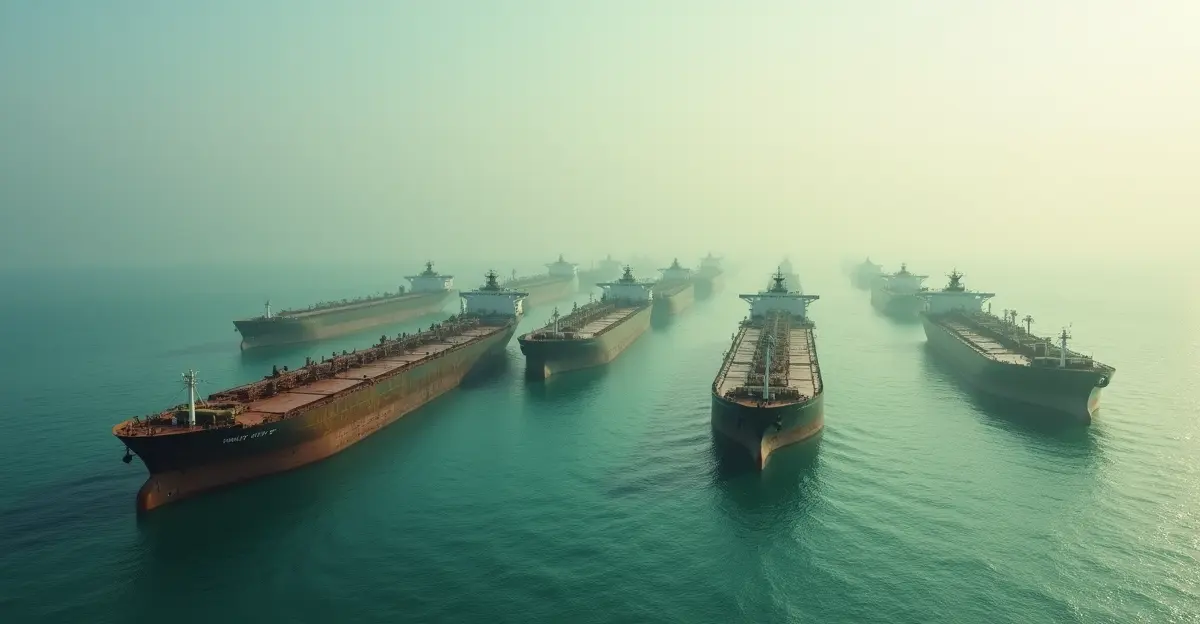
The Strait of Hormuz, a 167-kilometer waterway between Iran and Oman, normally carries about 20% of the world's oil and 25% of seaborne LNG trade. Since the escalation of the Iran conflict on February 28, 2026, vessel traffic through the strait has collapsed by over 95%, falling from 130 ships daily to single digits, according to UNCTAD. The global oil supply disruption has driven Brent crude from $66 per barrel in January to a March peak of $126, settling around $102 as of mid-April. But the crisis extends far beyond energy markets.
Critical Commodities at Risk
Fertilizers and Food Security
The Gulf region supplies 46% of global urea trade and 23% of ammonia, with roughly 30% of all globally traded fertilizers moving through the strait. Since the blockade, urea prices have jumped 40%, with Middle Eastern urea rising 19% and Egyptian urea 28% in early March alone. The FAO projects fertilizer prices could average 15-20% higher in the first half of 2026 if the crisis persists. This timing is catastrophic: it coincides with spring planting season across the Northern Hemisphere. The UN warns that up to 9.1 million additional people in Asia could face acute food insecurity, while the World Food Programme projects 45 million more people globally could fall into acute hunger if oil prices stay above $100 per barrel. Countries like Sri Lanka, Bangladesh, India, Egypt, and Sudan are most vulnerable.
Helium: A Medical and Semiconductor Crisis
Qatar's Ras Laffan facility, which produces roughly one-third of the world's helium, went offline after Iranian strikes. Helium is irreplaceable for MRI scanners, semiconductor manufacturing, fiber optics, and aerospace. Spot prices for helium have doubled since March 2026. South Korea sourced 64.7% of its helium from Qatar in 2025, and Taiwan's dependence on Gulf Cooperation Council (GCC) helium stood at 69% in 2024. While a recent surplus mitigates an immediate crisis, experts estimate a net 15% shortage. Chipmakers rely on helium for precise temperature control during etching—a process repeated hundreds of times per wafer—and cannot easily substitute cheaper gases. The helium supply chain crisis threatens to delay AI chip production and medical imaging services worldwide.
Aluminium and Metals
GCC nations produced approximately 6.16 million tonnes of primary aluminium in 2025, representing 8.35% of global supply, with 9% of global primary aluminium transiting the strait. Rotterdam premiums jumped to $300-340 per tonne amid the crisis, with analysts targeting $400-420 per tonne. US Midwest premiums rose to 104-107 cents per pound, exacerbated by existing 50% tariffs. European markets face compound shortages due to reduced Russian imports, while Asian markets contend with 10-15 day shipping delays via the Cape of Good Hope. LME aluminium reached $3,418 per tonne, a 31% increase, with forward projections of $3,600-4,000 per tonne under extended disruptions.
Battery and Petrochemical Feedstocks
The crisis is disrupting Asia's battery supply chain at a critical moment. Key battery components—separators, electrolyte solvents, and binders—are derived from petrochemicals tracing back to naphtha imported from the Gulf. Asia imports 60-70% of its naphtha via Hormuz, with prices surging from $776 to over $1,000 per metric ton. South Korea is most exposed, importing 70% of its crude via the strait. Sulfur, a critical byproduct of refining used in battery chemistry and fertilizers, has seen prices rise over 70% since the conflict began. The Middle East accounts for ~24% of global sulfur production and ~50% of seaborne sulfur trade. Methanol supplies to China are also severely disrupted, affecting chemical manufacturing across the region. The EV battery supply chain vulnerabilities are forcing automakers to reconsider production timelines and cost assumptions.
Economic and Geopolitical Implications
The IMF's April 2026 World Economic Outlook cut global growth to 3.1%, down from 3.3% in January, explicitly citing the Middle East conflict as the primary threat. The IMF warns of a potential "Severe Scenario" where growth could collapse to 2.0% if energy shocks persist. Central banks may be forced into a "higher for longer" interest rate policy as energy-driven inflation hits 4.4%. The crisis is accelerating a structural shift toward regionalized trade and energy independence. ADNOC's CEO called the closure "economic terrorism," as Asia is hardest hit, with India scrambling for fertilizer cargoes and Bangladesh shutting four of five fertilizer plants. The geopolitical risk to global trade is now the central concern for policymakers worldwide.
Expert Perspectives
"The Strait of Hormuz disruption is not just an energy crisis—it is a systemic shock to the global economy that exposes the fragility of just-in-time supply chains for critical materials," said Frida Youssef, an economist at UNCTAD. "The timing could not be worse, coinciding with planting seasons and the ramp-up of clean energy manufacturing."
"We are witnessing a fundamental reassessment of supply chain resilience," noted a senior analyst at the World Economic Forum. "Governments are now treating access to fertilizers, helium, and specialty chemicals as matters of national security, not just commercial logistics."
FAQ: Strait of Hormuz Crisis and Global Supply Chains
What commodities beyond oil are affected by the Strait of Hormuz closure?
Fertilizers (46% of global urea trade), helium (one-third of global supply), aluminium (9% of global primary supply), sulfur (50% of seaborne trade), methanol, graphite feedstocks for EV batteries, and petrochemical feedstocks like naphtha are all severely disrupted.
How long will the disruption last?
Analysts do not expect commercial normalization before July 2026 at the earliest, even if the strait reopens soon. Production stoppages require months of requalification work for alternative suppliers.
Which countries are most vulnerable?
Asian economies like South Korea, India, Bangladesh, Sri Lanka, and Pakistan are most exposed due to heavy reliance on Gulf imports for energy, fertilizers, and industrial inputs. Sub-Saharan African nations also face severe food security risks.
How is this affecting food prices globally?
Fertilizer prices have surged 15-40% since the crisis began, and the FAO projects a 15-20% average increase in H1 2026. Combined with higher fuel costs for farming and transport, food prices are expected to rise significantly, with the UN warning of 9.1 million additional people facing acute food insecurity.
What are the long-term implications for supply chains?
The crisis is accelerating a structural shift toward regionalized trade, diversification of critical mineral sourcing, and national stockpiling of essential commodities. Governments are treating supply chain resilience as a matter of economic security, likely leading to higher costs but greater stability in the long term.
Conclusion: A Watershed Moment for Global Trade
The Strait of Hormuz crisis represents a watershed moment for global trade. The assumption that critical commodities would flow freely through strategic chokepoints has been shattered. Governments and industries are now racing to diversify supply chains, build strategic reserves, and invest in alternative production capacity. The future of global trade resilience will depend on how effectively the world learns from this crisis and builds more robust systems capable of withstanding geopolitical shocks. As the IMF and UN have made clear, the stakes could not be higher: economic stability, food security, and the clean energy transition all hang in the balance.
Follow Discussion