


 Deutsch
 English
 Español
 Français
 Nederlands
 Português


 Share
Share




A powerful magnitude 7.4 earthquake struck western Colombia on Monday morning, killing at least 111 people and injuring 87 others, according to official tallies. The tremor, the strongest to hit the country in over a decade, was centered near San José del Palmar in the department of Chocó at a depth of approximately 100 kilometers. Shaking was felt across the entire nation and in neighboring Ecuador, Venezuela, and Panama.
The Earthquake and Its Epicenter
The Colombian Geological Service (SGC) reported the quake struck at 7:34 a.m. local time, with the epicenter in the seismically active Chocó region. Director Julio Fierro Morales described it as the most powerful earthquake in Colombia since at least 2016. Two significant aftershocks followed within hours, compounding the damage and hampering rescue efforts. The United States Geological Survey (USGS) issued an orange alert, estimating the final death toll could reach between 100 and 1,000, with a 20 percent probability of exceeding 1,000. Unlike the 2026 Venezuela earthquakes that devastated Caracas in June, this event was an intermediate-depth subduction-zone quake, which typically causes less surface damage but affects a much wider area.
Casualties and Damage Across Multiple Cities
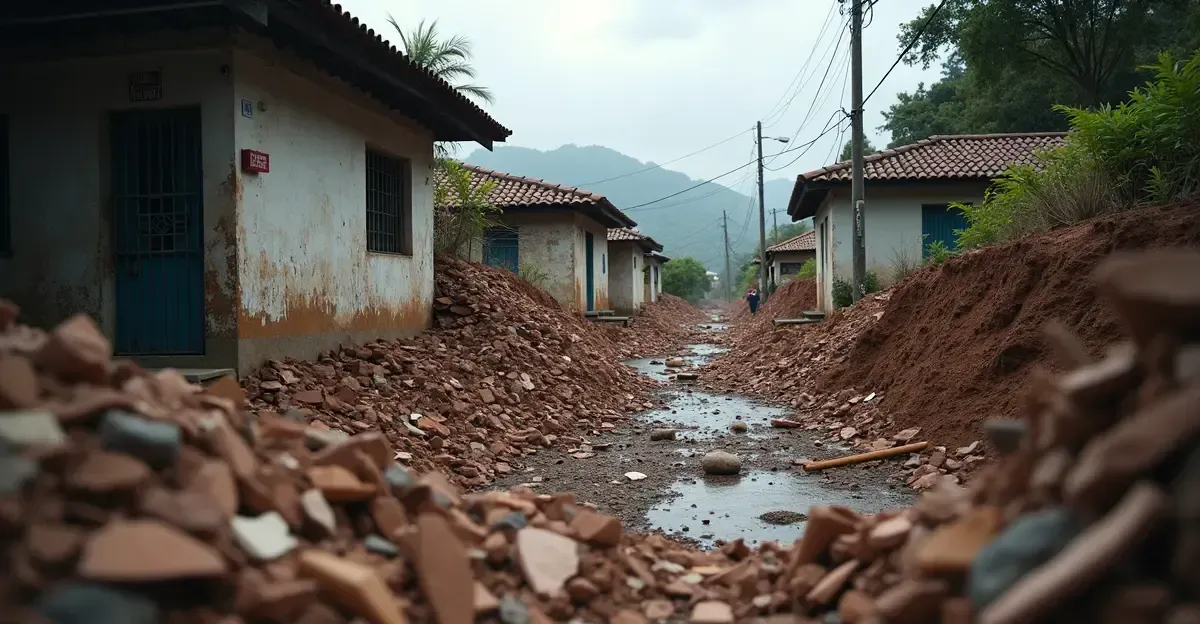
Hardest-hit were the departments of Valle del Cauca and Risaralda. In Cali, at least 20 buildings collapsed, and local authorities confirmed 27 deaths. Emergency crews pulled a young girl and an elderly woman alive from the rubble, offering moments of hope amid widespread destruction. Jeroen Buyck, a 51-year-old Dutch resident of Cali, described the scene: “The whole house was shaking violently. I rushed downstairs to check on my son, who is visiting—I was terrified the ceiling might come down.”
In Pereira, the capital of Risaralda, at least 18 people died. Eight buildings were completely destroyed and four others were at imminent risk of collapse. Approximately 30 passengers were stranded mid-air in a cable car used for public transit, adding urgency to the rescue mission. Manizales, in the coffee-growing region, reported at least two fatalities, and its historic cathedral tower partially collapsed. The city of Quibdó and the capital Bogotá also experienced significant structural damage, though casualty figures remained lower.
Government Response and International Aid
President Abelardo de la Espriella, sworn into office just three days before the disaster, suspended all scheduled activities and rushed to Bogotá to lead the emergency response. “You are not alone. The State is present and taking action,” he said in a video address on X. A Unified Command Post was established at the National Unit for Disaster Risk Management (UNGRD), and the president declared a national disaster to fast-track funding and coordination. De la Espriella announced he would personally travel to Pereira, one of the most severely affected cities.
International assistance poured in rapidly. The United States, Israel, Mexico, and Ecuador offered search-and-rescue teams and humanitarian aid. Six airports, including those serving Cali and Pereira, suspended operations to assess runway integrity. The Panamanian government evacuated several hospitals as a precautionary measure. The disaster risk management in Latin America framework has been activated to coordinate cross-border relief efforts.
Seismic Context: Colombia’s Vulnerability
Colombia sits at the boundary of five tectonic plates—the Malpelo, Panama, Caribbean, North Andes, and South American—making it one of the most seismically active countries on the Pacific Ring of Fire. The strongest recorded earthquake in modern history was the 1906 Esmeraldas-Tumaco event, estimated at magnitude 8.8, which generated a destructive tsunami. Other major events include the 1999 Armenia earthquake (6.1), which killed 921 people, and the 1979 Tumaco quake (8.1), which triggered a deadly tsunami. Monday’s 7.4 tremor ranks as the fourth-strongest in Colombian history, behind only those three events. The Colombian geological fault systems remain under close monitoring as aftershocks continue.
FAQ
How strong was the Colombia earthquake?
The earthquake had a magnitude of 7.4, making it the strongest to hit Colombia in over ten years. It struck at a depth of about 100 km, which moderated surface destruction but spread shaking across a wide area.
Where was the epicenter of the August 10, 2026 Colombia earthquake?
The epicenter was near San José del Palmar in the western department of Chocó, approximately 60 km from the Pacific coast. The region is known for its high seismic activity due to subduction of the Malpelo Plate.
How many people died in the 2026 Colombia earthquake?
As of August 10, 2026, at least 111 people have been confirmed dead and 87 injured, though numbers are expected to rise as search-and-rescue operations continue in collapsed structures.
Did the earthquake affect other countries?
Yes, the earthquake was felt in Ecuador, Venezuela, and Panama. Panamanian authorities evacuated hospitals as a precaution, though no major damage was reported outside Colombia.
What is the government doing to help earthquake victims?
President Abelardo de la Espriella declared a national disaster, activated the UNGRD, and established a Unified Command Post. International rescue teams from the US, Israel, Mexico, and Ecuador have offered assistance. The president is visiting the hardest-hit city of Pereira.

Follow Discussion