


 Deutsch
 English
 Español
 Français
 Nederlands
 Português


 Share
Share




French Teenager Sentenced to 18 Years for Fatal Stabbing of School Supervisor
A French court has sentenced a 15-year-old boy to 18 years in prison for the murder of a school supervisor during a random bag check at a secondary school in Nogent, eastern France. The attack, which took place on June 10, 2025, at the Françoise-Dolto secondary school, shocked the nation and reignited a fierce debate over knife violence in French schools and the influence of violent media on minors.
Background: The Attack During a Bag Check
The victim, 31-year-old Mélanie Grapinet, a mother of a young child, was assisting gendarmes with a routine bag search at the school entrance when the then-14-year-old student stabbed her seven times with a kitchen knife. The fatal wound measured 18 centimeters deep. A police officer was also injured during the incident. The teenager later told investigators he had decided to kill “any school supervisor, it didn’t matter which one.” The bag checks had been introduced nationwide by the French government in early 2025 as part of a crackdown on rising knife violence in schools. According to the French Ministry of Education, approximately 1 in 10 students checked during random searches was found carrying a bladed weapon. Between March and December 2025, authorities reported that 525 students were caught with a knife in their bag.
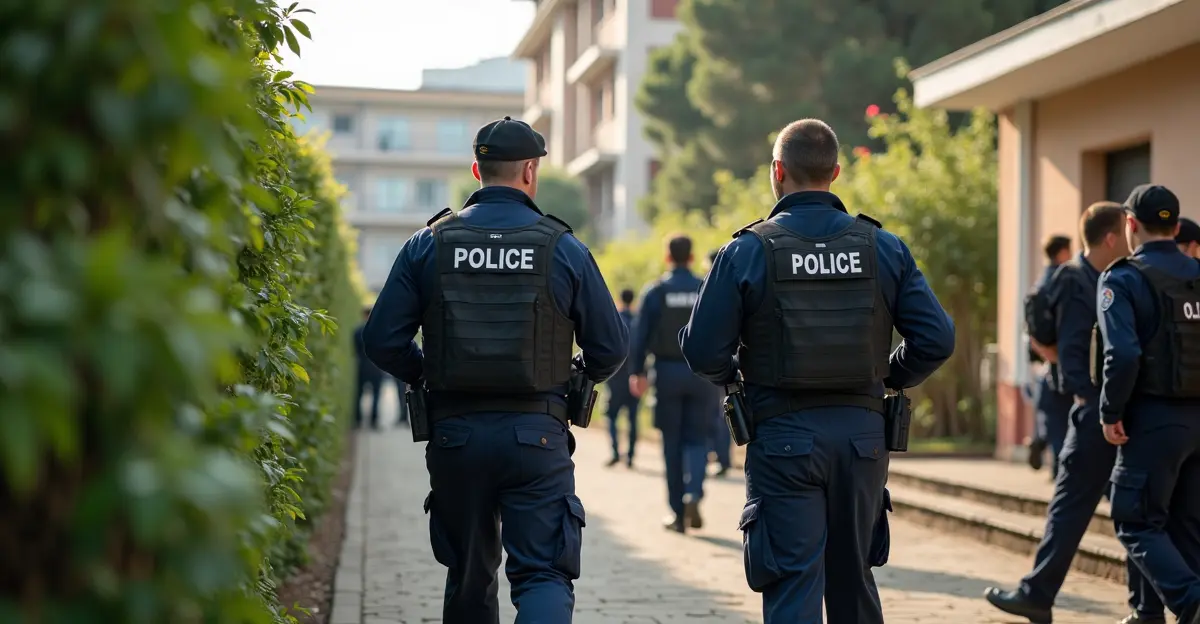
The surge in school knife violence in France prompted the government to expand random bag searches and consider installing metal detectors at school gates.
Trial and Sentencing: No Remorse, Extreme Severity
Because of his age, the teenager was tried behind closed doors by a juvenile court in Chaumont. Under French law, minors typically receive reduced sentences—at most half the maximum penalty an adult would face for the same crime. However, the court ruled that no mitigating circumstances applied due to the “extreme seriousness” of the facts. The prosecution had sought the maximum possible sentence of 20 years. The court imposed 18 years of criminal detention, followed by 10 years of judicial supervision with compulsory psychiatric treatment after release. The presiding judge cited the teenager’s complete lack of “empathy, remorse, or regret” during the proceedings, along with the premeditated nature of the attack and his previous suspensions for violence against classmates. Grapinet’s mother told reporters after the verdict: “He showed no regret, no emotion. The sentence reflects the severity of the crime, but it does not bring my daughter back.”
Psychological Profile and Fascination with Violence
Psychiatric experts determined that the teenager did not suffer from a mental disorder but exhibited a “persecutory delusion” at the time of the act, which impaired his judgment. The court found this insufficient to reduce his culpability. The boy was described as a fan of violent video games and fascinated by death and violence. His social media activity reportedly included content glorifying school attacks. This case, along with other knife incidents in French schools, prompted President Emmanuel Macron to call for a ban on social media for children under 15 and to denounce a “desensitization to violence” fueled by online platforms. In January 2026, the French National Assembly passed a bill banning social media for under-15s, with enforcement planned for the start of the 2026 school year. The social media ban for French minors has been a flagship policy of Macron’s government, though critics argue it oversimplifies a complex problem.
Impact and National Response
The murder of Mélanie Grapinet sent shockwaves through France’s education system. Vigils were held outside the Françoise-Dolto school, and the hashtag #StopViolenceScolaire trended nationally. The government responded by intensifying random bag searches: between April and May 2025 alone, 958 checks yielded 94 knives, and over a two-month period, 186 knives were seized and 32 people detained. Prime Minister François Bayrou suggested installing metal detectors in schools, calling for action against what he termed “endemic violence” among some youths. The far-right leader Marine Le Pen also weighed in, criticizing the “trivialization of ultra-violence” by public authorities. The case also raised questions about the French juvenile justice system's handling of violent minors. While France generally prioritizes rehabilitation for underage offenders, this sentence—one of the harshest for a minor in recent years—signals a shift toward greater accountability for extreme acts of violence committed by adolescents.
FAQ
What happened in the Nogent school stabbing?
On June 10, 2025, a 14-year-old student stabbed school supervisor Mélanie Grapinet to death during a random bag check at Françoise-Dolto secondary school in Nogent, eastern France. He stabbed her seven times with a kitchen knife.
Why did the teenager receive 18 years instead of a lighter sentence?
Under French law, minors can receive reduced sentences, but the court ruled that the extreme severity of the crime, premeditation, and the teenager’s complete lack of remorse justified the maximum penalty range. He was sentenced to 18 years, just below the 20-year maximum for his age.
What was the motive for the attack?
The teenager stated he wanted to kill “any school supervisor” at random. He had no personal grievance against the victim. Psychiatric experts noted a “persecutory delusion” and a fascination with violence and death, influenced by violent video games and social media content.
How has France responded to school knife violence?
France has intensified random bag checks at schools, with authorities seizing hundreds of knives. The government has also passed a law banning social media for children under 15, set to take effect in September 2026, and is considering metal detectors in schools.
What happens after the teenager serves his prison sentence?
After completing 18 years in prison, he will be subject to 10 years of judicial supervision, including compulsory psychiatric treatment. This is intended to monitor his behavior and protect the public.





Follow Discussion