


 Deutsch
 English
 Español
 Français
 Nederlands
 Português


 Share
Share




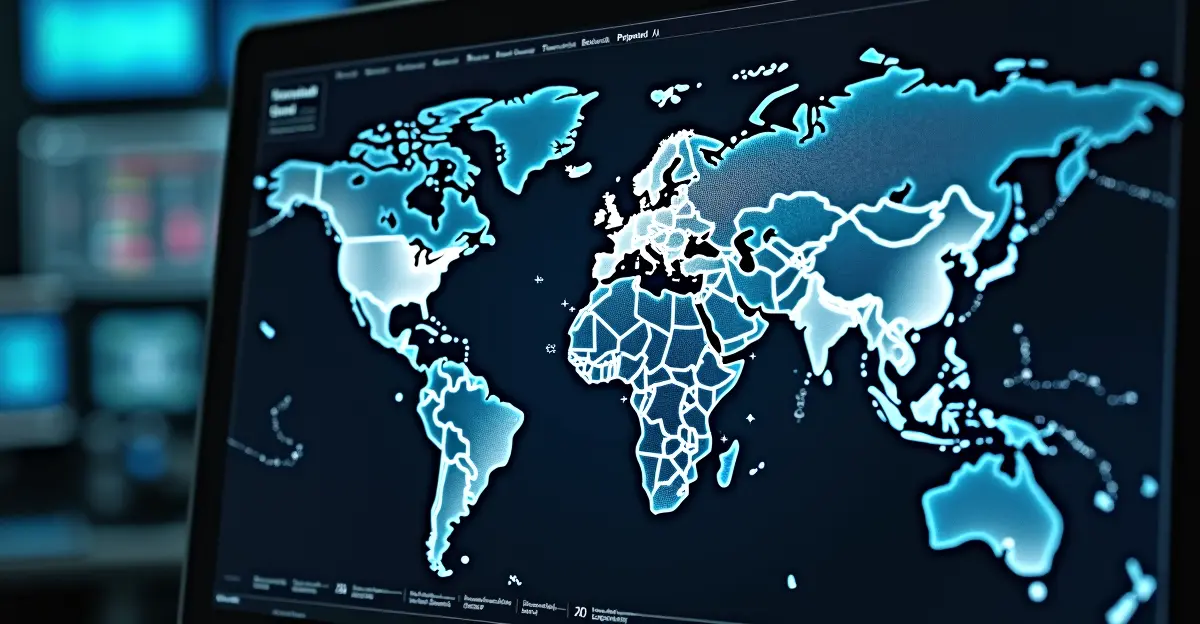
The global artificial intelligence landscape has undergone a structural transformation in 2026. The United States and China are no longer competing within a single technological framework; they are building parallel, incompatible AI ecosystems that force other nations to choose sides. This great AI bifurcation represents the defining geopolitical and technological dynamic of the year, with profound implications for global standards, military alignment, and economic dependencies.
According to the 2026 AI Index Report from Stanford HAI, the U.S.-China AI model performance gap has effectively closed, with a mere 2.7% difference as of March 2026. But the competition has moved beyond benchmarks into a structural split of the global technology landscape into two separate, incompatible stacks.
The US-Led Stack: Frontier Models and Cloud Dominance
The American AI ecosystem is built around frontier model innovation and hyperscale cloud infrastructure. U.S. hyperscalers—Amazon, Alphabet, Microsoft, and Oracle—are on track to spend approximately $725 billion in combined capital expenditure in 2026, with roughly 75% directed at AI-optimized servers, chips, and data centers. AWS targets $200 billion in CapEx, deploying its Trainium 3 chip—the first 3nm AI accelerator—while Google Cloud grew 63% year-over-year in Q1 2026 with a $460 billion backlog. Microsoft deployed NVIDIA Vera Rubin NVL72 systems commercially and raised CapEx guidance to $190 billion.
The U.S. hosts an estimated 5,427 data centers—ten times more than any other country—and controls 74% of global AI supercomputer capacity, according to a Federal Reserve FEDS Note from October 2025. U.S. AI investment reached $285.9 billion in 2025, dwarfing other nations. This stack prioritizes proprietary frontier models, massive compute clusters, and cloud-based AI services sold to enterprises worldwide.
The US export controls on AI chips have been a central lever of this strategy. The Bureau of Industry and Security maintains a presumption of denial for advanced semiconductor exports to China, though the Trump administration briefly reversed course in mid-2025, allowing Nvidia to resume H20 processor shipments before tightening again. These controls have forced Chinese firms to innovate around hardware constraints.
China's State-Directed Approach: Physical AI and Open-Weight Models
China's AI strategy takes a fundamentally different path. Constrained by U.S. chip export controls and limited capital access, Chinese labs have pioneered algorithmic efficiency through mixture-of-experts architectures, quantization techniques, and open-weight strategies. The results are striking: Chinese models now account for 61% of total token consumption among the top ten models on OpenRouter, with four of the five most-used models globally being Chinese. Daily AI token usage in China surged from 100 billion in early 2024 to over 140 trillion by March 2026.
DeepSeek's R1 model, released in January 2025, matched Western frontier performance at a fraction of the cost. Alibaba's Qwen has overtaken Meta's Llama in downloads, spawning over 40% of new Hugging Face model derivatives. Unlike proprietary U.S. models, Chinese companies publish weights under permissive MIT licenses, allowing free download, inspection, and modification. A MIT study shows Chinese open-source models have surpassed U.S. models in total downloads.
Where the U.S. excels in digital AI, China is embedding intelligence into physical systems. The China AI robotics manufacturing revolution is accelerating rapidly. China already leads globally with an operational stock of approximately 2 million industrial robots—4.5 times more than Japan—and accounts for 54% of annual global robot installations, per the World Robotics 2025 Report. Unitree Robotics scaled humanoid production from 5,500 units in 2025 to over 20,000 in 2026—a nearly 300% increase. Over 300 humanoid robots competed in Beijing's second annual robot half-marathon, with the winner completing 21.1 km in 50 minutes and 26 seconds.
China's 15th Five-Year Plan (2026-2030) places AI-powered robotics at the center of its modern industrial strategy. The country's embodied intelligence industry is surging from 1,800 humanoid robots shipped in 2025 to an anticipated 100,000+ in 2026, backed by $195 billion in annual funding and a supply chain that cuts costs to 50% of Western equivalents.
Energy Infrastructure as a Strategic Advantage
China's massive power generation capacity provides a critical advantage for energy-intensive AI training and inference. In 2025, China added a record 430 million kilowatts of new solar and wind capacity—a 22% increase year-on-year—bringing cumulative grid-connected wind and solar to 1.84 billion kilowatts, surpassing thermal power for the first time. The NDRC and NEA have issued guidelines to integrate AI across the energy sector, targeting five sector-specific large language models for grid management by 2027 and world-leading energy AI capabilities by 2030. Chinese AI firms benefit from up to 50% power discounts in western provinces, making inference costs 1/6 to 1/4 of comparable U.S. systems.
The Global Digital Schism
As both superpowers export their respective AI stacks to emerging markets, the world faces a dangerous digital schism. The global AI standards and governance split is becoming entrenched. The European Union's AI Act, fully enforceable from August 2, 2026, establishes a risk-based framework with penalties up to €35 million or 7% of global turnover. The United States follows a decentralized, sector-specific approach without overarching federal legislation, relying on executive orders and agency action. China integrates AI governance into state control, requiring outputs to align with socialist values through mandatory content labeling and censorship.
These competing governance models create a fragmented landscape for multinational companies. A RAND study tracking LLM adoption across 135 countries from April 2024 through May 2025 found distinct geographic adoption patterns, with U.S. models dominating in Western markets and Chinese models gaining traction across Asia, Africa, and Latin America.
Military Alignment and Strategic Competition
The military dimension of the AI bifurcation is accelerating. According to The Diplomat, the shift from generative AI to "agentic warfare"—systems capable of independently planning, reasoning, and executing complex tasks—is reshaping defense strategies. The U.S. retains a fragile first-mover advantage in frontier model development, driven by a competitive private sector. China leads in rapid deployment and civil-military fusion, aggressively fielding autonomous hardware like drone swarms and uncrewed vessels. The Pentagon is urged to form "agentic coalitions" with allies like AUKUS and shift doctrine from human "in the loop" to commanders "on the loop."
A March 2026 National Defense Magazine report details how China is investing heavily in AI-driven military capabilities to offset traditional U.S. advantages in aircraft carrier strike groups, stealth aircraft, and missile defense systems. The US China AI military race is now a central feature of great-power competition.
Expert Perspectives
"The U.S. leads in frontier AI models and compute power, but China is pursuing a different, full-stack approach focused on efficiency, adoption, and physical-world AI integration," said Kyle Chan in April 2026 testimony before the U.S. House Select Committee on U.S.-China AI competition, as reported by Brookings.
"China's commitment to open source will continue, driven by talent concentration, institutional incentives, and a strategic push to close the gap with US AI," noted a MIT Technology Review analysis from February 2026.
FAQ
What is the AI bifurcation between the US and China?
The AI bifurcation refers to the structural split of the global AI landscape into two separate, incompatible ecosystems: the US-led stack focused on frontier models and cloud dominance, and China's state-directed approach emphasizing physical AI integration and open-weight models.
How close are Chinese AI models to US models in 2026?
According to the Stanford HAI 2026 AI Index, the performance gap has effectively closed to just 2.7% as of March 2026, with Chinese models trading leads on various benchmarks.
Why is China investing so heavily in humanoid robots?
China's demographic crisis—the "4-2-1" structure where single children support aging parents—drives demand for automation. Humanoid robots are seen as a solution for manufacturing, elder care, and maintaining economic growth.
How do US export controls affect China's AI development?
US export controls on advanced semiconductors have forced Chinese labs to innovate in algorithmic efficiency, mixture-of-experts architectures, and open-weight strategies, while also accelerating domestic chip development through companies like Huawei.
What are the implications for other countries?
Emerging markets face pressure to choose between US and Chinese AI stacks, creating technology dependencies that align with broader geopolitical alliances. This digital schism affects everything from cloud services to military systems and data governance standards.
Conclusion
The AI bifurcation of 2026 represents a structural transformation of the global technology order. The US and China are building not just competing products but entire parallel infrastructures—from chips and cloud platforms to robotics and energy systems—that are increasingly incompatible with one another. For the rest of the world, the choice of AI ecosystem is becoming a choice of geopolitical alignment, with profound consequences for economic development, military security, and technological sovereignty. As both superpowers continue to export their respective stacks, the world faces a future of digital division that will define international relations for decades to come.
Sources
- Stanford HAI, 2026 AI Index Report
- Brookings Institution, Competing AI Strategies for the US and China, April 2026
- Federal Reserve FEDS Note, The State of AI Competition in Advanced Economies, October 2025
- International Federation of Robotics, World Robotics 2025 Report
- MIT Technology Review, What's Next for Chinese Open-Source AI, February 2026
- The Diplomat, The Military Dimension of the US-China AI Race, January 2026
- National Defense Magazine, Algorithmic Warfare, March 2026
- RAND Corporation, US-China Competition for AI Markets, 2025





Follow Discussion