


 Deutsch
 English
 Español
 Français
 Nederlands
 Português


 Share
Share




The artificial intelligence industry has slammed into a hard physical constraint that no amount of software optimization can fix: the world's aging electrical grids cannot keep pace with hyperscale data center demand. In 2026, over half of planned U.S. data center builds are delayed or cancelled due to transformer shortages, 36-to-48-month lead times on high-voltage equipment, and grid connection timelines that stretch a decade or more. This shift—from chip scarcity to power scarcity—is reshaping where and how AI infrastructure gets built, handing strategic leverage to utility companies, pro-nuclear policymakers, and nations with spare grid capacity.
With $650 billion in Big Tech capex committed but only one-third of planned 2026 capacity under active construction, the power bottleneck has become the defining operational crisis for the AI industry this year. The four largest hyperscalers—Alphabet, Amazon, Meta, and Microsoft—have pledged a combined $650–700 billion in AI infrastructure spending for 2026, the largest single-year capex surge in tech history. Yet of roughly 12–16 GW of announced capacity, only about 5 GW is under active construction, creating a 7 GW capacity shortfall. The cumulative pipeline gap exceeds 50 GW of announced-but-unbuilt capacity through 2032.
The Transformer Bottleneck: A Physical Constraint Money Cannot Solve
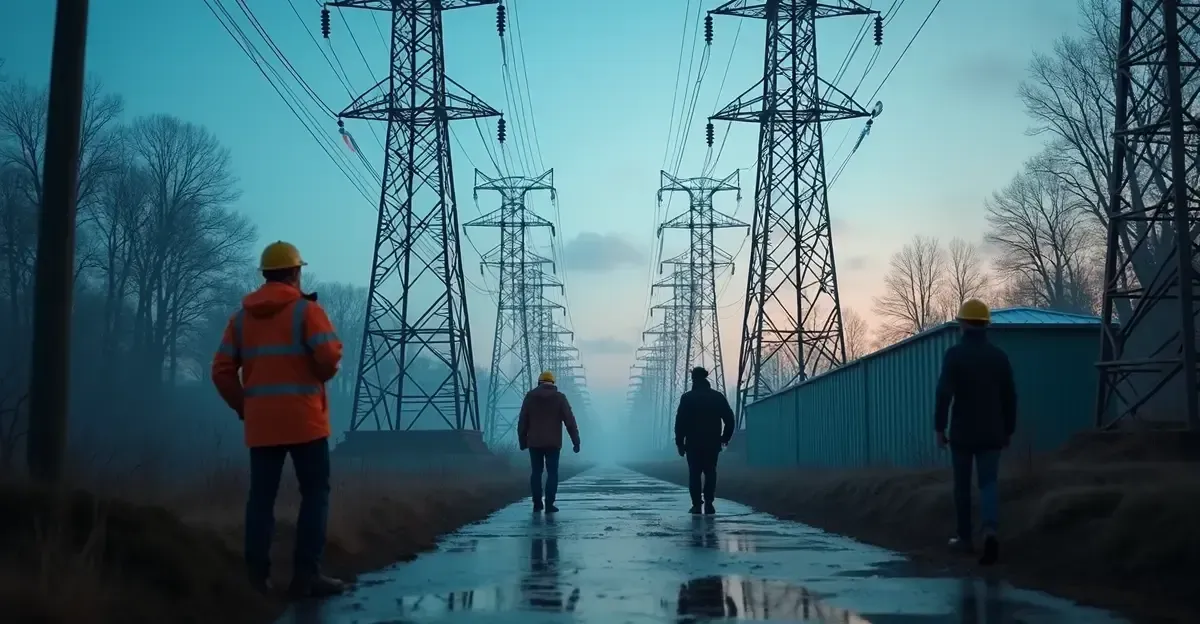
At the heart of the crisis lies a mundane but indispensable component: the electrical power transformer. These large devices, essential for stepping down high-voltage power from the grid to usable levels for data centers, have become the single most constrained item in the AI supply chain. Lead times for large power transformers have ballooned from 24–30 months pre-2020 to 128–144 weeks (roughly 2.5–3 years) today, with prices climbing 45–77% depending on class. Wood Mackenzie reports power transformer demand has surged 119% since 2019, with generator step-up units up 274%.
The transformer shortage crisis is compounded by the fact that over half of U.S. distribution transformers—some 40 million units—are beyond their service life. Manufacturing capacity is a fixed physical constraint that money cannot instantly expand. Even $1.8 billion in new North American transformer factory investments won't deliver relief until 2027–2029, making this a multi-year structural bottleneck rather than a temporary blip. Many components are manufactured in China, and tariff disruptions have compounded the squeeze.
From Chip Scarcity to Power Scarcity: A Structural Shift
Between 2021 and 2024, the primary risk to data center development was extended hardware delivery times for GPUs and servers, with lead times stretching up to 52 weeks. From 2025 onward, the bottleneck shifted decisively to substations and grid capacity. U.S. interconnection queues now delay projects for years, and utility providers warn of regional shortages. The AI data center power demand surge is driving this transformation: AI data centers use 60+ kilowatts of power per server rack, compared to 5–10 kilowatts for standard racks.
Goldman Sachs forecasts U.S. data center power demand will grow at a 15% CAGR through 2030, with data centers consuming 8% of total U.S. electricity—up from roughly 4% in 2024. Gartner predicts power shortages will operationally constrain 40% of AI data centers by 2027. The International Energy Agency projects global data center consumption will reach 1,100 TWh in 2026.
Regional Grid Strain and Community Backlash
The strain is not evenly distributed. Northern Virginia, the world's largest data center market, is facing interconnection moratoriums. AEP Ohio froze new data center interconnections, and towns across multiple states are demanding tech companies fund their own power infrastructure. PJM, the largest U.S. wholesale electricity market, has seen capacity market prices spike tenfold. Electricity rates are up 42% since 2019, and utilities requested $31 billion in rate hikes in 2025 alone.
Site selection is now governed by power availability, forcing geographic expansion away from constrained primary markets toward regions with surplus grid capacity—including parts of the Midwest, Southwest, and Mountain West. The data center site selection trends are shifting from traditional hubs to secondary markets with available interconnection capacity.
Big Tech's Nuclear Pivot: SMRs and Reactor Restarts
In response to grid constraints, hyperscale operators are pivoting to direct power generation investments, with nuclear energy emerging as the preferred solution. Major tech companies have made historic nuclear commitments in 2025–2026:
- Microsoft signed a $1.6 billion deal to restart Three Mile Island Unit 1, accelerated to 2027.
- Google and Kairos Power signed the first U.S. corporate small modular reactor (SMR) fleet agreement.
- Amazon led $500 million in financing for X-energy's SMR development.
- Meta issued RFPs for 1–4 GW of new nuclear capacity.
- Oracle plans a gigawatt-scale data center powered by three SMRs.
Google also formed a $20 billion clean energy partnership with Intersect Power and TPG for captive renewable generation. However, no commercial SMR is operational yet; first deployments are expected between 2028–2030. The small modular reactor investments 2026 represent a bet on future capacity, not a solution to today's crisis.
Market Consequences: Pricing Power Shifts and Cloud Cost Spikes
The grid bottleneck is reshaping market dynamics. Owners of permitted sites, utilities with available capacity, and electrical OEMs have become the pricing-makers in this constrained market. Cloud pricing is spiking, with on-demand premiums reaching 2–3x for GPU instances. The market is bifurcating: only hyperscalers with guaranteed power contracts can secure chips, while smaller AI firms face allocation uncertainty.
Industry analysts note that actual energization rates for 2026 may end up closer to 20% than 33% by year-end. The crisis extends beyond the U.S.: global interconnection queues are growing, and nations with spare grid capacity—including parts of the Middle East, Southeast Asia, and Scandinavia—are positioning themselves as alternative AI infrastructure hubs.
Expert Perspectives
"The bottleneck has shifted from capital to physical infrastructure. Critical electrical components like transformers and switchgear—representing less than 10% of construction costs—are causing the delays," notes a recent industry analysis. "Utilities and component suppliers now hold pricing power over AI cloud companies."
Bain & Company's 2030 global data center forecast warns that while sufficient energy supply exists in aggregate, power access remains the critical gatekeeper of growth. The firm identifies four actions to cut construction timelines by up to a year, including standardized designs, early utility engagement, and behind-the-meter generation.
FAQ: The AI Power Grid Crisis
What is the AI power grid bottleneck?
The AI power grid bottleneck refers to the inability of aging electrical infrastructure—particularly transformers, substations, and interconnection capacity—to keep pace with the exponential energy demands of hyperscale AI data centers. In 2026, this has become the primary constraint on AI infrastructure buildout, surpassing chip availability.
Why are transformers in short supply?
Transformer demand has surged 119% since 2019 due to data center, EV, and renewable energy growth. Manufacturing capacity is limited, lead times have stretched to 2–4 years, and over half of U.S. distribution transformers are beyond their service life. Tariffs on imported steel and copper have further constrained supply.
How much AI infrastructure spending is at risk?
Big Tech has committed $650–700 billion in AI capex for 2026, but only about one-third of planned capacity is under active construction. The cumulative announced-but-unbuilt capacity exceeds 50 GW through 2032, representing hundreds of billions in delayed or at-risk investment.
Can nuclear power solve the AI energy crisis?
Nuclear power, particularly small modular reactors (SMRs), is a promising long-term solution, with major tech companies investing billions. However, no commercial SMR is operational yet; first deployments are expected between 2028–2030. In the near term, behind-the-meter gas generation and renewable partnerships are more immediate alternatives.
Which regions are benefiting from the grid shift?
Regions with available grid capacity—including the U.S. Midwest, Southwest, Mountain West, and parts of the Middle East, Southeast Asia, and Scandinavia—are attracting new data center investments as traditional hubs like Northern Virginia face interconnection moratoriums.
Conclusion: The New Strategic Leverage
The grid ceiling represents a fundamental reordering of the AI industry's supply chain. For the first time, the rate of AI infrastructure deployment is constrained not by capital, chips, or software talent, but by the physical limits of electrical engineering and manufacturing. Utilities, transformer manufacturers, and pro-nuclear policymakers now hold strategic leverage over the world's most valuable technology companies. The nations and companies that can build grid capacity fastest will win the next phase of the AI race.

Follow Discussion