


 Deutsch
 English
 Español
 Français
 Nederlands
 Português


 Share
Share




The World Economic Forum's Global Risks Report 2026 has ranked geoeconomic confrontation as the top global risk for the first time, signaling a fundamental shift in international relations. As the US, China, and the European Union weaponize tariffs, export controls, and sanctions at unprecedented scale, global supply chains are undergoing their most dramatic reconfiguration since the end of the Cold War. US effective tariff rates have surged from 2.4% in early 2024 to approximately 22% before settling near 12% in mid-2026 — the highest levels since the 1940s — while over 18,000 discriminatory trade measures have been introduced globally since 2020.
The WEF 2026 Global Risks Report: A New Era of Confrontation
Published in January 2026, the WEF report draws on insights from over 1,300 experts worldwide. For the first time, geoeconomic confrontation — defined as the strategic use of trade barriers, financial sanctions, and technology restrictions to achieve geopolitical objectives — ranks as the most likely risk to trigger a global crisis in the short term. The report warns that 68% of experts expect a multipolar or fragmented global order over the next decade, with multilateralism in retreat as trust, transparency, and the rule of law decline.
State-based armed conflict ranks second, while economic downturn and inflation have risen sharply. The WEF Global Risks 2026 analysis underscores that these risks are increasingly compounding rather than isolated, creating cascading disruptions across trade, finance, and security.
Tariff Escalation: From 2.4% to 22% in Two Years
The United States has led the charge in tariff escalation. According to the Yale Budget Lab, the US average effective tariff rate stood at 11.0% as of April 2026 — the highest since 1943 — though it would fall to 8.2% if Section 122 tariffs expire as scheduled. However, the peak rate reached roughly 22% in early 2026 before partial rollbacks. Key measures include:
- Section 122: A 10% global reciprocal tariff on nearly all imports, effective February 24, 2026, with exemptions for energy, pharmaceuticals, certain electronics, and aerospace.
- Section 301: Tariffs of 7.5–100% on Chinese-origin goods, with EVs at 100%, solar and semiconductors at 50%, and most goods at 25%.
- Section 232: 50% tariffs on steel, aluminum, and copper (raised from 25% on February 1, 2026), with no country exemptions. Russian aluminum faces a 200% duty.
These tariffs are additive. For example, Chinese steel rebar faces a combined effective rate of 88.8% (3.8% MFN + 10% Section 122 + 25% Section 301 + 50% Section 232). The US tariff escalation 2026 has reshaped trade flows across virtually every sector.
The Great Supply Chain Reconfiguration
In response to this geoeconomic pressure, global supply chains are shifting from cost-optimized, centralized networks toward regionally resilient, multi-hub configurations. The US-China trade corridor has shrunk by roughly 30%, with approximately $165 billion in trade redirected to alternative routes. Mexico replaced China as the largest US trading partner in 2023, and the gap has widened since: in 2025, the US imported $535 billion worth of Mexican goods compared to only $308 billion from China.
Key trends driving this reconfiguration include:
Friendshoring and Nearshoring
Friendshoring — shifting supply chains to politically allied nations — has become a strategic imperative. According to McKinsey, 51% of firms are actively nearshoring production, while 65% are changing sourcing patterns. Vietnam, Thailand, Malaysia, and India have emerged as Western-aligned manufacturing hubs. Vietnam surged as the third-largest US deficit partner ($140 billion deficit) by becoming a primary electronics and textiles assembly hub.
Regional Bloc Formation
Three distinct trade blocs are crystallizing: a North American bloc centered on the USMCA, a European bloc anchored by the EU and its Eastern Partnership, and an Asian bloc increasingly dominated by China's Belt and Road Initiative and Regional Comprehensive Economic Partnership. The friendshoring vs nearshoring debate highlights the tension between efficiency and security in corporate strategy.
Economic Implications: The 2% Output Loss Warning
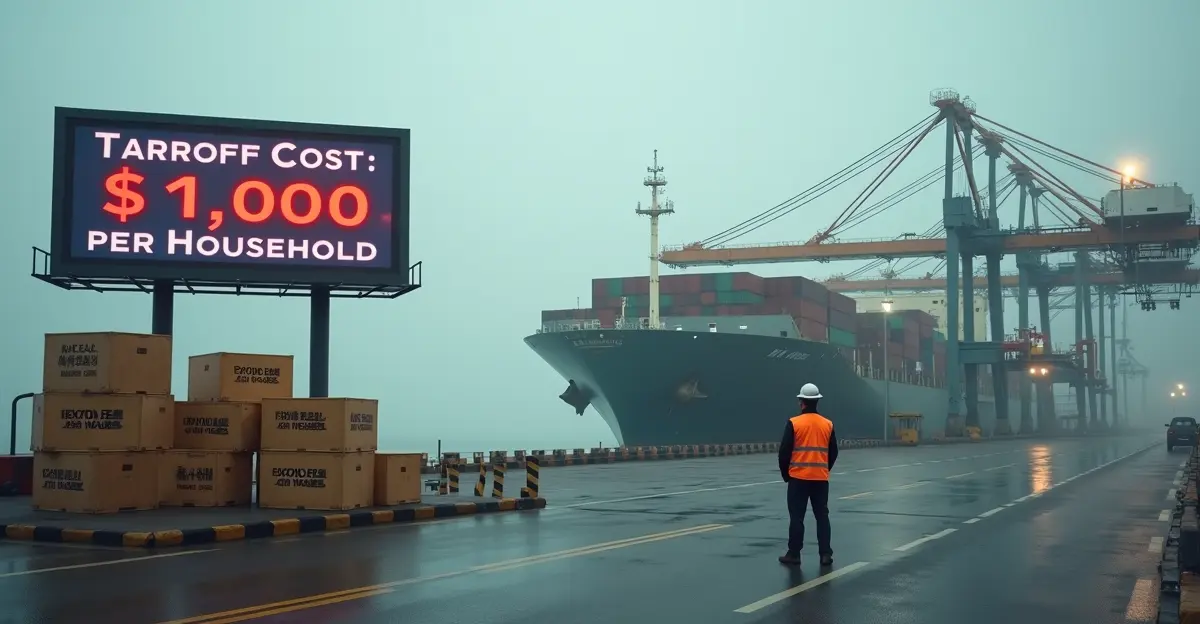
The International Monetary Fund warns that friendshoring could reduce global output by 2%, with developing economies facing GDP losses of up to 6%. The Yale Budget Lab estimates that US tariffs will raise approximately $1.1 trillion over 2026–2035 (or $1.7 trillion if Section 122 is extended), but the price level impact is estimated at 0.5%–0.6%, costing the average household between $650 and $780 annually. If Section 122 is made permanent, household losses rise to $1,130–$1,340.
Manufacturing output in the US expands by 0.7% under current tariffs, but construction contracts by 2.0% and mining declines by 0.8%. The economy is expected to be persistently 0.1% smaller in the long run — about $27 billion annually. These supply chain resilience strategies 2026 carry profound implications for corporate strategy, inflation dynamics, and geopolitical alignment through the remainder of the decade.
Expert Perspectives
"Geoeconomic confrontation is no longer a theoretical risk — it is the defining strategic shift of 2026 for global business and policymakers alike," said Lucas Schneider, geopolitical analyst. "The weaponization of economic tools has reached a scale not seen since the 1930s, and supply chains are being redesigned in real time."
ISEP deputy CEO Martin Baxter noted that climate change is opening new Arctic routes and areas for resource exploitation, while global powers compete for critical resources like copper and lithium. The WEF report emphasizes that environmental concerns remain the most severe over the 10-year horizon, with extreme weather events as the top long-term risk.
FAQ
What is geoeconomic confrontation?
Geoeconomic confrontation refers to the strategic use of economic tools — including tariffs, export controls, sanctions, and technology restrictions — by nations to achieve geopolitical objectives. It has become the top global risk according to the WEF 2026 Global Risks Report.
How much has US trade with China declined?
The US-China trade corridor has shrunk by approximately 30%, with $165 billion in trade redirected to other countries. Mexico has replaced China as the largest US trading partner.
What is friendshoring?
Friendshoring is the practice of shifting supply chains and production to politically allied nations to reduce dependence on strategic rivals. It is a key component of the global supply chain reconfiguration underway in 2026.
What is the economic impact of friendshoring?
The IMF warns friendshoring could reduce global output by 2%, with developing economies facing GDP losses of up to 6%. US households face annual cost increases of $650–$1,340 depending on tariff permanence.
Which countries are benefiting from supply chain shifts?
Mexico, Vietnam, Thailand, Malaysia, India, and select Eastern European nations are emerging as major beneficiaries of nearshoring and friendshoring trends, attracting manufacturing investment previously destined for China.
Conclusion
The geoeconomic confrontation of 2026 represents a structural break from the globalization era. Supply chains are being redesigned for resilience over efficiency, with profound consequences for trade, inflation, and geopolitical alignment. As the WEF report makes clear, the era of hyper-globalization is giving way to a fragmented, multipolar order — and businesses and governments must adapt or face irrelevance.


Follow Discussion