


 Deutsch
 English
 Español
 Français
 Nederlands
 Português


 Share
Share




China's escalating export controls on rare earths, tungsten, and antimony have triggered sixfold price spikes outside China and slashed licensing approval rates for European firms below 25%, fundamentally reshaping global supply chains in 2026. With Beijing controlling roughly 90% of global rare earth processing, 80% of tungsten refining, and 60% of antimony production, Western nations face a strategic crisis that threatens defense, electric vehicle (EV), and renewable energy industries. This analysis examines the implications of China's weaponization of critical mineral supply chains and whether the West has a narrowing 12-18 month window to respond effectively.
Background: China's Export Control Regime
In April and October 2025, China introduced two waves of export controls on rare-earth elements (REEs), citing national security interests in response to U.S. tariffs. A second wave was suspended until November 2026, but the licensing regime remains stringent. The controls cover 17 rare-earth elements, tungsten, antimony, and other critical minerals essential for high-performance magnets, semiconductors, defense systems, and clean energy technologies. According to a multi-institutional analysis published in early 2026, China's export licensing approval rates for European firms have fallen below 25%, effectively creating a bottleneck that Western companies cannot bypass. The rare earth supply chain has become a central front in the broader U.S.-China trade war.
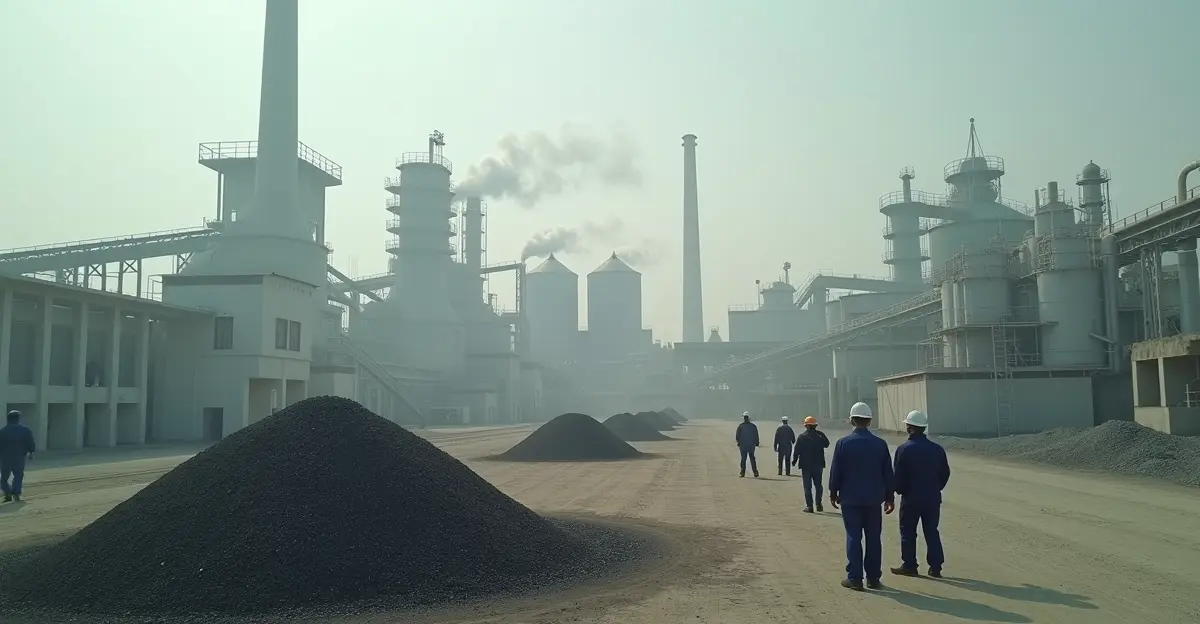
China's dominance is structural: it processes 90% of global rare earth oxides, 80% of tungsten, and 60% of antimony. This concentration means that even modest restrictions have outsized impacts. The European Union's Critical Raw Materials Act, passed in 2024, aimed to reduce dependency, but implementation lags far behind the pace of China's actions. Over 80% of European companies remain dependent on Chinese supply chains for critical minerals, according to industry surveys.
Price Spikes and Market Disruption
The most immediate impact of China's export controls has been on pricing. Neodymium-praseodymium (NdPr) oxide, a key input for permanent magnets used in EV motors and wind turbines, saw prices surge up to sixfold outside China between mid-2025 and early 2026. Antimony, used in flame retardants, semiconductors, and defense applications, peaked at $59,750 per tonne in July 2025 — a quadrupling from pre-control levels. Tungsten prices followed a similar trajectory, driven by reduced export quotas and stricter licensing.
These price spikes are not merely market fluctuations; they represent a deliberate strategy. Analysts argue that China is weaponizing control rather than scarcity. By imposing temporary, reversible restrictions, Beijing maintains pricing power and extracts strategic concessions while discouraging large-scale Western investment in alternative supply chains. The uncertainty created by China's licensing regime — where approvals can be revoked or delayed arbitrarily — makes it difficult for Western companies to justify the multi-billion-dollar investments needed to build independent processing capacity.
Strategic Implications for Defense, EVs, and Renewables
Defense Sector Under Pressure
NATO's list of 12 defence-critical raw materials, published in December 2024, includes rare earth elements, tungsten, cobalt, and lithium — all heavily dependent on Chinese supply chains. The NATO critical minerals strategy has identified these vulnerabilities, but stockpiles remain dangerously low. Current NATO defense stockpiles are sufficient for only 6-9 months of high-intensity conflict, according to defense analysts. This shortfall affects production of missile guidance systems, F-35 components, submarine sensors, and advanced radar systems. European defense contractors have reported delays of 6-12 months in receiving critical magnet assemblies, directly impacting delivery timelines for military equipment.
Electric Vehicle Industry Hit Hard
The global EV transition faces significant headwinds from China's export controls. Permanent magnets — which rely on neodymium, praseodymium, and dysprosium — are essential for EV motors. Outside China, EV production costs have risen by an estimated $500 per vehicle due to rare earth price increases. This cost pressure comes at a delicate time when automakers are struggling to achieve price parity with internal combustion engines. The EV battery supply chain is also affected, as China controls processing of lithium, cobalt, and graphite. Some Western automakers are exploring magnet-free motor designs, but these alternatives require years of development and retooling.
Renewable Energy Delays
Wind turbine manufacturers, particularly those producing direct-drive turbines that use permanent magnet generators, face similar challenges. Offshore wind projects in Europe and North America have reported cost overruns of 15-25% attributable to rare earth price increases. The International Energy Agency (IEA) has warned that China's export controls could delay global renewable energy deployment targets by 2-3 years if alternative supply chains are not established quickly.
Western Response: FORGE and the $30 Billion Pledge
In February 2026, the United States launched the Forum on Resource Geostrategic Engagement (FORGE), a 54-nation alliance that replaces the earlier Minerals Security Partnership. FORGE committed over $30 billion to diversify critical mineral supply chains, including the $10 billion Project Vault for domestic strategic reserves. The initiative aims to accelerate mining and processing projects in Australia, Canada, the United States, Brazil, and select African nations.
However, the timeline for achieving meaningful independence remains daunting. Analysts estimate that building new rare earth separation facilities requires 12-18 months minimum, with full supply chain independence — from mining to magnet manufacturing — taking 5-7 years. The Western rare earth processing projects currently under development face permitting hurdles, technical challenges, and high capital costs. China's 2026-2030 Five-Year Plan is expected to reinforce its dominance through state-backed investments in processing technology and overseas mining acquisitions.
Expert Perspectives
China is not trying to cut off supply entirely; it is using calibrated pressure to maintain leverage while making Western alternatives economically unviable, said Dr. Elena Voss, a senior fellow at the Center for Strategic and International Studies (CSIS). The 12-18 month window is real. If the West does not commit to concrete projects by mid-2027, the window for independent supply chains will close for at least a decade.
European Commission Vice President for Trade, Valdis Dombrovskis, acknowledged the severity of the situation in a March 2026 speech: Our dependency on a single supplier for materials essential to our defense and green transition is a strategic vulnerability we cannot afford. FORGE is a start, but member states must match rhetoric with investment.
FAQ: China's Critical Minerals Export Controls
What minerals does China control?
China controls approximately 90% of global rare earth processing, 80% of tungsten refining, and 60% of antimony production. It also dominates processing of lithium, cobalt, graphite, and gallium.
Why did China impose export controls?
China cites national security concerns and retaliation for U.S. tariffs. Analysts believe the controls are designed to extract geopolitical concessions, maintain pricing power, and discourage Western investment in alternative supply chains.
How have prices been affected?
Prices for neodymium-praseodymium oxide and antimony have surged up to sixfold outside China since mid-2025. Tungsten prices have also risen sharply.
Can the West build independent supply chains?
Building independent processing capacity is technically feasible but requires 5-7 years and $30-50 billion in investment. The FORGE alliance has committed $30 billion, but analysts warn that China's ongoing dominance and the complexity of rare earth processing create significant barriers.
What is the 12-18 month window?
Analysts estimate that Western nations have 12-18 months to begin concrete diversification projects before China's 2026-2030 Five-Year Plan reinforces its dominance. Delaying beyond mid-2027 could lock in dependency for another decade.
Conclusion: A Narrowing Window
China's critical minerals stranglehold represents one of the most significant geopolitical and economic challenges of 2026. The combination of structural dominance, calibrated export controls, and the slow pace of Western alternative development has created a crisis point for defense, EV, and renewable energy supply chains. The FORGE alliance and $30 billion commitment are important steps, but execution remains the critical variable. Without rapid permitting, substantial investment, and international coordination, the West risks accepting prolonged vulnerability. The next 12-18 months will determine whether the global critical minerals landscape becomes multipolar or remains dominated by Beijing.

Follow Discussion