


 Deutsch
 English
 Español
 Français
 Nederlands
 Português


 Share





The U.S. Federal Communications Commission has given Elon Musk's SpaceX permission to launch up to one million data centers into space under the Starmind program, a move that has alarmed scientists over collision risks, light pollution, and atmospheric damage. The plan, approved on November 26, 2026, aims to relocate AI computing infrastructure off Earth to avoid local opposition to terrestrial data centers, but experts warn that just because something can be done does not mean it should be.
What is SpaceX Starmind?
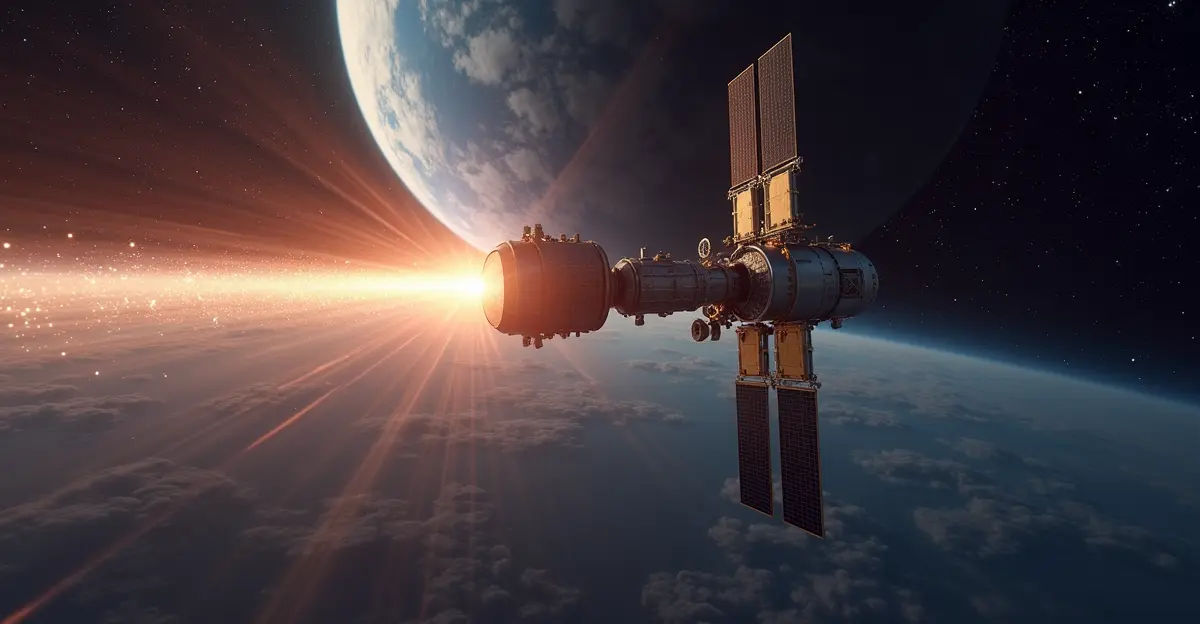
Starmind is SpaceX's proposed constellation of orbital data centers designed to support artificial intelligence applications on Earth. Unlike Starlink, which already operates roughly 11,000 broadband satellites, Starmind would deploy satellites measuring 30 by 75 meters—about a quarter the size of the International Space Station. The FCC conditions require at least one satellite to be launched by 2033, 100,000 by 2035, and full operational capacity by the end of 2040. The satellite collision tracking challenge alone is enormous.
Why move data centers to space?
Terrestrial data centers consume massive amounts of energy and water, and their constant hum has triggered strong local resistance. In recent U.S. elections, voters in 40 of 41 referendums supported stricter rules on data centers. Musk argues that space-based data centers eliminate those problems: "This will be a huge asset for the US and the world." In space, solar panels provide power and noise is irrelevant, addressing the data center energy consumption debate.
Key safety concerns from scientists
Collision and tracking capacity
Satellite expert Marco Langbroek of TU Delft questions whether the U.S. military's tracking network can handle a million new objects. Currently about 17,000 satellites are in orbit, 11,000 launched by SpaceX in recent years. "We see that the current tracking network of the American army can barely keep up. There are fewer orbit updates and more errors." This increases collision risk and could trigger chain reactions of debris.
Light pollution for astronomers
The American Astronomical Society warns that a million large satellites would brighten the night sky. Starlink's smaller satellites are already visible to the naked eye; Starmind's larger units would be far more intrusive, potentially disrupting ground-based astronomy.
Atmospheric impact
Langbroek notes that re-entering satellites leave aluminum oxides in the upper atmosphere that damage the ozone layer and affect temperature balance. "We know little about it, but we have big concerns." The space debris mitigation community shares these fears.
The cooling challenge in space
Data centers generate enormous heat, but in the vacuum of space, cooling is much harder because heat cannot dissipate through convection. While techniques exist, none have been tested at the scale of a million units, raising doubts about whether Starmind is technically feasible.
Impact on international regulation
Langbroek expects little from international rules because UN procedures are slow while SpaceX moves rapidly. The FCC's approval demonstrates how dependent the world is on the launching country's decisions, a dynamic already visible in the Starlink regulatory debate.
Frequently Asked Questions
What is Starmind?
Starmind is SpaceX's plan to launch up to one million orbital data centers for AI, approved by the FCC in November 2026.
Why are scientists worried about Starmind?
Scientists cite collision risks, light pollution, ozone damage from re-entry, and untested cooling at scale.
How many Starlink satellites are in orbit?
About 11,000 Starlink satellites are operational as of late 2026, roughly 75% of all maneuverable satellites in orbit.
When must Starmind be operational?
At least one satellite by 2033, 100,000 by 2035, and full capacity by the end of 2040.
Can data centers be cooled in space?
Cooling in a vacuum is difficult; existing techniques have never been tested at this scale.


Follow Discussion