


 Deutsch
 English
 Español
 Français
 Nederlands
 Português


 Share
Share




Archaeologists Uncover Centuries of History Beneath Notre-Dame Forecourt
Archaeologists digging beneath the forecourt of Notre-Dame Cathedral in Paris have uncovered a remarkable trove of artifacts spanning nearly 2,000 years, offering an unprecedented glimpse into the city's ancient past. The excavation, prompted by plans to renovate and green the square after the cathedral's devastating 2019 fire and December 2024 reopening, has already reached 4 meters (13 feet) below the surface on the Île de la Cité. Discoveries include a fourth-century Roman coin bearing the face of Emperor Constantine, complete medieval ceramic vessels, and mysterious pottery shards with undeciphered markings.
Context: The Dig of the Century
The excavation is part of a broader urban renewal project by the City of Paris to transform the hot, bare plaza in front of Notre-Dame into a green, shaded space with trees and a thin layer of water to cool the stones during increasingly hot summers driven by climate change. Before construction begins, archaeologists from the French National Institute for Preventive Archaeological Research (INRAP) and the archaeological service of Paris were given a rare opportunity to explore the layers of history beneath the square. French media have dubbed it the "dig of the century." The new square is expected to be completed by 2028.
Similar to the 2025 Notre-Dame reopening celebrations, this dig has captured global attention. The site's location on the Île de la Cité, the historic heart of Paris, means the soil holds a continuous record of human habitation from the Gaulish period through Roman occupation, the Middle Ages, and into modern times.
Key Discoveries
A Coin from the Age of Constantine
Among the hundreds of objects already recovered is a bronze coin from the fourth century AD, stamped with the profile of Emperor Constantine the Great, who ruled from 306 to 337 AD. The coin emerged as a blackened, corroded disc, but X-ray imaging revealed the emperor's face. This find confirms that the site was part of Roman Lutetia, the ancient precursor to Paris.
Medieval Ceramics with Mysterious Markings
Archaeologists also unearthed sherds of medieval pottery, some of which feature red painted markings on their interiors that have not yet been deciphered by experts. Valentine Breloux, an archaeologist on the team, described the finds as "astonishing" after cleaning the ceramics. Complete jugs and cups were also recovered from deep pits that served as medieval garbage dumps. "It's rare to find complete ceramic material," Breloux told the Associated Press. The fragile pottery was protected by the soft waste in which it was buried.
Roman and Medieval Structures
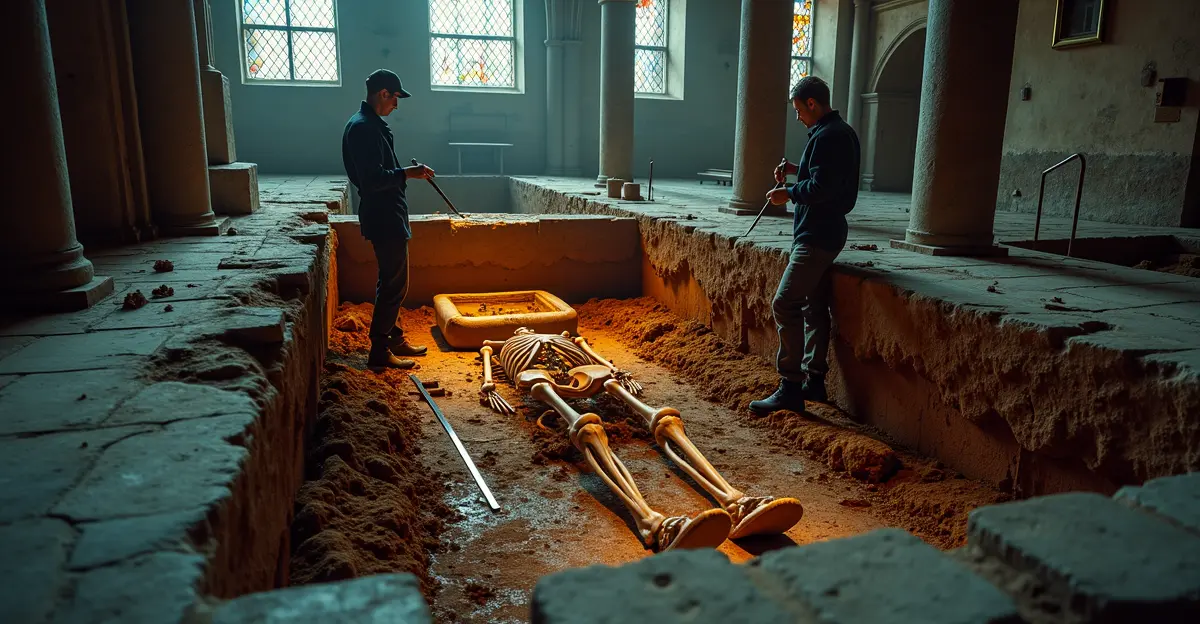
Beneath the square, archaeologists have identified layered remains: medieval house cellars from the time of the cathedral's construction (12th–13th centuries), grain storage pits from the Merovingian and Carolingian periods (6th–10th centuries), and a dense Roman residential quarter from the 4th–5th centuries. A Roman doorstep, later repurposed as paving stone, was also found. The team is now hoping to dig even deeper, toward the Gaulish period — the Parisii tribe, a Celtic-Gallic people, settled on the Île de la Cité around 300 BC and gave the city its name.
These findings align with earlier excavations inside the cathedral after the 2019 fire, which uncovered a 14th-century lead sarcophagus, fragments of the medieval rood screen with original paint, and Roman-era foundations. Experts in preventive archaeology in France note that such digs are crucial before major urban works.
Impact and Implications
The excavation offers a rare, tangible connection to Paris's layered history. "It's a rare opportunity to make the history of Paris tangible," said Lucie Altenburg, curator at the archaeological service of Paris. A tourist from Manchester remarked: "It brings Notre-Dame to life again. You come for the cathedral and then you realize there's another city beneath your feet."
The artifacts are being sent to an archaeological center in northern Paris for further analysis, including carbon dating and conservation. The dig is expected to continue for several more months, with the possibility of reaching Gaulish-era deposits that have never been systematically studied on the Île de la Cité. The project highlights how climate adaptation urban projects can inadvertently unlock historical treasures.
FAQ
Why are archaeologists digging under Notre-Dame?
The dig is a preventive archaeological excavation required before the City of Paris renovates the forecourt into a greener, cooler public space. The project was prompted by the need to adapt the square to hotter summers caused by climate change.
What have archaeologists found so far?
Finds include a 4th-century Roman coin with Emperor Constantine's image, complete medieval ceramic vessels, pottery with mysterious red markings, Roman building remains, and medieval house cellars. The artifacts span nearly 2,000 years of history.
How deep are they digging?
Archaeologists have already reached 4 meters (13 feet) below the current surface. They hope to dig deeper to reach traces of the Gaulish Parisii tribe from around 300 BC.
When will the new square be finished?
The renovated square, featuring trees, shade structures, and a thin water layer for cooling, is expected to be completed by 2028.
What happens to the artifacts?
All discovered objects are sent to an archaeological conservation center in northern Paris for cleaning, analysis, carbon dating, and eventual display or storage in museum collections.

Follow Discussion