


 Deutsch
 English
 Español
 Français
 Nederlands
 Português


 Share
Share




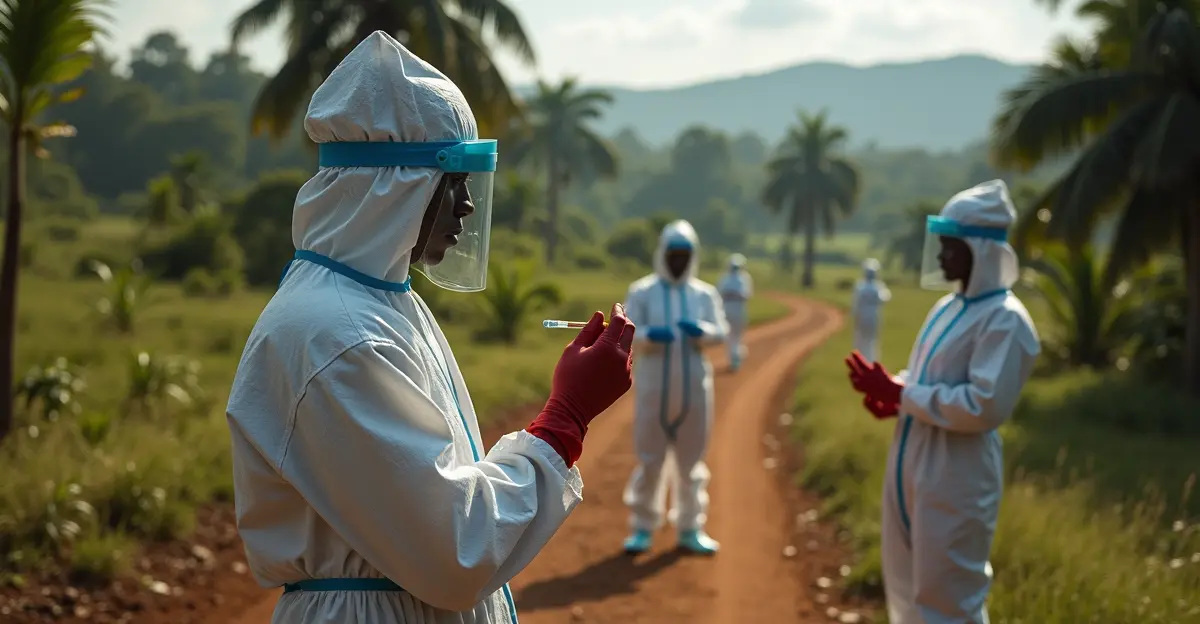
The death toll from the Ebola outbreak in the Democratic Republic of the Congo (DRC) has skyrocketed to 1,709 in just two weeks, making it the fastest-growing Ebola epidemic on record. Health authorities confirmed on 4 August 2026 that the number of infections has also surged from 2,473 to 3,823, with a case fatality rate of 44.7 percent. The outbreak, caused by the rare Bundibugyo ebolavirus, has now spread to five provinces and crossed into neighbouring Uganda, prompting the World Health Organization (WHO) to declare a Public Health Emergency of International Concern (PHEIC) on 16 May 2026.
The Bundibugyo Variant: A New and Dangerous Challenge
Unlike previous Ebola outbreaks in the DRC — including the 2018–2020 Ebola epidemic in North Kivu — which were driven by the Zaire ebolavirus, the current crisis is caused by the Bundibugyo variant (BDBV). This strain was first identified in Uganda in 2007, and it remains poorly understood. Crucially, there are currently no approved vaccines or specific treatments for BDBV. Existing vaccines such as ERVEBO, which proved effective against the Zaire strain, do not offer reliable cross-protection against Bundibugyo.
“We are essentially fighting this outbreak with the tools of the 20th century — isolation, contact tracing, and supportive care,” said Dr. Jean-Jacques Muyembe, director of the DRC’s National Institute for Biomedical Research. “The virus is exploiting every gap in our defences.”
The WHO reports that candidate vaccines and experimental therapies are being fast-tracked, with the first diagnostic test for Bundibugyo added to its Emergency Use Listing on 2 July 2026. Clinical trials for potential treatments have also begun enrolling patients in the affected zones, but results are not expected before October.
Why Is This Outbreak Spreading So Fast?
This outbreak has outpaced all previous Ebola epidemics in terms of speed. It took just 40 days to surpass 1,000 confirmed cases — compared to 235 days during the 2018 outbreak. Several factors are fuelling the crisis.
Armed Conflict and Mass Displacement
The epicentre is in Ituri province, where 90 percent of cases have been recorded. This region has been plagued by armed conflict and insecurity in eastern Congo for decades. Ongoing violence between armed groups has displaced hundreds of thousands of people, making contact tracing and source identification nearly impossible.
“When entire villages flee overnight, our surveillance teams lose the thread,” explained Dr. Matshidiso Moeti, WHO Regional Director for Africa. “We don’t know where the first patient was infected, and that hampers everything.”
Healthcare Worker Strikes
In July 2026, health workers at several Ebola treatment centres in Ituri went on strike over unpaid wages. The walkouts disrupted patient care at the height of the outbreak, leaving dozens of confirmed cases without medical attention for days. Local health authorities eventually negotiated a temporary settlement, but the strikes underscored the fragile conditions under which frontline workers operate.
Cultural Barriers and Misinformation
Many patients continue to seek help from traditional healers rather than reporting to official health facilities. Combined with widespread misinformation about the disease and resistance to safe burial practices, community engagement remains a critical bottleneck. The WHO has repeatedly emphasized that without community trust, containment will fail.
Global Response and the Vaccine Race
The international community has mobilised significant resources. The WHO, Africa CDC, and partners such as Médecins Sans Frontières emergency response teams have deployed hundreds of staff to the region. The U.S. Centers for Disease Control and Prevention (CDC) has roughly 400 personnel involved, including over 120 deployed in the field. A joint continental preparedness and response plan covering June to November 2026 has been launched, focusing on surveillance, laboratory strengthening, and cross-border coordination.
However, the absence of a proven vaccine continues to hinder efforts. Researchers are investigating whether existing Zaire-targeting vaccines might offer partial protection, but early data is inconclusive. The WHO has urged accelerated research, warning that the window for containing the outbreak is narrowing.
Uganda: A Glimmer of Hope
On 28 July 2026, Uganda declared itself Ebola-free after recording only 20 cases and 2 deaths, with no community transmission. Swift action by Ugandan health authorities — including immediate isolation, rigorous contact tracing, and cross-border screening — prevented the virus from gaining a foothold. Uganda’s experience demonstrates that rapid, coordinated public health measures can contain Bundibugyo even without a vaccine.
Frequently Asked Questions
What is the Bundibugyo variant of Ebola?
Bundibugyo ebolavirus (BDBV) is one of four Ebola virus species known to cause disease in humans. It was first discovered in Uganda in 2007 and is distinct from the more common Zaire ebolavirus. No licensed vaccines or treatments currently exist for BDBV.
How does Ebola spread?
Ebola is transmitted through direct contact with the bodily fluids of an infected person or contaminated surfaces and materials. It is not airborne. Traditional burial practices, where mourners touch the body, have historically been a major driver of transmission.
Why is this outbreak spreading faster than previous ones?
The combination of armed conflict, population displacement, healthcare worker strikes, community distrust, and the lack of a vaccine for the Bundibugyo strain has created a perfect storm, allowing the virus to spread at an unprecedented pace.
Is there a vaccine for this Ebola outbreak?
Not yet. Existing Ebola vaccines target the Zaire species and are not proven to protect against Bundibugyo. Experimental vaccines are in development, and clinical trials are underway, but none are yet approved for emergency use.
What is the global risk?
The WHO assesses the risk as “very high” for the DRC and “high” for Uganda. The risk of international spread remains low, but countries have been urged to strengthen surveillance and preparedness.

Follow Discussion