


 Deutsch
 English
 Español
 Français
 Nederlands
 Português


 Share
Share




In February 2026, the United States hosted the largest diplomatic gathering ever convened on critical minerals, bringing together 54 nations and the European Commission for the inaugural Critical Minerals Ministerial in Washington, D.C. The summit launched the Forum on Resource Geostrategic Engagement (FORGE), a plurilateral coalition designed to reduce dependence on China, which controls nearly 90% of global rare earth processing capacity. Yet even as Western leaders announced over $30 billion in mobilized investments, Beijing simultaneously tightened export controls on rare earths and antimony, triggering sixfold price spikes outside China and exposing a strategic vulnerability that analysts warn could take 20 to 30 years to resolve. The critical minerals race has become the defining geoeconomic fault line of 2026.
China's Processing Monopoly: A Three-Decade Strategy
China's dominance in critical minerals did not happen by accident. Over three decades of deliberate industrial policy—including state subsidies, technology acquisition, and strategic stockpiling—have given Beijing control over 90% of rare earth processing, 80% of tungsten refining, and 60% of antimony processing. According to a multi-institutional analysis published in early 2026, China's 2025-2026 export controls have transformed critical minerals from market commodities into strategically controlled assets under national security frameworks. The controls began with indium in February 2025, expanded to seven heavy rare earth elements in April 2025, and extended to processing technology and technical know-how by October 2025. Unlike reversible tariffs, these licensing regimes create permanent bureaucratic dependencies. European firms now face approval rates below 25% for export licenses, while over 80% of European companies depend on Chinese supply chains for minerals essential to defense, electric vehicles, and renewable energy.
The 2026 Critical Minerals Ministerial and FORGE Initiative
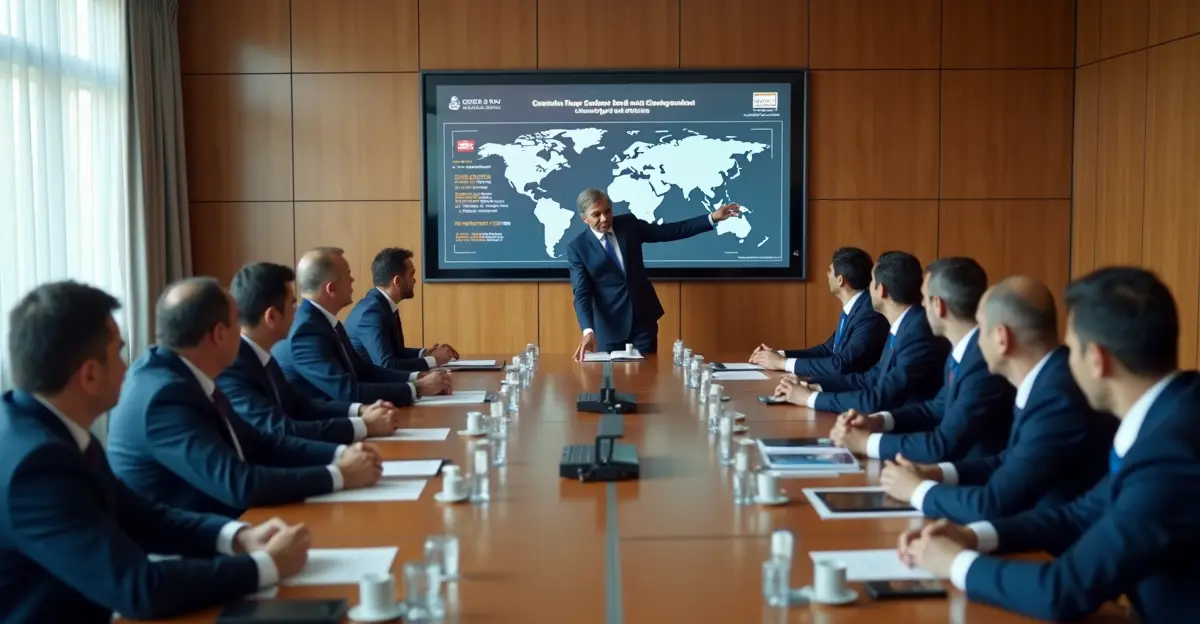
The February 2026 summit marked a turning point in Western strategy. Secretary of State Marco Rubio and Vice President JD Vance convened representatives from 54 nations to launch FORGE, which succeeds the Biden-era Minerals Security Partnership. South Korea was named inaugural chair. The U.S. signed 11 new bilateral agreements with countries including Argentina, Morocco, the Philippines, and Uzbekistan. Vice President Vance proposed a preferential trade zone with enforceable price floors for critical minerals. The administration also announced Project Vault, a $12 billion domestic strategic reserve combining $2 billion in private capital with a $10 billion Export-Import Bank loan—the largest financing in the agency's history. Project Vault will stockpile all 60 U.S. Geological Survey-listed critical minerals, including rare earth elements, cobalt, and copper, acting as a buffer against supply disruptions. The FORGE initiative represents the most ambitious Western attempt to date to build alternative supply chains.
Why Diversification Could Take Decades
Despite the diplomatic fanfare and financial commitments, analysts warn that rebuilding independent processing capacity is a generational challenge. Building new processing facilities takes a minimum of 12 to 18 months for initial capacity, with full-scale production requiring 5 to 7 years. However, the deeper problem is the loss of technical expertise. China has accumulated decades of specialized knowledge in rare earth separation and refining—a skill set that cannot be replicated quickly. A comprehensive report from the Rare Earth Exchanges analysis notes that rebuilding independent supply chains could take 20 to 30 years, far exceeding the current geopolitical window. NATO warns that defense stockpiles are sufficient for only 6 to 9 months of high-intensity conflict, while price spikes have added an estimated $500 to each electric vehicle produced outside China. The Western diversification efforts face a narrowing 12- to 18-month window before vulnerability becomes permanent.
China's Reversible Export Restrictions as a Strategic Tool
Beijing's strategy is more sophisticated than simple supply denial. By using temporary, reversible export restrictions, China maintains pricing power and extracts strategic concessions without triggering full decoupling. The controls are designed to discourage Western investment in alternative supply chains by creating uncertainty about future availability. When prices spike, Western companies face immediate production disruptions; when restrictions are temporarily eased, the urgency for diversification fades. This pattern of "weaponizing control rather than scarcity" has been documented by multiple analysts. The World Economic Forum's Global Risks Report 2026 ranks geoeconomic confrontation as the top short-term risk, surpassing state-based armed conflict. Half of the over 1,300 global leaders surveyed expect 2026 to be "turbulent" or "stormy," with 68% believing the global political environment will become more fragmented over the next decade. The geoeconomic confrontation risk is now the central strategic challenge for Western policymakers.
Impact on Defense, Technology, and Green Energy
The consequences of China's critical minerals leverage are felt across multiple sectors. In aerospace, rare earths are essential for jet engine coatings and precision-guided munitions. In semiconductors, they are used in chip manufacturing and AI infrastructure. In green energy, rare earth magnets are critical for wind turbines and electric vehicle motors. The U.S. Department of Defense has identified critical minerals as a national security priority, but current stockpiles are inadequate. The price spikes triggered by China's 2026 export controls have already disrupted production schedules for major defense contractors and automakers. European companies, which depend even more heavily on Chinese supply chains, face particularly acute vulnerabilities. The critical minerals supply chain has become the Achilles' heel of the Western industrial base.
Expert Perspectives
"China is not trying to cut off supply entirely—that would trigger a decisive Western response. Instead, they are using calibrated, reversible restrictions to maintain leverage and extract concessions without provoking full decoupling," said Dr. Emily Chen, a geoeconomics fellow at the Center for Strategic and International Studies. "The 12- to 18-month window is real. If Western nations do not make irreversible investments in processing capacity by mid-2027, China's dominance will become effectively permanent."
"Project Vault and FORGE are important first steps, but they are not enough," added retired General James Mattis, former U.S. Secretary of Defense. "We need a wartime-level mobilization of resources and expertise. The current pace of investment will not close the gap with China's three-decade head start."
FAQ
What is the Critical Minerals Trap?
The Critical Minerals Trap refers to the strategic vulnerability created by China's near-total control over global processing capacity for rare earths, tungsten, antimony, and other minerals essential for defense, technology, and green energy. Western nations are trapped because building alternative processing capacity would take decades, while continued dependence on China exposes them to geopolitical leverage.
What is the FORGE initiative?
FORGE (Forum on Resource Geostrategic Engagement) is a plurilateral coalition launched at the February 2026 Critical Minerals Ministerial. It succeeds the Minerals Security Partnership and aims to establish a U.S.-led preferential trade zone for critical minerals with enforceable price floors. South Korea serves as its inaugural chair.
How much has the West committed to critical minerals diversification?
Western governments have mobilized over $30 billion in investments, including Project Vault's $12 billion domestic strategic reserve. However, analysts estimate that rebuilding independent processing capacity will require hundreds of billions more over the next two decades.
Why can't Western nations quickly build processing capacity?
Building rare earth processing facilities requires specialized technical expertise that China has accumulated over 30 years. New facilities take 12-18 months for initial capacity and 5-7 years for full production, while the broader ecosystem of skilled workers, supply chains, and regulatory frameworks takes decades to develop.
What are the consequences of inaction?
If Western nations fail to build alternative processing capacity within the next 12-18 months, China's dominance will become effectively permanent. This would leave NATO defense stockpiles vulnerable (sufficient for only 6-9 months of high-intensity conflict), add hundreds of dollars to each EV produced outside China, and cede strategic control over the technologies of the 21st century.
Conclusion
The critical minerals race is the defining geoeconomic fault line of 2026. China's three-decade head start in processing capacity, combined with its sophisticated use of reversible export restrictions, has created a strategic trap for the West. While the 54-nation Critical Minerals Ministerial and the FORGE initiative represent important diplomatic and financial commitments, the gap between ambition and execution remains vast. The next 12 to 18 months will determine whether Western nations can break free from dependence on Chinese processing or accept a future of permanent strategic vulnerability. As the WEF Global Risks Report 2026 makes clear, geoeconomic confrontation is no longer a future risk—it is the present reality.




Follow Discussion