


 Deutsch
 English
 Español
 Français
 Nederlands
 Português


 Share
Share




The explosive growth of artificial intelligence is reshaping global energy and resource markets, with AI data centers projected to consume nearly 1,000 terawatt-hours (TWh) of electricity by 2026 — equivalent to the entire power demand of Japan. This insatiable appetite for compute is triggering a massive surge in demand for critical minerals, including copper, rare earth elements, lithium, and nickel, which are essential for grid infrastructure, cooling systems, backup power, and semiconductor manufacturing. The resulting demand collision — between AI compute expansion, electric vehicle (EV) production, and military modernization — is intensifying the US-China rivalry over mineral supply chains, with Beijing reinforcing its dominance through its 15th Five-Year Plan while Washington pursues bilateral deals and domestic stockpiles. The strategic question is whether the world can secure enough mineral supply to power both the digital and green transitions simultaneously without triggering new resource conflicts.
AI Data Centers: A New Frontier for Mineral Demand
The International Energy Agency (IEA) projects that global electricity generation to supply data centers will grow from 460 TWh in 2024 to over 1,000 TWh by 2030, with some estimates reaching that threshold as early as 2026. This surge is driven largely by AI training and inference workloads, which require massive parallel processing capabilities. According to S&P Global, copper demand from data centers is forecast to rise from 1.1 million metric tons in 2025 to 2.5 million metric tons by 2040, with AI-related copper demand accounting for 58% of total data center copper use by 2030. A typical data center uses 27 metric tons of copper per megawatt of capacity, and AI facilities are even more power-hungry due to higher density computing.
The critical minerals supply chain faces unprecedented strain. Copper prices hit record highs in early 2026, with LME contracts above $14,000 per ton and US spot prices near $6.35 per pound — up 47% year-over-year. Analysts project a global refined copper deficit of 300,000 to 850,000 tons in 2026 alone, as mines take 10 to 15 years to develop and ore grades continue to decline.
The Demand Collision: AI, EVs, and Defense
The competition for critical minerals is not limited to AI. J.P. Morgan identifies three key demand drivers: AI and data centers (projected to account for nearly 9% of US electricity demand by 2035), the global energy transition (with COP28 commitments to triple renewable capacity by 2030), and increased defense spending. Lithium demand is forecast to grow 16% year-over-year in 2026, with 58% from EVs and 30% from energy storage systems. EVs use four times more copper than traditional internal combustion engine vehicles, while each F-35 fighter jet requires approximately 920 pounds of rare earth elements.
This US-China rivalry over critical minerals has created a zero-sum dynamic. The US Department of Defense has classified rare earth elements as critical to national security, while China has used its processing dominance as a geopolitical lever. In April 2025, Beijing imposed new export licensing requirements on seven rare earth elements — samarium, gadolinium, terbium, dysprosium, lutetium, scandium, and yttrium — and later expanded controls to include holmium, erbium, thulium, europium, and ytterbium, along with refining technologies. These measures, effective through late 2026, sent shockwaves through global supply chains.
China's 15th Five-Year Plan: Doubling Down on Dominance
China's 15th Five-Year Plan (2026–2030) signals a strategic shift in energy, metals, and critical minerals policy. The plan emphasizes strengthening domestic production capabilities, reducing dependency on foreign sources, and achieving greater self-sufficiency. Beijing aims to maintain its stranglehold on processing: China currently controls approximately 90% of global rare earth refining capacity and about 60% of mining production. A 2026 policy study led by the Griffith Asia Institute concludes that China's dominance in rare earth processing is "strategic, durable, and still deepening" — the product of a coordinated national strategy spanning over three decades.
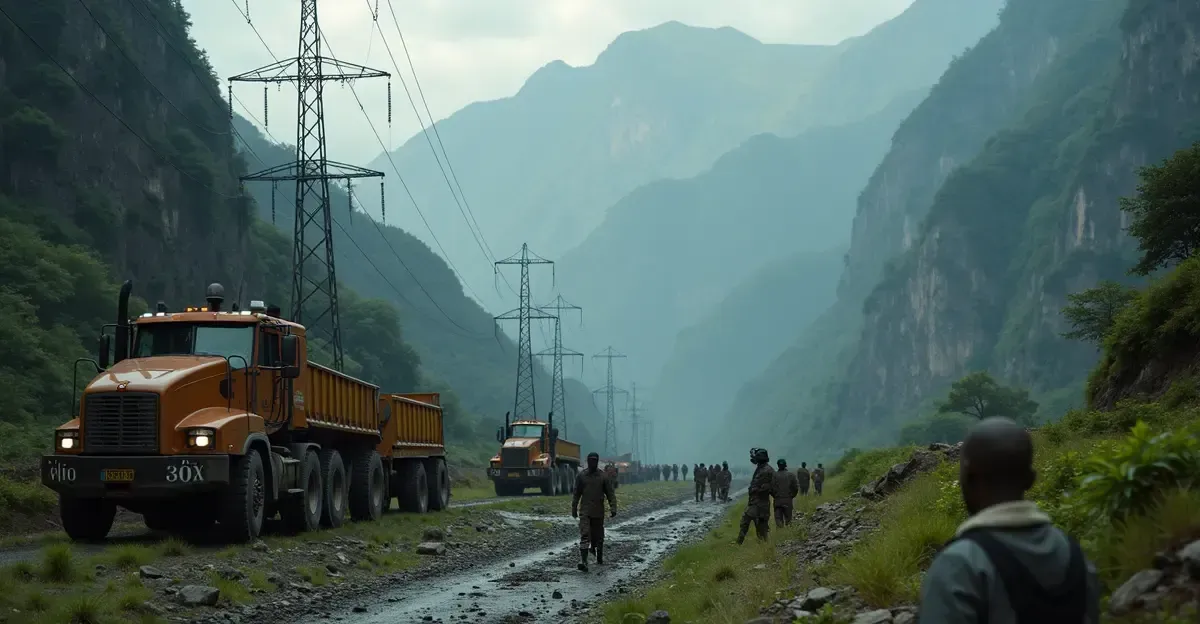
The plan also focuses on enhancing market stability, securing raw material supplies, and strengthening China's influence over global commodity pricing. Chinese companies control significant shares of Indonesian nickel production (80%) and Democratic Republic of Congo cobalt output, further entrenching Beijing's grip on the critical mineral supply chain geopolitics.
Washington's Response: FORGE and Project Vault
On February 4, 2026, the US Department of State hosted the 2026 Critical Minerals Ministerial, led by Secretary of State Marco Rubio and Vice President JD Vance, with representatives from 54 countries and the European Commission. The centerpiece of the event was the launch of FORGE (Forum on Resource Geostrategic Engagement), a plurilateral coalition designed to create a preferential trade-and-investment zone for critical minerals with coordinated price floors to counter adversarial market manipulation. FORGE, chaired by the Republic of Korea, succeeds the Minerals Security Partnership and aims to link 21 bilateral framework agreements signed in five months — including deals with Argentina, Morocco, Peru, the Philippines, the UAE, and the UK — into a system covering two-thirds of the global economy.
The US has mobilized over $30 billion in letters of interest, investments, and loans for critical mineral projects. President Trump announced Project Vault, a $10 billion Export-Import Bank initiative to establish a domestic strategic reserve for critical minerals. Additionally, the Pax Silica public-private partnership ($250 million) targets semiconductor supply chain resilience. However, challenges remain: US mines take an average of 29 years to open due to permitting hurdles, and domestic processing capacity is virtually nonexistent for many minerals.
Can Supply Keep Pace?
The scale of the challenge is immense. Goldman Sachs forecasts a 126 GW global power demand surge through 2028, with a 49 GW shortfall expected in the US alone. Transformer lead times of 2 to 4 years and rising electricity costs (up 42% since 2019) compound the problem. Communities are pushing back — AEP Ohio has frozen new data center interconnections, and towns across multiple states are demanding tech companies fund their own power infrastructure.
Big Tech is turning to nuclear energy: Microsoft is restarting Three Mile Island Unit 1 (835 MW), while Amazon, Google, and Oracle are investing in small modular reactors (SMRs), though none are commercially operational yet. Battery storage is emerging as a key solution, with the US Inflation Reduction Act targeting 100 GW of battery storage deployments by 2030. However, lithium-ion batteries themselves require critical minerals, creating a circular demand problem.
Experts suggest that leapfrogging through disruptive recycling technologies may be more viable than trying to out-mine China. The critical minerals recycling and circular economy could reduce primary demand by up to 30% by 2040, according to some estimates, but scaling these technologies remains a challenge.
Expert Perspectives
"The AI boom is creating a new wave of demand for critical minerals that is colliding with the green transition and military modernization," says Christoph Nedopil, lead author of the Griffith Asia Institute study on China's rare earth dominance. "China's control is not accidental or temporary — it's the result of a 30-year strategic plan. The West cannot simply out-mine China; it needs to invest in processing and recycling at scale."
"FORGE represents a paradigm shift in US critical minerals policy," notes a senior Atlantic Council analyst. "By creating a preferential trade zone with price floors, the US is moving from project-by-project financing to a systemic approach that can counter China's market manipulation."
FAQ
What are critical minerals?
Critical minerals are raw materials designated by governments as essential for national economies and security, with vulnerable supply chains. They include rare earth elements, copper, lithium, cobalt, nickel, and others needed for AI infrastructure, EVs, renewable energy, and defense technologies.
Why does AI increase demand for critical minerals?
AI data centers require massive amounts of electricity, which demands copper for wiring, transformers, and cooling systems, as well as rare earths for magnets in backup generators and grid components. A typical data center uses 27 metric tons of copper per megawatt of capacity.
How much does China control critical mineral processing?
China controls approximately 90% of global rare earth refining capacity and about 60% of mining production. It also dominates processing of lithium, cobalt, and graphite, with over 80% market share in synthetic graphite and rare earths expected through 2030.
What is FORGE?
FORGE (Forum on Resource Geostrategic Engagement) is a US-led plurilateral coalition launched in February 2026 to create a preferential trade-and-investment zone for critical minerals. It includes 21 bilateral framework agreements and aims to cover two-thirds of the global economy with coordinated price floors.
Can the world meet both AI and green energy mineral demand?
Analysts warn of structural deficits in copper, rare earths, and lithium through 2030. Meeting demand will require massive investment in new mines (10-15 year lead times), recycling technologies, and alternative materials. Without action, supply constraints could slow both the AI and green transitions.
Conclusion: A Defining Resource Geopolitics Story
The competition for critical minerals has become the defining resource geopolitics story of 2026. With AI data center electricity demand soaring, the US hosting its Critical Minerals Ministerial, and China doubling down on processing control through its 15th Five-Year Plan, the world faces a stark choice: invest aggressively in diversified supply chains and recycling infrastructure, or risk resource conflicts that could derail both the digital and green transitions. The next five years will determine whether the global economy can power its future without being held hostage by mineral scarcity.


Follow Discussion