


 Deutsch
 English
 Español
 Français
 Nederlands
 Português


 Share
Share




Western Europe has just endured its hottest combined June and July since measurements began, according to data released today by the EU’s Copernicus Climate Change Service. The two-month average temperature reached 21.62°C — a staggering 2.79°C above the 1991–2020 baseline — shattering the previous record set in 2022. The milestone comes as the region grapples with four distinct heatwaves since May, prolonged drought, and a cascade of impacts ranging from catastrophic wildfires to crippled river transport.
A summer of relentless heat
The June–July record did not come as a surprise to climate scientists, who had already flagged June 2026 as the hottest June on record for western Europe. The June 2026 European heatwave broke national records in France, England, Ireland, and Belgium, with Paris reaching 40.9°C and the French Landes region hitting 44.3°C. July brought two additional heatwaves, though they were less intense than the late-June event. Nevertheless, the cumulative effect kept average temperatures elevated across virtually the entire region.
“July 2026 was the third consecutive month with exceptional heat in western Europe, with the combined June–July temperatures marking a new record for the region,” said Dr Samantha Burgess, Deputy Director of the Copernicus Climate Change Service. “This period is a clear example of how climate change is intensifying extreme heat and drought.”
Drought and rivers at historic lows
The heat was accompanied by exceptionally low rainfall. According to the Copernicus Emergency Management Service, most European rivers recorded well-below-average discharge in July. The Rhine at the Kaub chokepoint — a critical gauge for commercial shipping — dropped to just 9 inches, forcing cargo vessels to reduce loads by up to 80%. The Danube fell to 4 inches at Budapest, shattering the 2018 record and forcing Hungary’s Paks nuclear plant to operate at roughly 10% capacity. In Romania, authorities resorted to blasting river rocks to divert water toward the Cernavodă nuclear reactor.
The drought affecting European rivers has disrupted supply chains, energy production, and irrigation across the continent. France, Spain, Germany, and the United Kingdom all reported severe agricultural stress, with June grain losses alone estimated at €2 billion. Two Polish coal-fired power plants were forced to shut down due to insufficient cooling water, while low flows on the Seine complicated navigation and water management in the Paris basin.
Wildfires unprecedented in scale
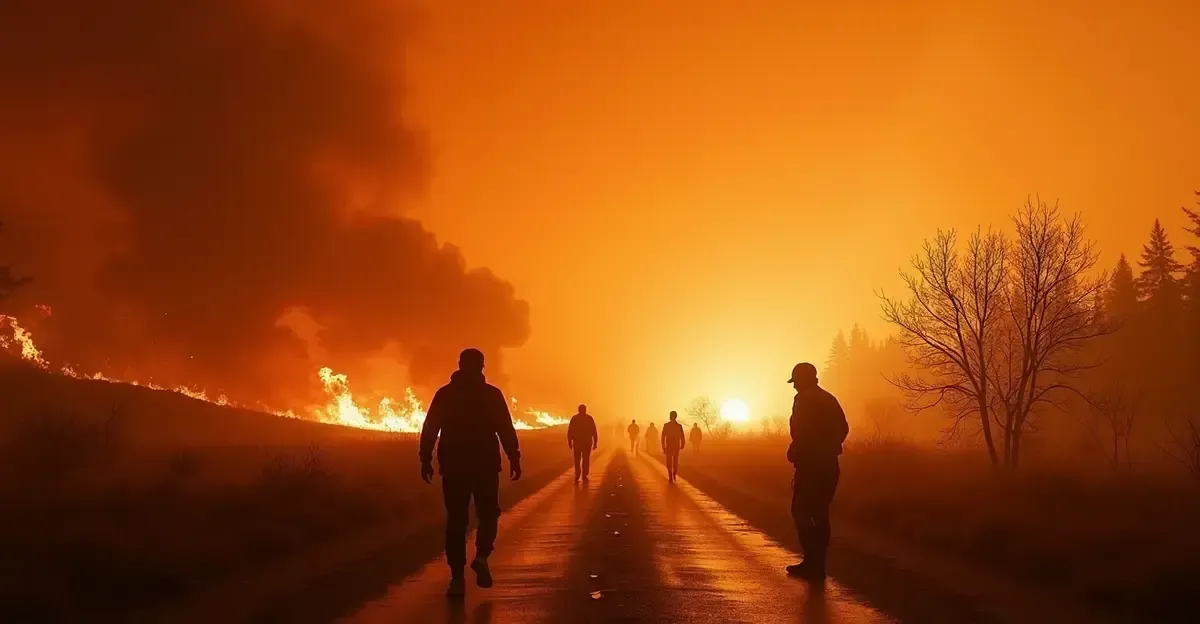
Hot and dry conditions created a tinderbox across southern Europe. By the end of July, France had burned more than 116,000 hectares — an absolute record surpassing the devastating 2022 season. Spain’s merged fires west of Madrid consumed over 6,000 hectares, triggering the evacuation of some 63,000 people. Across both countries, more than 300,000 residents were displaced in what officials described as France’s largest peacetime evacuation since World War II.
“Climate change is causing increasingly frequent hot and dry conditions that favor large and intense wildfires in southern Europe,” explained Dr Laurence Rouil, Director of the Copernicus Atmosphere Monitoring Service. “At the same time, the fire season is expanding northwards.”
The human toll has been severe. Preliminary estimates suggest the June heatwave alone caused thousands of excess deaths across Europe — with one study calculating 20,390 heat-related fatalities during the week of 22–28 June. The World Health Organization confirmed more than 1,300 excess deaths in the first week of the event, but the final toll is expected to be far higher once all-cause mortality data are fully analyzed. Only about 20% of European homes have air conditioning, leaving vulnerable populations — particularly the elderly — at heightened risk.
Oceans and the El Niño factor
The extreme continental heat was mirrored at sea. The average sea-surface temperature for oceans outside the polar regions hit 20.96°C in July — the highest July value on record. The Mediterranean, which has been in a near-continuous marine heatwave since early 2025, saw 80% of its basin under strong, severe, or extreme marine heatwave conditions in the first half of the year. The North Sea, too, set a new July benchmark at 20.4°C off the Dutch coast, where a marine heatwave persisted from late May.
The developing El Niño climate pattern is adding further heat to an already warmed system. El Niño, characterized by unusually warm waters in the central and eastern tropical Pacific, tends to boost global temperatures and disrupt weather patterns worldwide. Scientists warn that its superposition on long-term ocean warming driven by greenhouse gas emissions could push 2026 or early 2027 into record-breaking territory for global mean temperature.
Frequently asked questions
Why was June–July 2026 so hot in western Europe?
A persistent high-pressure system, often referred to as a heat dome, settled over the region repeatedly since May. Combined with very dry soils — which prevent cooling through evaporation — and background warming from climate change, this pattern produced the hottest June–July period on record. Copernicus data show the two-month average was 2.79°C above the 1991–2020 norm.
How does this compare to previous European heatwaves?
The previous June–July record was set in 2022. While the 2022 summer also featured severe heat and drought, the 2026 event broke that record by a significant margin and included a more intense early-season heatwave in June. The World Weather Attribution group concluded that the June 2026 heatwave was “virtually impossible” without human-caused climate change.
What are the economic impacts of the drought?
Low river levels on the Rhine and Danube have disrupted shipping, raised freight costs, and forced power plants to reduce output. Agricultural losses are estimated in the billions of euros, and wildfire suppression costs are mounting. The cumulative economic impact is expected to run into tens of billions of euros, with ripple effects on food prices and energy security.
Is climate change making European summers permanently hotter?
Europe is the fastest-warming continent, heating at roughly twice the global average. While individual summers will still vary, the trend is unmistakable: the five hottest summers in Europe since 1500 have all occurred in the 21st century. Adaptation measures — such as expanding air conditioning, greening cities, and updating infrastructure — are becoming urgent priorities for governments across the region.





Follow Discussion