


 Deutsch
 English
 Español
 Français
 Nederlands
 Português


 Share
Share




COP29 Climate Finance: How $300 Billion Deal Reshapes Global Power Dynamics
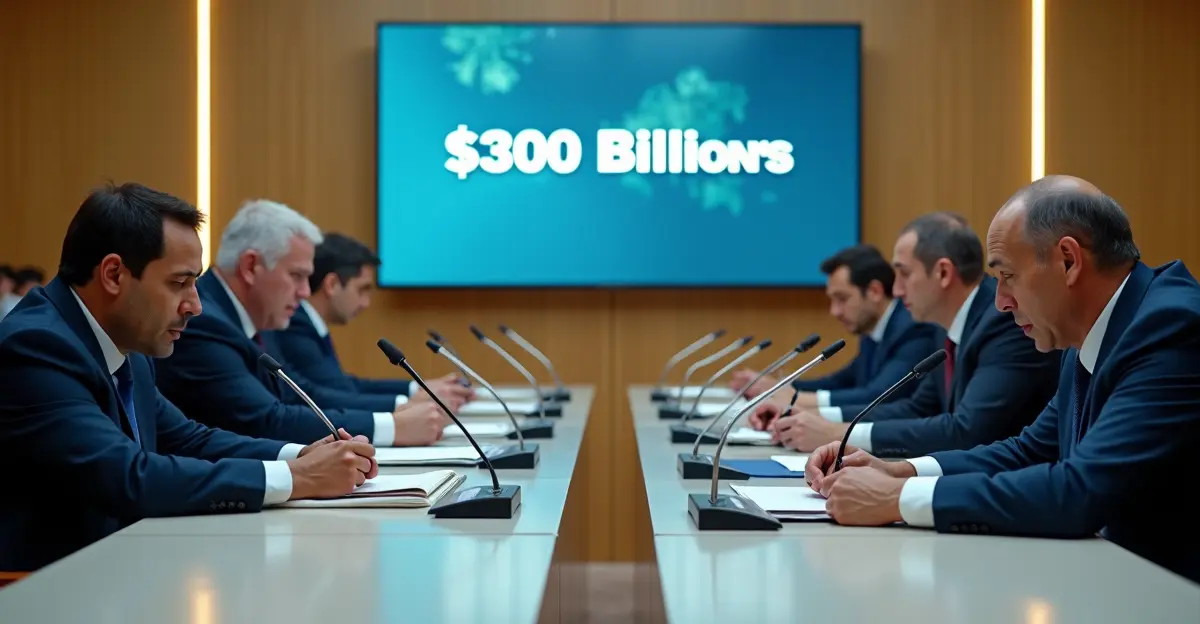
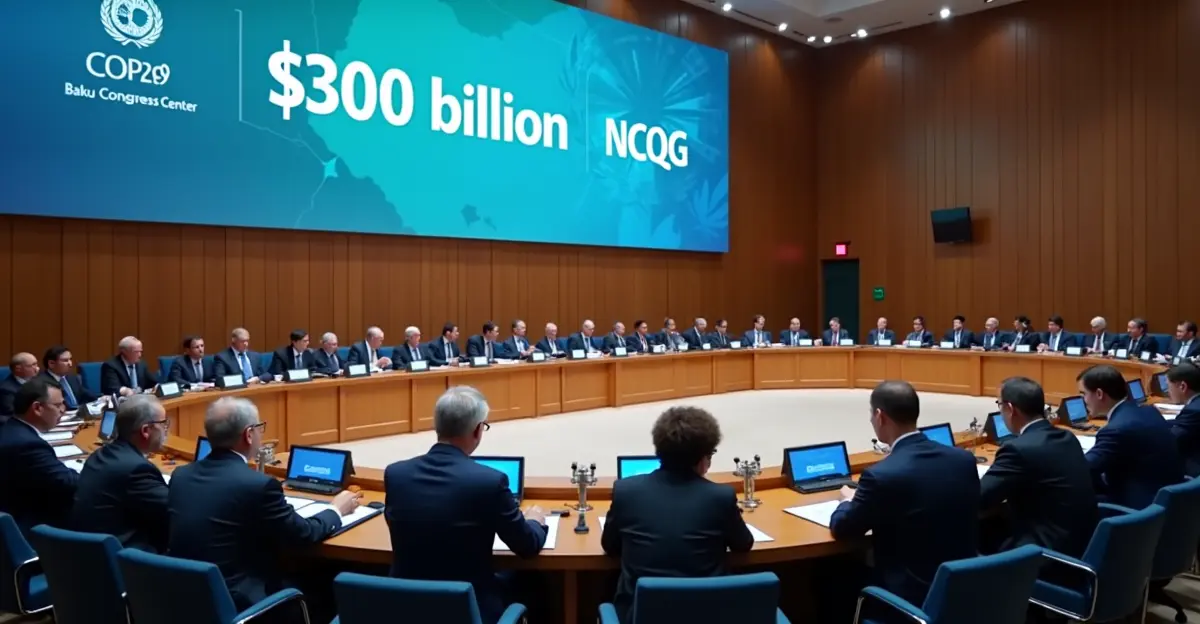
The landmark COP29 agreement to provide at least $300 billion annually in climate finance to developing countries by 2035 represents more than just environmental policy—it's a fundamental restructuring of global power dynamics that will reshape economic dependencies and strategic alliances for decades to come. Concluded in November 2024 in Baku, Azerbaijan, this historic climate finance deal establishes the first new collective quantified goal in fifteen years, creating immediate strategic implications for global climate diplomacy and economic relationships that will shape the next decade of environmental policy.
What is the COP29 Climate Finance Agreement?
The COP29 agreement establishes a New Collective Quantified Goal (NCQG) requiring developed nations to provide at least $300 billion annually to developing countries by 2035, with a broader aspiration to mobilize $1.3 trillion in total international climate finance. This represents a tripling from the previous $100 billion target and marks the first major climate finance framework established since the 2009 Copenhagen Accord. The agreement operates alongside the 'Baku to Belém Roadmap to 1.3T'—a comprehensive blueprint developed by Azerbaijan's COP29 President Mukhtar Babayev and Brazil's COP30 President André Corrêa do Lago to scale up all sources of climate finance.
According to World Resources Institute analysis, while the $300 billion target falls short of developing countries' estimated $1.46 trillion annual needs by 2030, it represents a crucial 'downpayment toward a safer, more equitable future.' The agreement recognizes that developed countries must take the lead while encouraging voluntary contributions from developing nations, creating a framework that acknowledges historical responsibility while establishing new financial architecture.
The Baku to Belém Roadmap: Creating New Leverage Points
The 'Baku to Belém Roadmap' represents a sophisticated geopolitical instrument that creates multiple leverage points in international relations. This framework outlines five priority action areas (5Rs) that will fundamentally reshape how climate finance flows between nations:
- Replenishing grants and concessional finance: Establishing new funding mechanisms with favorable terms for developing nations
- Rebalancing fiscal space and debt sustainability: Addressing the debt burdens that constrain climate investment
- Rechanneling private finance: Mobilizing private sector capital through innovative mechanisms
- Revamping capacity for climate portfolios: Building institutional capabilities in recipient countries
- Reshaping systems for equitable capital flows: Reforming global financial architecture
This roadmap effectively creates a new climate finance governance framework that gives developing countries unprecedented influence over how funds are allocated and managed. As noted in the official COP30 documentation, the plan includes 'practical early actions for 2026-2028 to kickstart implementation and build momentum,' creating immediate opportunities for strategic positioning.
Geopolitical Winners and Emerging Power Centers
The COP29 agreement creates distinct geopolitical winners and establishes new power centers in the global climate finance landscape. Resource-rich developing nations, particularly those in Africa and Latin America with significant renewable energy potential, stand to gain substantial influence through this financial architecture. Countries like Brazil, India, Indonesia, and South Africa—already influential in climate negotiations—will see their leverage increase as they become both recipients and potential contributors to climate finance.
The agreement also strengthens the position of multilateral development banks (MDBs), which are expected to contribute up to 80% of the $300 billion target. According to WRI analysis, MDBs have committed to $120 billion by 2030, positioning them as critical intermediaries in the new climate finance ecosystem. This creates a parallel power structure where financial institutions gain influence alongside traditional nation-states, similar to patterns observed during the 2008 financial crisis reforms.
Strategic Alliances and New Economic Dependencies
The $300 billion climate finance deal is fundamentally reshaping strategic alliances between developed and developing nations. Traditional donor-recipient relationships are being replaced by more complex partnerships where climate finance serves as both development assistance and strategic investment. Developed countries are using climate finance to secure access to critical minerals, renewable energy projects, and emerging markets, while developing nations are leveraging their climate vulnerability to negotiate better terms and greater autonomy.
This dynamic creates new economic dependencies that differ from traditional aid relationships. As noted in geopolitical analysis from 2025, 'climate policy has become a central instrument of global geopolitics, with nations using climate action as both moral and strategic leverage.' The COP29 agreement institutionalizes this trend, creating formal mechanisms for climate finance to serve geopolitical objectives.
Energy Transition Strategies in Resource-Rich Nations
For resource-rich developing nations, the COP29 agreement creates unprecedented opportunities to shape their energy transition strategies while maintaining economic sovereignty. Countries with significant fossil fuel reserves now have access to finance that can support diversification into renewable energy without sacrificing near-term revenue. This addresses a critical tension in climate diplomacy where nations like Azerbaijan—a major oil and gas producer that hosted COP29—face pressure to transition while managing economic realities.
The agreement's emphasis on 'just transitions' provides political cover for gradual shifts, allowing countries to balance climate commitments with development needs. This represents a significant departure from previous climate finance approaches that often imposed rigid conditions, reflecting the growing influence of developing countries in shaping the global energy transition framework.
Implications for Global Climate Diplomacy
The COP29 climate finance deal establishes a new paradigm in global climate diplomacy that will influence negotiations for years to come. By setting the $300 billion target as a floor rather than a ceiling, and linking it to the aspirational $1.3 trillion goal through the Baku to Belém Roadmap, the agreement creates continuous pressure for increased ambition. This dynamic ensures that climate finance remains central to all future climate negotiations, with each COP serving as a checkpoint for progress.
The agreement also institutionalizes the principle of 'common but differentiated responsibilities' in practical financial terms, addressing a long-standing demand from developing countries. As UNCTAD analysis notes, while the $300 billion target represents progress, 'actual needs could reach $1.46 trillion annually by 2030,' ensuring continued negotiation pressure. This creates a built-in escalation mechanism that will shape diplomatic relations through 2035 and beyond.
Expert Perspectives on the Geopolitical Shift
Climate finance experts recognize the profound geopolitical implications of the COP29 agreement. 'This isn't just about money—it's about power,' notes Dr. Elena Rodriguez, a climate diplomacy scholar at the London School of Economics. 'The $300 billion target creates new leverage points that developing countries can use to negotiate better terms across multiple policy areas, from trade to technology transfer.'
Similarly, former UN climate negotiator Kwame Asante observes: 'The Baku to Belém Roadmap represents the most sophisticated climate finance framework ever developed. It gives developing countries tools to hold developed nations accountable while creating space for South-South cooperation and alternative financing models.' This reflects a broader shift in global governance where climate finance serves as both carrot and stick in international relations.
Frequently Asked Questions
What is the difference between the $300 billion and $1.3 trillion climate finance targets?
The $300 billion represents the minimum annual commitment from developed to developing countries by 2035, while the $1.3 trillion is the aspirational total for all international climate finance mobilization including private investment and South-South cooperation.
How will the COP29 agreement affect developing countries' debt burdens?
The agreement includes specific provisions for 'rebalancing fiscal space and debt sustainability' through the Baku to Belém Roadmap, potentially offering debt relief or restructuring in exchange for climate investments.
Which countries stand to benefit most from the climate finance deal?
Climate-vulnerable developing nations with significant renewable energy potential, particularly in Africa, Latin America, and Southeast Asia, will gain substantial influence and resources through this financial architecture.
How does the agreement address concerns about 'green colonialism'?
The Baku to Belém Roadmap emphasizes country-led priorities and local capacity building, aiming to prevent climate finance from reinforcing dependency while promoting genuine partnership models.
What are the implications for COP30 in Brazil?
COP30 will focus on implementation and scaling, with Brazil positioned to champion developing country interests while building on the framework established at COP29, creating continuity in climate diplomacy.
Future Outlook and Strategic Considerations
The COP29 climate finance agreement establishes a new geopolitical reality where climate policy serves as both environmental imperative and strategic instrument. As implementation progresses through 2026-2028, nations will position themselves within this new financial architecture, forming alliances and negotiating terms that will shape global power dynamics for decades. The success of this framework will depend not only on meeting financial targets but on creating genuinely equitable partnerships that address both climate needs and development aspirations.
The agreement represents a watershed moment in global governance, where climate finance becomes a primary vehicle for international cooperation and competition. As countries navigate this new landscape, the principles established at COP29—particularly through the Baku to Belém Roadmap—will influence everything from energy security to economic development, creating a complex web of dependencies and opportunities that will define the coming decade of climate action and international relations.
Sources
World Resources Institute, UNFCCC, COP30 Brazil Presidency, UNCTAD, Carbon Brief, The Word 360, Reuters



Follow Discussion