


 Deutsch
 English
 Español
 Français
 Nederlands
 Português


 Share
Share




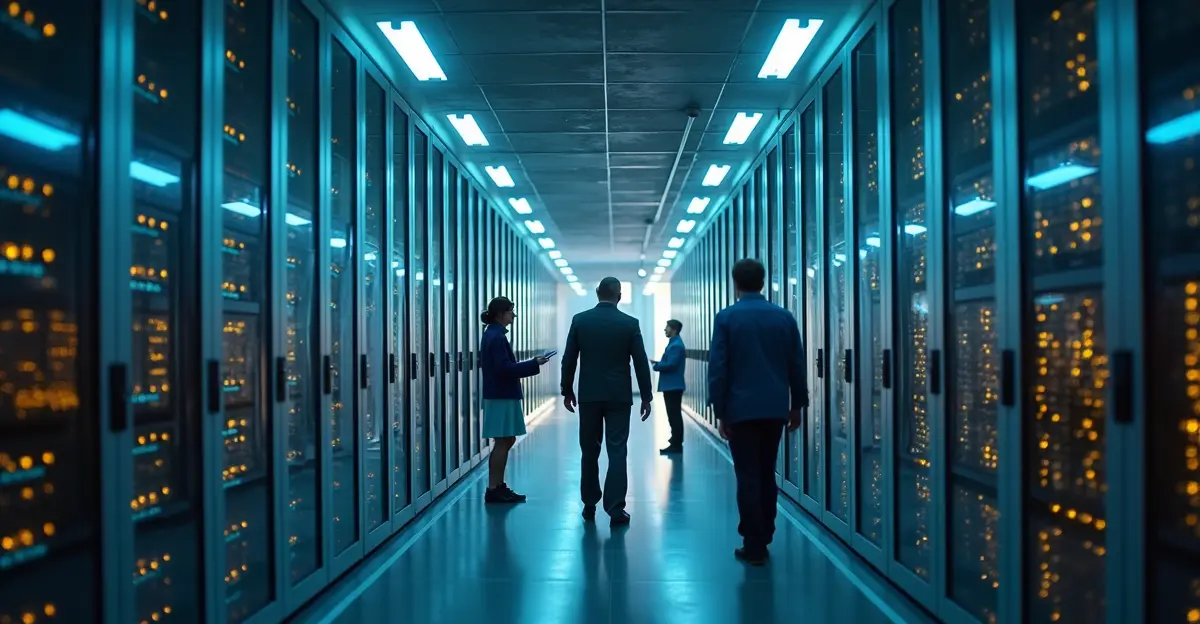
Nearly half of all planned U.S. AI data center capacity has been delayed or canceled in 2026 as physical power infrastructure — transformers, switchgear, and interconnection grids — becomes the binding constraint on the artificial intelligence buildout. While Alphabet, Amazon, Meta, and Microsoft have collectively committed over $650 billion in AI capital expenditures this year, grid lead times stretching five years and the first-ever failure of the PJM capacity auction in December 2025 have created what analysts call the widest gap on record between announced spending and energized megawatts.
The International Energy Agency (IEA) projects that AI data centers will consume 1,000 terawatt-hours (TWh) annually by 2026 — equivalent to Japan's entire electricity use — yet the U.S. grid interconnection queue now averages five years, with a staggering 2,300 GW backlog and only a 14% historical completion rate, according to Lawrence Berkeley National Laboratory data. This structural bottleneck is reshaping AI buildout strategy, driving hyperscalers toward on-site small modular reactors (SMRs), behind-the-meter generation, and a fundamental rethinking of where and how AI infrastructure gets deployed globally.
The $650 Billion Capex Surge Meets a Power Wall
The four largest technology companies — Alphabet, Amazon, Meta, and Microsoft — are on track to spend a combined $650 billion or more on AI infrastructure in 2026, a 71% increase over 2025's $380 billion, according to MUFG and Morgan Stanley estimates. Amazon alone may spend $200 billion, Meta up to $135 billion, and Alphabet as much as $185 billion. Roughly 75% of that spend, or $450 billion, is directly tied to AI infrastructure: servers, GPUs, data centers, and electrical equipment.
Yet of roughly 12 GW of new data center capacity announced for 2026 in the U.S., only about 5 GW — one-third — is under active construction, according to industry tracking by Sightline Climate and other analysts. The remaining 7 GW faces delays pushing completion into 2027 or beyond. The bottleneck has decisively shifted from GPU/chip shortages to physical power infrastructure.
"The binding constraint is no longer capital or chips — it is the physical electrical layer required to power these facilities," said a senior infrastructure analyst at a major hyperscaler, speaking on condition of anonymity. "We can buy all the H100s and GB200s we want, but if we can't get a transformer for 128 weeks or a generator step-up unit for 144 weeks, those GPUs sit in warehouses."
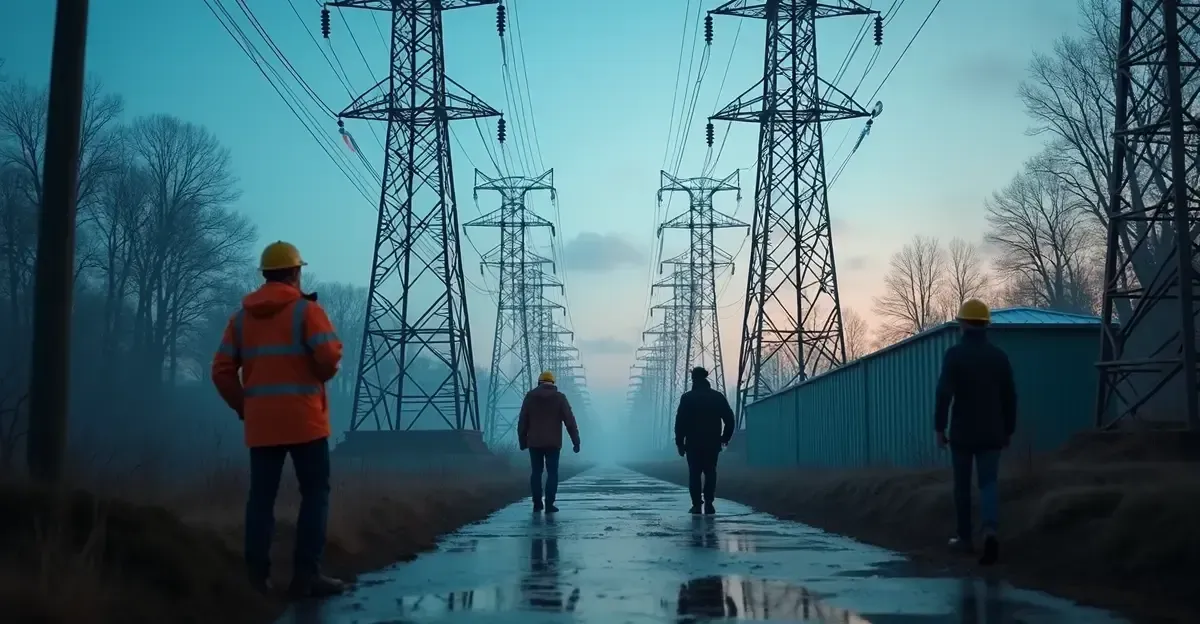
The AI data center power crisis has exposed deep vulnerabilities in the electrical supply chain. Power transformer lead times now average 128 weeks, while generator step-up units require 144 weeks, exacerbated by Chinese tariffs on electrical equipment and a global shortage of skilled manufacturing labor.
Grid Interconnection: The Five-Year Queue
The U.S. grid interconnection system — the process by which new power loads and generators connect to the transmission network — is overwhelmed. ERCOT's large-load interconnection queue surged from 63 GW to 226 GW in a single year. Dominion Energy has stated it cannot accommodate additional large-load requests in Northern Virginia through 2030, a stark admission from the utility serving the world's largest data center market.
Northern Virginia itself reports a 0.72% vacancy rate with 87% of 2025-2026 inventory already preleased, according to commercial real estate data. The region's power constraints have forced developers to look elsewhere — Ohio, Indiana, Texas, and even West Virginia, which now permits certified microgrid districts to bypass interconnection queues entirely.
"Regulatory queue capacity — not just hardware — is the primary constraint," noted a recent analysis by the grid consultancy MGrid. "Even if transformers were available, the administrative backlog at ISOs and utilities would still delay projects by years."
Regional responses vary. Ohio's AEP has enforced minimum billing requirements for large loads. Virginia created a large-user rate class to recover infrastructure costs. But these measures are stopgaps, not solutions, as the U.S. grid modernization challenges continue to mount.
PJM's Historic Capacity Auction Failure
The most dramatic signal of grid stress came in December 2025, when PJM Interconnection — the largest grid operator in the U.S., serving 13 states from the Mid-Atlantic to the Midwest — held its capacity auction for the 2027/2028 delivery year. The auction ended at the price cap after failing to procure enough capacity to meet the one-event-in-10-years reliability standard of a 20% reserve margin. PJM only managed a 14.8% reserve margin, a shortfall of approximately 6,625 MW.
This was the first such failure in PJM's history, and it sent shockwaves through energy markets and the data center industry. Capacity prices hit record highs, signaling that the grid simply cannot keep pace with surging demand from AI, electrification, and reshoring. The implications for data center operators are stark: even if they secure interconnection agreements, the cost of firm capacity has skyrocketed, and reliability margins are razor-thin.
Hyperscalers Go Off-Grid: SMRs and Behind-the-Meter Generation
Faced with multi-year grid delays, hyperscalers are increasingly taking power generation into their own hands. The most prominent strategy involves small modular reactors (SMRs) — compact nuclear units producing up to 300 MW per module, with 95%+ capacity factors and passive safety systems. Tech giants have collectively committed to over 10 GW of nuclear capacity, according to the State of SMR 2026 report.
Major projects include Amazon securing 960 MW in Pennsylvania, Microsoft's 837 MW deal to restart Three Mile Island Unit 1 by 2027, Meta and Oklo developing a 1.2 GW campus in Ohio, and Google partnering with Kairos Power. The SMR market, valued at $6.9 billion in 2025, is projected to reach $13.8 billion by 2032. However, no commercial SMRs are yet operational in the West — China's Linglong One (125 MWe) is set to become the world's first commercial land-based SMR in H1 2026, while Russia's floating Akademik Lomonosov has been operating since 2020.
"SMRs offer the only realistic path to 24/7 carbon-free power at the scale AI demands," said a nuclear energy analyst. "But the HALEU fuel supply chain remains the biggest bottleneck — current U.S. production is about 900 kg per year versus target needs in the tens of thousands of kilograms." The DOE has invested $10 billion-plus since 2020 to address this, but commercial deployments are not expected until 2028-2030 at the earliest.
In the near term, behind-the-meter (BTM) generation — on-site power via reciprocating gas engines, gas turbines, fuel cells, or solar-plus-storage — is the fastest path to energizing new capacity. BTM allows developers to power compute infrastructure while waiting for permanent grid connections, turning stranded capital into phased revenue. The behind-the-meter generation for data centers approach is gaining traction across the Midwest and Texas, where natural gas infrastructure is abundant and regulatory hurdles are lower.
Impact on AI Buildout Strategy and Global Deployment
The power bottleneck is forcing a fundamental rethinking of where and how AI infrastructure gets built. Hyperscalers are increasingly prioritizing sites with existing power capacity — co-location with gas plants, nuclear facilities, or hydroelectric dams — over greenfield developments. The global AI infrastructure deployment trends show a shift toward regions with faster permitting and shorter interconnection queues, including parts of the Middle East, Southeast Asia, and Eastern Europe.
"We are seeing a geographic dispersion of AI compute that would not have happened without the grid crisis," said a data center development executive. "Northern Virginia is saturated. Silicon Valley is impossible. The next wave of AI infrastructure will be built in Ohio, Indiana, Texas, and increasingly outside the U.S. entirely — in places like Malaysia, Indonesia, and Saudi Arabia where power can be brought online in 18 months instead of five years."
This dispersion has geopolitical implications. Countries with reliable, low-cost power and streamlined permitting are positioning themselves as AI infrastructure hubs. The U.S., despite its capital advantage, risks losing its leadership position if grid constraints are not addressed.
Expert Perspectives
"The gap between announced AI capex and energized megawatts is the defining infrastructure tension of 2026," said Amina Khalid, energy infrastructure analyst. "We have never seen a situation where so much capital is chasing so little deliverable power. The market is sending a clear signal: build power first, then build compute."
"The PJM auction failure was a wake-up call," said a former FERC commissioner. "The grid was not designed for the kind of load growth AI demands. We need a national priority permitting process for transmission and generation serving AI infrastructure, or we will see more auction failures and rolling reliability issues."
"Behind-the-meter gas generation is the bridge, but nuclear is the destination," said an SMR developer. "The hyperscalers understand that they need 24/7 carbon-free power at scale, and only advanced nuclear can deliver that. The question is whether regulatory and fuel supply challenges can be resolved fast enough."
Frequently Asked Questions
Why are AI data centers facing power shortages in 2026?
AI data centers require enormous amounts of electricity — up to 80 MW per facility, double standard needs. The U.S. grid interconnection queue averages five years, transformer lead times are 128 weeks, and the PJM capacity auction failed for the first time in December 2025, creating a structural bottleneck between capital spending and available power.
How much are tech companies spending on AI infrastructure in 2026?
Alphabet, Amazon, Meta, and Microsoft are on track to spend over $650 billion combined on AI infrastructure in 2026, a 71% increase from 2025. Roughly 75% of that is directly tied to AI servers, GPUs, data centers, and electrical equipment.
What is behind-the-meter generation for data centers?
Behind-the-meter (BTM) generation involves on-site electrical production via gas engines, turbines, fuel cells, or solar-plus-storage on the customer's side of the utility meter. It allows data centers to power compute capacity while waiting for permanent grid connections, reducing time-to-market from years to months.
Will small modular reactors power AI data centers?
Hyperscalers have committed to over 10 GW of nuclear capacity, including SMRs. However, no commercial SMRs are operational in the West yet — first deployments are expected between 2028-2030. Challenges include HALEU fuel supply, regulatory approval, and cost uncertainty.
How much electricity will AI data centers consume by 2026?
The IEA projects AI data centers will consume 1,000 TWh annually by 2026, equivalent to Japan's total electricity use. This represents about 3% of global electricity consumption and is driving unprecedented strain on power grids worldwide.
Conclusion and Future Outlook
The $650 billion power gap between AI capital expenditure and energized infrastructure is the defining challenge of the AI era. In the near term, behind-the-meter gas generation and aggressive grid modernization will be essential to bridge the gap. In the medium term, SMRs and advanced nuclear offer the only scalable path to 24/7 carbon-free power. But without fundamental reforms to interconnection processes, transformer manufacturing, and transmission permitting, the gap will only widen.
As one hyperscaler executive put it: "We are building the AI future on a grid built for the 20th century. The question is whether we can rebuild the grid fast enough to power it."



Follow Discussion