


 Deutsch
 English
 Español
 Français
 Nederlands
 Português


 Share
Share




What is the North Korea Missile Test Incident?
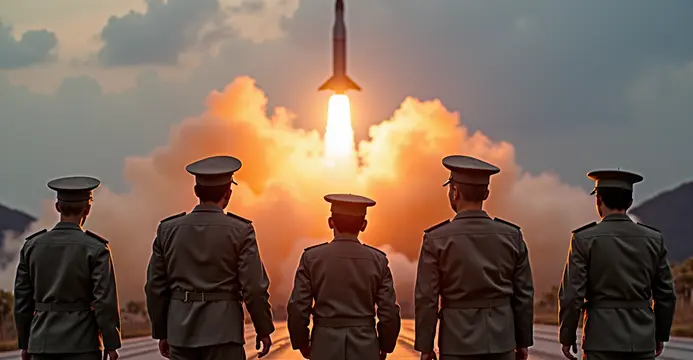
North Korean leader Kim Jong-un has conducted a provocative ballistic missile test while accompanied by his teenage daughter Kim Ju-ae, marking a significant escalation in regional tensions during ongoing US-South Korea military exercises. On March 14, 2026, North Korea fired approximately 10 ballistic missiles from the Pyongyang region toward the East Sea (Sea of Japan), with South Korea's military detecting the launches in real-time. The test involved twelve 600mm-caliber multiple rocket launchers that accurately struck targets approximately 364 kilometers away, demonstrating what Kim described as the 'destructive power of tactical nuclear weapons' capable of reaching targets within a 420-kilometer radius.
Context and Background: Rising Tensions on the Korean Peninsula
The missile launches occurred during the annual Freedom Shield military exercises between the United States and South Korea, which run from March 8-19, 2026. North Korea has consistently viewed these joint drills as invasion rehearsals and has historically responded with weapons tests. The current exercises involve approximately 18,000 South Korean troops and multinational forces, though US participation numbers remain unconfirmed. This latest provocation follows a pattern of North Korean responses to US-South Korea military exercises, which have intensified diplomatic tensions in the region.
Kim Ju-ae's Role and Succession Speculation
The presence of Kim Jong-un's daughter, believed to be 13-14 year old Kim Ju-ae, has drawn significant international attention. This marks her latest appearance at a major military event since late 2022, fueling speculation among analysts that she may be groomed as a potential successor. 'Kim Ju-ae's repeated presence at these high-profile military demonstrations suggests careful positioning within the regime's power structure,' noted one regional security analyst. Her involvement in the missile test represents a calculated political message about dynastic continuity in North Korea's leadership.
Technical Details of the Missile Launch
The North Korean state media agency KCNA reported that the test involved 'ultra-precision' 600mm multiple rocket launchers that achieved 100% accuracy against island targets. According to technical analysis:
- Launch System: Twelve 600mm-caliber multiple rocket launchers
- Range: Approximately 364-420 kilometers
- Target Area: East Sea (Sea of Japan)
- Accuracy: Reported 100% hit rate on designated targets
- Nuclear Capability: Described as 'tactical nuclear weapon delivery system'
South Korea's Joint Chiefs of Staff confirmed detecting about 10 ballistic missiles launched from North Korea's capital region, with the projectiles traveling approximately 350 kilometers before landing in the sea. The weapons system demonstrated in this test represents a significant advancement in North Korea's conventional and potentially nuclear-capable arsenal.
International Reactions and Diplomatic Fallout
The missile launches have drawn immediate condemnation from regional powers and international organizations. South Korea's Ministry of National Defense called the tests 'a clear violation of United Nations Security Council resolutions' and 'a serious provocation that threatens regional stability.' The United Nations Security Council has repeatedly prohibited North Korea from conducting ballistic missile tests, making these latest launches a direct challenge to international law.
Japan's Defense Ministry also monitored the launches, with officials expressing concern about the missiles' trajectory toward Japanese waters. The timing is particularly sensitive given ongoing discussions about nuclear non-proliferation agreements in the region and recent diplomatic efforts to reduce tensions.
Kim Jong-un's Statements and Strategic Messaging
According to KCNA reports, Kim Jong-un stated that the drill would expose enemies within the 420-kilometer striking range to 'uneasiness' and demonstrate North Korea's military capabilities. 'Any military infrastructure within our striking range can never survive,' Kim was quoted as saying. This rhetoric aligns with North Korea's longstanding position that its weapons development is necessary for self-defense against what it perceives as hostile US and South Korean military postures.
Regional Security Implications
The March 2026 missile test represents several concerning developments for regional security:
- Escalation Pattern: This marks North Korea's third major weapons test in 2026, continuing an aggressive testing schedule
- Technological Advancement: The 600mm rocket system demonstrates improved accuracy and range capabilities
- Political Signaling: The inclusion of Kim Ju-ae suggests dynastic planning amid ongoing tensions
- Timing Significance: The test directly responds to US-South Korea exercises, reinforcing North Korea's action-reaction pattern
Security analysts warn that these developments could lead to increased military posturing by all parties, potentially creating a dangerous escalation cycle on the Korean Peninsula. The situation is further complicated by North Korea's recent security treaty with Russia, which has altered regional power dynamics.
FAQ: North Korea Missile Test March 2026
Why did North Korea conduct this missile test?
North Korea conducted the test in response to ongoing US-South Korea Freedom Shield military exercises, which Pyongyang views as invasion rehearsals. The regime uses such tests to demonstrate military capabilities and protest perceived threats.
Who is Kim Ju-ae and why was she present?
Kim Ju-ae is Kim Jong-un's teenage daughter, believed to be 13-14 years old. Her presence at military events fuels speculation she may be groomed as a potential successor, representing dynastic continuity in North Korean leadership.
What type of missiles were launched?
North Korea launched approximately 10 ballistic missiles using 600mm-caliber multiple rocket launchers with a range of 364-420 kilometers, described as 'ultra-precision' systems capable of delivering tactical nuclear weapons.
How have other countries responded?
South Korea condemned the launches as violations of UN Security Council resolutions, Japan expressed concern about missiles approaching its waters, and the international community has generally viewed the tests as provocative escalations.
What are the implications for regional security?
The tests increase tensions on the Korean Peninsula, potentially triggering escalation cycles, undermining diplomatic efforts, and challenging non-proliferation frameworks in Northeast Asia.





Follow Discussion