


 Deutsch
 English
 Español
 Français
 Nederlands
 Português


 Share
Share




In 2026, China's tightening export controls on rare earths, tungsten, and antimony are triggering price spikes of up to sixfold and reducing licensing approval rates for European firms below 25%, exposing a systemic Western dependency that will take decades to unwind. With over 80% of European defense and clean energy companies reliant on Chinese processing, and independent alternatives estimated to require 20–30 years to rebuild, this is the defining geoeconomic confrontation of the decade. The World Economic Forum's Global Risks Report 2026 ranks geoeconomic confrontation as the world's top risk, and China's 2025–2026 export controls are now causing measurable market dislocations and policy crises in Europe and North America.
China's Dominance in Critical Mineral Supply Chains
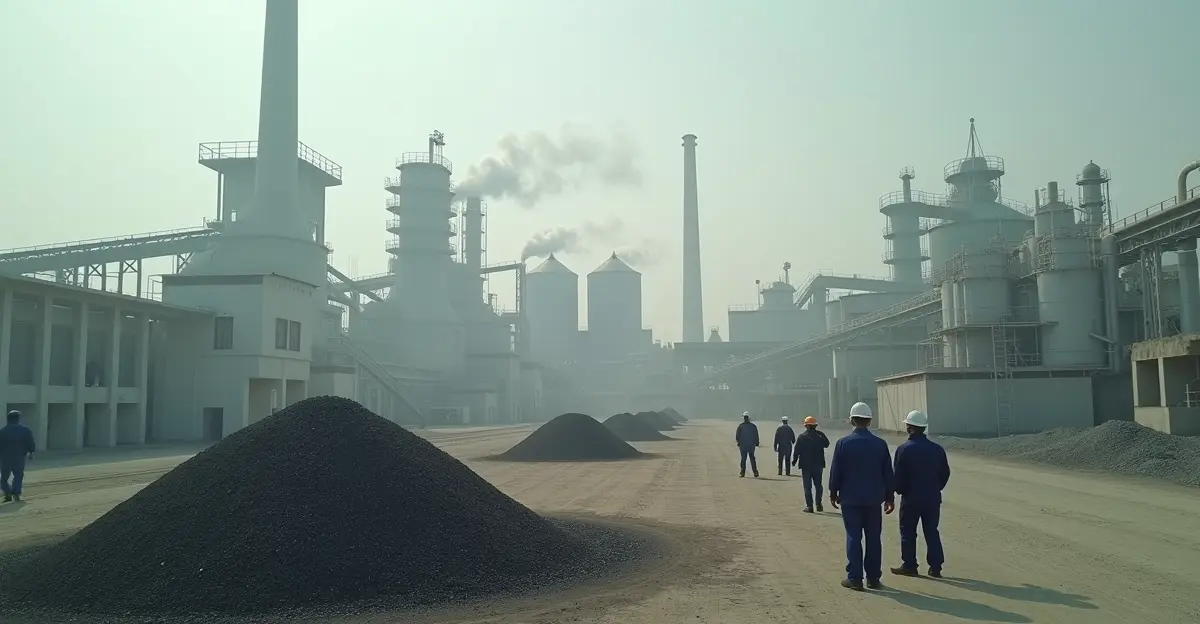
China controls approximately 90% of global rare earth processing, 80% of tungsten refining, and 60% of antimony production, according to a multi-institutional analysis published in early 2026. The rare earth supply chain is heavily concentrated in China, which also holds the world's largest known reserves at 44 million tonnes of rare-earth-oxide equivalent, per the US Geological Survey's February 2026 Mineral Commodity Summaries. China's dominance extends to patents, accounting for 81% of global rare-earth-related patent filings between 2014 and 2024.
Since 2025, Beijing has introduced two waves of export controls covering rare earth elements, tungsten, antimony, and related technologies. A second wave was temporarily suspended in November 2025 in exchange for US tariff concessions, but the core architecture remained intact. New restrictions on unprocessed rare earths took effect on January 1, 2026, alongside automated real-time monitoring and penalties for violations. The export control system uses a tiered permit framework operated by MOFCOM, with 30-60 day processing times, end-user certification requirements, and complete bans on US military applications.
Price Spikes and Market Dislocation
The impact has been dramatic. Neodymium-praseodymium oxide prices surged sixfold between January and June 2026, while tungsten tripled and antimony doubled from approximately $10,000 to $59,750 per tonne. European firms report that licensing approval rates have fallen below 25% for critical mineral exports, effectively strangling supply to key industries. The European defense industry has been particularly hard hit, with over 80% of European companies dependent on Chinese supply chains for materials essential to defense systems, electric vehicles, and renewable energy technologies.
Analysts argue that China is weaponizing control rather than scarcity. By using temporary, reversible restrictions, Beijing maintains pricing power and extracts strategic concessions while discouraging large-scale Western investment in alternative supply chains. The November 2025 truce, which suspended certain export bans in exchange for US tariff concessions, exemplifies this strategy of calibrated leverage.
The 12-to-18 Month Policy Window
Western nations face a narrowing window to respond. Building independent rare earth separation facilities requires a minimum of 12-18 months for initial capacity and 5-7 years to achieve meaningful scale. Rebuilding entire supply chains from mining to magnet manufacturing could take 20-30 years, far exceeding the current geopolitical window for decisive action.
In February 2026, the United States launched a major counteroffensive at the inaugural Critical Minerals Ministerial in Washington, DC. Secretary of State Marco Rubio announced over $30 billion in government support and established the Forum on Resource Geostrategic Engagement (FORGE), a 54-nation alliance succeeding the Minerals Security Partnership. FORGE creates a preferential trade-and-investment zone with coordinated price floors to counter Chinese market influence, chaired by South Korea through June 2026. A key component is Project Vault, a $12 billion public-private partnership to establish the US Strategic Critical Minerals Reserve, backed by a $10 billion EXIM Bank loan.
The European Union has responded with the Critical Raw Materials Act, aiming to diversify supply sources, invest in domestic mining and recycling, and strengthen strategic partnerships with resource-rich countries like Australia, Canada, and Greenland. However, the EU Critical Raw Materials Act faces implementation challenges, with member states divided on funding and regulatory timelines.
Strategic Implications for Global Trade and Security
The weaponization of mineral supply chains marks a new era of strategic resource competition. China's dominance in processing means that even countries with significant mineral reserves, such as Australia and the United States, remain dependent on Chinese refineries. The International Energy Agency estimates that China accounted for about 91% of global rare earth separation and refining production and 94% of sintered permanent magnet production in 2024.
The geoeconomic confrontation between US and China is now playing out in boardrooms and government ministries worldwide. Defense contractors are scrambling to secure alternative sources for rare earth magnets used in precision-guided munitions, radar systems, and electronic warfare equipment. Clean energy companies face similar pressures, with wind turbine manufacturers and electric vehicle producers warning of production delays and cost increases.
Three strategic paths have emerged for Western nations, according to analysts: managed dependence, which accepts continued reliance on Chinese supply chains while building strategic reserves; costly independence, which pursues full domestic processing capacity at significant economic cost; and hybrid resilience, which balances diversification with strategic stockpiling and international partnerships. Each path carries distinct risks and trade-offs.
Expert Perspectives
This is not a resource scarcity problem; it is a processing monopoly problem. China has spent 40 years building an unassailable position in rare earth refining, and reversing that will require a generational commitment from Western governments, said Dr. Emily Zhang, a critical minerals analyst at the Center for Strategic and International Studies.
The 12-18 month window is real. If we do not make tangible progress on alternative processing capacity by mid-2027, China's leverage will become structurally irreversible, warned a senior European Commission official involved in critical minerals policy, speaking on condition of anonymity.
FAQ
What critical minerals does China control?
China controls approximately 90% of global rare earth processing, 80% of tungsten refining, and 60% of antimony production. These minerals are essential for defense technologies, electric vehicles, wind turbines, consumer electronics, and semiconductors.
Why are China's export controls causing price spikes?
China's export controls require per-shipment licenses, with approval rates for European firms falling below 25%. This restricted supply has caused neodymium-praseodymium oxide prices to surge sixfold, tungsten to triple, and antimony to double in 2026.
How are Western nations responding?
The US launched the FORGE alliance (54 nations) and Project Vault ($12 billion strategic reserve). The EU passed the Critical Raw Materials Act. Over $30 billion in government support has been committed to develop alternative processing capacity, though analysts warn 5-7 years are needed to achieve meaningful scale.
How long would it take to rebuild independent supply chains?
Building initial rare earth separation facilities requires 12-18 months, but achieving full-scale independent supply chains from mining to magnet manufacturing could take 20-30 years, according to industry analysts.
What is the geoeconomic significance?
The World Economic Forum's Global Risks Report 2026 ranks geoeconomic confrontation as the world's top risk. China's mineral leverage is reshaping global trade alliances, defense procurement, and clean energy supply chains, marking the most significant strategic resource competition since the 1970s oil crises.
Conclusion and Future Outlook
The critical minerals confrontation is unlikely to ease in the near term. With China's dominance entrenched through decades of strategic investment and Western alternatives years away from meaningful production, the 2026 supply chain crisis represents a structural shift in global economic power. The coming 12-18 months will determine whether Western nations can mount an effective response or accept prolonged strategic vulnerability in defense, energy, and technology sectors. As the global trade war 2026 intensifies, critical minerals have become the new frontline in geoeconomic competition.



Follow Discussion