


 Deutsch
 English
 Español
 Français
 Nederlands
 Português


 Share
Share




In 2026, the global race for lithium, cobalt, and rare earth elements has become the central geopolitical battleground of the energy transition. As the second Trump administration, the European Union, China, and emerging Gulf state actors deploy unprecedented financial and diplomatic resources to secure critical mineral supply chains, developing producer nations are gaining historic leverage. Multiple analyses from the ODI, UNCTAD, and MineralPrices confirm that the critical minerals chessboard is reshaping global power dynamics faster than most strategic media have yet captured.
The US Offensive: Bilateral Deals and Stockpile Financing
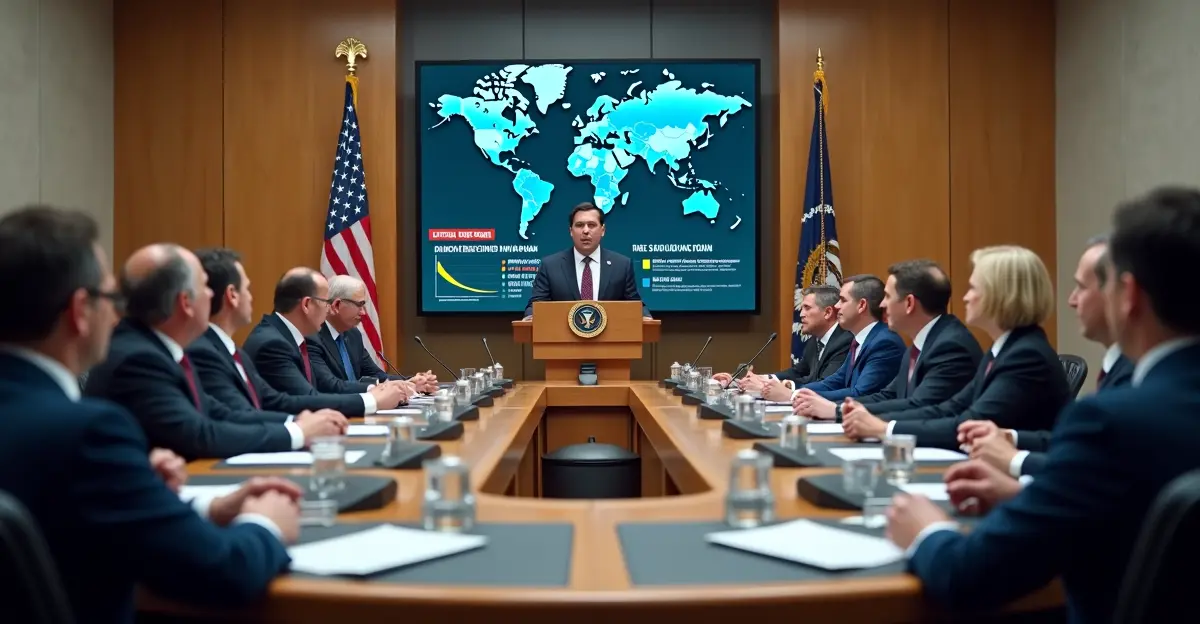
The United States under President Donald Trump has made critical minerals security a top national priority. On February 4, 2026, the State Department hosted the 2026 Critical Minerals Ministerial, bringing together 54 countries and the European Commission. Led by Secretary of State Marco Rubio and Vice President JD Vance, the event produced 11 new bilateral critical minerals frameworks or MOUs with countries including Argentina, Morocco, the Philippines, the UAE, and the United Kingdom.
Secretary Rubio announced FORGE (Forum on Resource Geostrategic Engagement) as the successor to the Minerals Security Partnership, chaired by the Republic of Korea. The US government is now mobilizing over $30 billion in support for critical mineral projects, including the Export-Import Bank's $10 billion Project Vault to establish a domestic strategic reserve. Domestically, the One Big Beautiful Bill Act allocated $2 billion for the National Defense Stockpile and $5 billion for the Industrial Base Fund. Major investments include a $400 million equity stake in MP Materials, a $1.4 billion public-private partnership with Vulcan Elements, and Department of Energy loans including $2.2 billion for Lithium Americas' Thacker Pass project.
The US critical minerals strategy also extends internationally through an $8.5 billion agreement with Australia, a framework agreement with Japan for mining and processing, and MOUs with Malaysia and Thailand. These efforts aim to reduce reliance on China's dominant position in critical minerals supply chains.
China's 15th Five-Year Plan: Reinforcing Dominance
China's 15th Five-Year Plan (2026–2030), released in October 2025, transforms rare earths from an industrial asset into a geopolitical weapon. Beijing controls 85–90% of global rare earth processing and 99% of heavy rare earth refining. Export controls imposed in late 2025 cover 12 of 17 rare earth elements, finished magnets, and processing technologies.
Western nations have committed only about $2 billion combined to build independent processing capacity, while China has invested $57 billion since 2000 and operates integrated mine-to-magnet supply chains. Most Western projects are unlikely to reach commercial scale before 2035, by which time China's dominance may exceed 90%. China will also reduce rare earth exports from roughly 50% historically to perhaps 25% by 2030 as domestic EV and wind energy demand soars.
However, the 15th Five-Year Plan faces internal contradictions. China's hybrid economic model is grappling with severe overcapacity across EVs, steel, and clean-tech manufacturing, producing far beyond what domestic consumption can absorb. The plan is notably silent on rare-earth extraction and critical mineral supply-chain resilience, raising concerns that China may repeat its overcapacity mistakes in these sectors. If downstream demand from EVs, wind, and aerospace falters due to surplus stress, upstream demand for critical minerals and magnets could collapse.
The EU's Financing Gap
The European Union's Critical Raw Materials Act (CRMA) sets ambitious 2030 targets: extracting 10%, processing 40%, and recycling 25% of strategic raw materials. The EU selected 60 Strategic Projects under the CRMA, with a second call for applications closing on January 15, 2026. The ReSourceEU Action Plan, adopted in December 2025, commits €3 billion to accelerate critical raw material projects and establishes a European Critical Raw Materials Centre.
Yet the €3 billion represents just 3% of the estimated €100 billion needed. The European Court of Auditors' Special Report 04/2026, published in February 2026, critically examines the EU's approach, highlighting structural underinvestment. The EU struggles to compete with China's $57 billion head start and Gulf sovereign wealth funds deploying vast capital. The EU Critical Raw Materials Act financing gap remains the bloc's Achilles' heel, as experts warn that without a dramatic scaling of investment, Europe's vulnerability to supply chain coercion will persist.
Gulf States: The Emerging Third Pole
Saudi Arabia and the UAE are executing a historic $100 billion-plus pivot from oil dependency to dominance in critical minerals, positioning themselves as a third pole in the US-China rivalry. Saudi Arabia has upgraded its estimated mineral wealth to $2.5 trillion and aims to make mining a third pillar of its economy under Vision 2030, with plans to mobilize $100 billion in investments by 2035. Its investment arm Manara Minerals (a PIF-Ma'aden joint venture) has built a $25 billion mining portfolio, including a rare earth refining plant with MP Materials and the US Department of War.
The UAE takes a complementary approach through sovereign wealth funds, launching the $1.8 billion Orion Critical Mineral Consortium with the US DFC and ADQ, focusing on production-ready projects and positioning Abu Dhabi as a geopolitically neutral processing hub. Lithium is the sole mineral targeted by every Gulf player, confirming its status as the battery metal of choice and the strategic hinge on which their post-oil diversification now turns. The Gulf states critical minerals investment strategy carries risks, as they must balance deepening ties with China against Western efforts to de-risk from Beijing.
Developing Producer Nations Gain Leverage
As global competition intensifies, developing producer nations are gaining unprecedented negotiating leverage. Latin America holds significant global shares of lithium, copper, and silver, but currently refines on average only 20% of key energy minerals it extracts. By 2035, the region could capture around $185 billion in economic value, though only one-fifth is expected from refining unless local processing expands.
Africa holds vast deposits of cobalt, copper, lithium, manganese, graphite, and rare earth elements. The continent's challenge is moving beyond raw material extraction toward value-added processing and manufacturing. The developing nations critical minerals leverage is growing as countries like the Democratic Republic of Congo, Zambia, and Indonesia demand better terms on value addition and technology transfer.
Impact on the Global Energy Transition
The multipolar scramble for minerals carries profound implications for the pace of the global energy transition. UNCTAD's June 2026 Global Trade Update projects lithium demand surging 353% by 2040. Yet a supply glut of lithium, cobalt, and rare earths in 2026 threatens to lower prices, stall Western investment, and deepen reliance on China's refining dominance. UNCTAD and ODI analyses reveal a narrow 12–18 month window for diversification before China's grip tightens further.
Innovation-led strategies such as rare-earth-free magnets and advanced recycling offer the fastest path to reducing dependency. But without coordinated policy action, the critical minerals chessboard may lock in a new era of strategic dependence that undermines both climate goals and geopolitical stability.
Expert Perspectives
"The critical minerals race is no longer just about resources—it's about who controls the processing, the technology, and the financing," said a senior analyst at ODI. "Developing countries have a once-in-a-generation opportunity to negotiate better terms, but they need to act quickly before the window closes."
"China's 15th Five-Year Plan treats rare earths as strategic weapons," noted a rare earth market specialist. "For Western corporations, supply risk now follows political alignment rather than market signals."
Frequently Asked Questions
What are critical minerals?
Critical minerals are raw materials essential for clean energy technologies, defense systems, and digital infrastructure, including lithium, cobalt, nickel, copper, and rare earth elements. They are considered "critical" due to their economic importance and supply chain vulnerability.
Why is China dominant in critical mineral processing?
China has invested over $57 billion since 2000 to build integrated mine-to-magnet supply chains, controlling 85–90% of global rare earth processing and 99% of heavy rare earth refining. Its 15th Five-Year Plan reinforces this dominance through export controls and strategic industrial policy.
What is the EU doing to secure critical minerals?
The EU's Critical Raw Materials Act sets targets for domestic extraction (10%), processing (40%), and recycling (25%) by 2030, with 60 Strategic Projects selected. However, the €3 billion ReSourceEU plan covers only 3% of the estimated €100 billion needed.
How are Gulf states entering the critical minerals race?
Saudi Arabia and the UAE are deploying sovereign wealth funds to acquire mining assets globally and build domestic processing capacity. Saudi Arabia's Manara Minerals has built a $25 billion portfolio, while the UAE's Orion Consortium focuses on production-ready projects.
What does the critical minerals scramble mean for the energy transition?
The competition could either accelerate the transition by diversifying supply or slow it down if supply chain bottlenecks and geopolitical tensions raise costs. Innovation in recycling and alternative materials offers a path to reduce dependency on concentrated supply chains.
Conclusion
The critical minerals chessboard of 2026 is being shaped by a multipolar struggle among the US, China, the EU, and emerging Gulf actors, with developing producer nations holding increasing leverage. The outcome will determine not only the pace of the global energy transition but also the distribution of economic and geopolitical power for decades to come. The narrow window for diversification is closing fast, and the decisions made in the next 12–18 months will echo through the rest of the century.




Follow Discussion