


 Deutsch
 English
 Español
 Français
 Nederlands
 Português


 Share
Share




The global financial order is undergoing its most significant transformation since the collapse of Bretton Woods as BRICS+ nations accelerate de-dollarization efforts in 2026. With the US dollar's share of global foreign exchange reserves falling below 57% for the first time since 1995, and BRICS+ members now conducting approximately 67% of intra-bloc trade in local currencies, a structural shift toward a multipolar reserve system is rapidly gaining momentum. This article examines the key drivers, instruments, and implications of this historic pivot.
The Dollar's Declining Dominance: By the Numbers
The US dollar's share of global foreign exchange reserves dropped to 56.3% in Q1 2026, according to IMF COFER data, continuing a steady decline from 71% in 2000. This erosion reflects a deliberate strategy by BRICS+ nations to diversify away from dollar-denominated assets following the weaponization of financial sanctions, particularly the freezing of Russia's $300 billion in reserves after the 2022 Ukraine invasion. The sanctions on Russia served as a wake-up call for many central banks, accelerating the search for alternatives.
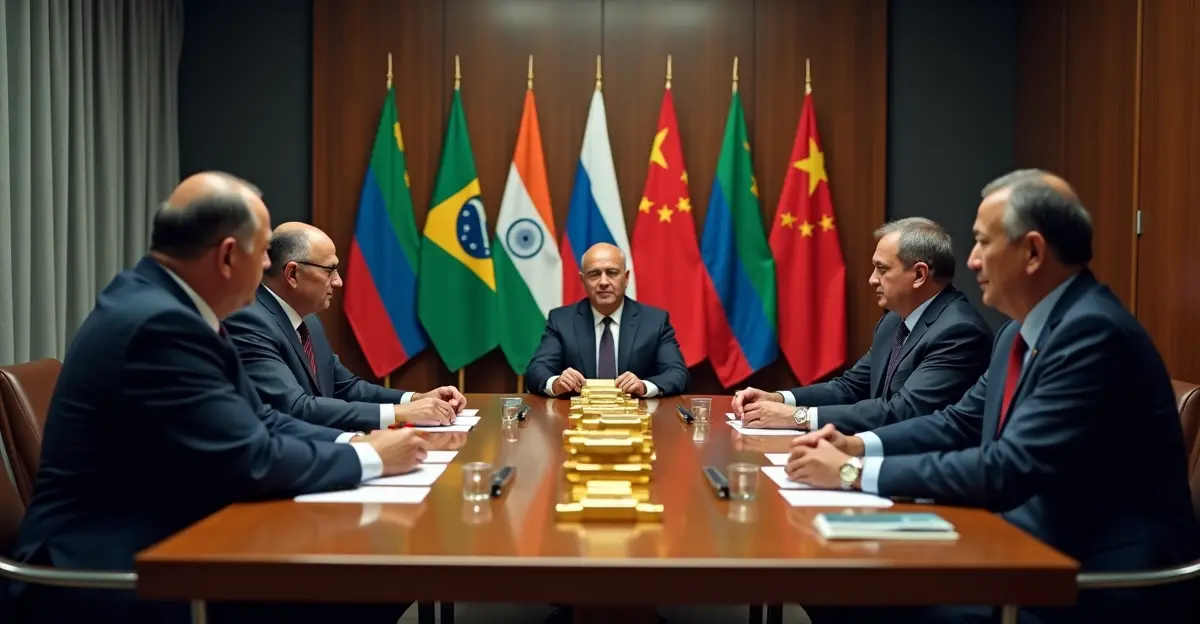
Central bank gold purchases reached a record 1,237 tonnes in 2025, marking the third consecutive year above 1,000 tonnes, led by China, Poland, Turkey, and India. BRICS+ nations now hold approximately 17.4% of global gold reserves, using the precious metal as a sanctions-proof anchor for their reserve diversification strategies. Gold prices tested $5,000 per ounce in early 2026 as institutional demand surged.
BRICS Pay and 'The Unit': New Settlement Infrastructure
A cornerstone of the de-dollarization push is the development of alternative payment systems. BRICS Pay, a blockchain-based digital payment platform designed to bypass SWIFT, is being built on interoperable central bank digital currencies (CBDCs). Rather than creating a single BRICS currency, the initiative focuses on linking existing national digital currencies—China's digital yuan, India's digital rupee, Russia's digital ruble—to enable cross-border trade settlement without dollar conversion.
Complementing BRICS Pay is 'The Unit,' a gold-backed digital settlement instrument piloted since October 2025. The Unit is backed 40% by physical gold and 60% by a basket of BRICS member currencies (real, ruble, rupee, renminbi, and rand at equal 12% weights). Administered by IRIAS on a blockchain platform, the pilot initially issued only 100 units but represents a proof-of-concept for a new reserve asset. While still a research-grade prototype, the Unit signals the bloc's ambition to create a gold-anchored alternative to the dollar-centric system. The BRICS Pay system could eventually process billions in trade volume if interoperability challenges are resolved.
CIPS: China's SWIFT Alternative Gains Traction
China's Cross-border Interbank Payment System (CIPS) processed ¥180 trillion ($25 trillion) in 2025, up 43% year-on-year, with 1,597 indirect participants across 117 countries. While CIPS still relies on SWIFT for messaging in many transactions, its rapid expansion provides a parallel infrastructure for yuan-denominated trade. Direct participants now include 194 institutions, with Asia accounting for 73% of indirect participants and Europe 17%. CIPS forged its first direct partnerships with six foreign banks in the Middle East and Africa in 2025, extending its reach into energy-trade corridors.
However, comparisons to SWIFT remain misleading. SWIFT connects over 11,500 institutions across 235+ countries, and the yuan accounts for only 3% of global SWIFT payments versus 48% for the dollar. CIPS's growth is significant but still represents a fraction of global payment flows. The CIPS vs SWIFT comparison highlights the gap between infrastructure development and actual usage.
The Petrodollar Under Siege: UAE Exits OPEC, Yuan Oil Contracts Surge
The UAE's departure from OPEC on May 1, 2026, marked a pivotal moment for the petrodollar system. Freed from OPEC production quotas, Abu Dhabi can now price and settle Murban crude in currencies mutually agreed with buyers, opening the door for Asian importers—China, India, Japan, and ASEAN nations—to settle oil trades in yuan, rupees, yen, or rupiah. Yuan-denominated oil contracts now approach 24% of daily Brent crude volumes, up from negligible levels five years ago.
Saudi Arabia increased yuan-priced oil exports to China from 15% to 22% in 2025, while Iran's Strait of Hormuz disruptions have created a two-tier market where yuan-settled cargoes receive preferential passage. The petrodollar system erosion is accelerating as BRICS+ energy producers controlling 46 million barrels per day seek alternatives to dollar pricing.
China's 15th Five-Year Plan: Critical Minerals as Geoeconomic Leverage
China's 15th Five-Year Plan (2026-2030), unveiled in March 2026, explicitly identifies rare earths as providing 'competitive advantages' for the first time. The plan calls for strengthening export controls on critical minerals—including rare earth elements, lithium, cobalt, and tungsten—while upgrading domestic processing capacity. China controls 60-70% of global rare earth production and an even higher share of processing, giving it significant leverage in the green energy transition.
The IEA projects global demand for critical minerals will nearly triple by 2030 and quadruple by 2050. By tightening export controls while expanding domestic processing, China can influence supply chains for electric vehicles, wind turbines, and defense technologies. This critical minerals geopolitics adds a new dimension to de-dollarization, as mineral-rich BRICS+ members can bypass dollar settlement in strategic resource trade.
Implications for Global Financial Stability and Sanctions Efficacy
The shift toward a multipolar reserve system carries profound implications. For sanctions efficacy, the development of alternative payment systems like BRICS Pay and CIPS reduces the West's ability to enforce financial penalties. Russia and Iran, both under heavy sanctions, have been primary drivers of this infrastructure. As more countries gain access to dollar-free settlement channels, the coercive power of US financial sanctions diminishes.
For global financial stability, a multi-currency reserve system could reduce the concentration risk inherent in a dollar-centric order. However, transition periods are inherently volatile. Increased currency diversification may lead to higher transaction costs, more complex hedging requirements, and potential liquidity fragmentation. The dollar still settles 88% of global forex transactions and benefits from deep capital markets, network effects, and the rule of law—advantages not easily replicated.
Most analysts expect a gradual transition rather than a sudden collapse of dollar hegemony. The multipolar reserve system outlook suggests the dollar will share dominance with the euro, renminbi, and gold, rather than being fully replaced. For US borrowing costs, reduced foreign demand for Treasuries could increase fiscal pressure, particularly with national debt exceeding $39 trillion.
Expert Perspectives
"The de-dollarization trend has reached an inflection point that demands strategic analysis in real time," notes financial analyst Chloe Nowak. "With the UAE exiting OPEC, yuan-denominated oil contracts approaching 24% of Brent crude volumes, and China's 15th Five-Year Plan sharpening critical minerals leverage, we are witnessing a structural transformation of the global financial architecture."
However, skeptics caution against overstating the shift. Jim O'Neill, the economist who coined the BRIC acronym, has described the grouping as a failed project, arguing that member countries have proven incapable of uniting as a meaningful global force. The dollar's incumbency advantages—deep liquidity, trust, and institutional infrastructure—remain formidable barriers to any challenger.
FAQ
What is BRICS de-dollarization?
BRICS de-dollarization refers to the coordinated efforts by BRICS+ nations (Brazil, Russia, India, China, South Africa, and new members) to reduce reliance on the US dollar in international trade, reserves, and financial transactions, promoting local currencies and alternative payment systems instead.
What is 'The Unit' in BRICS?
'The Unit' is a gold-backed digital settlement instrument piloted by BRICS+, backed 40% by physical gold and 60% by a basket of member currencies. It is designed to facilitate cross-border trade settlement without using the US dollar.
How does BRICS Pay work?
BRICS Pay is a blockchain-based digital payment system that links member countries' central bank digital currencies (CBDCs), enabling cross-border settlements in local currencies without relying on SWIFT or dollar conversion.
Is the US dollar going to collapse?
Most experts do not predict a sudden collapse of the US dollar. Instead, they foresee a gradual transition to a multipolar reserve system where the dollar shares dominance with the euro, renminbi, and gold. The dollar retains significant advantages in liquidity, trust, and market depth.
What is CIPS and how does it compare to SWIFT?
CIPS (Cross-border Interbank Payment System) is China's alternative to SWIFT for yuan-denominated transactions. While it processed ¥180 trillion in 2025 and connects 1,597 institutions, it remains much smaller than SWIFT (11,500+ institutions) and still relies on SWIFT for messaging in many transactions.
Conclusion
The de-dollarization trend of 2026 represents a genuine structural shift in global finance, driven by geopolitical tensions, technological innovation, and deliberate policy choices by BRICS+ nations. While the dollar's dominance will not end overnight, the infrastructure for a multipolar system is being built in real time. For investors, policymakers, and businesses, understanding these dynamics is no longer optional—it is essential for navigating the financial landscape of the coming decade.




Follow Discussion