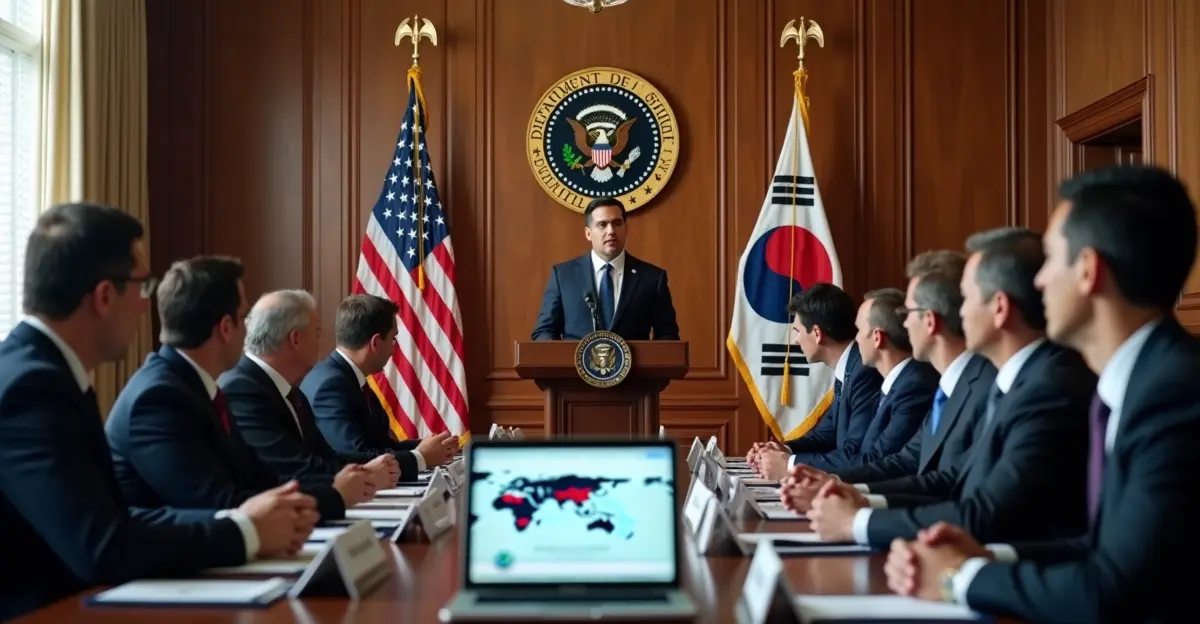
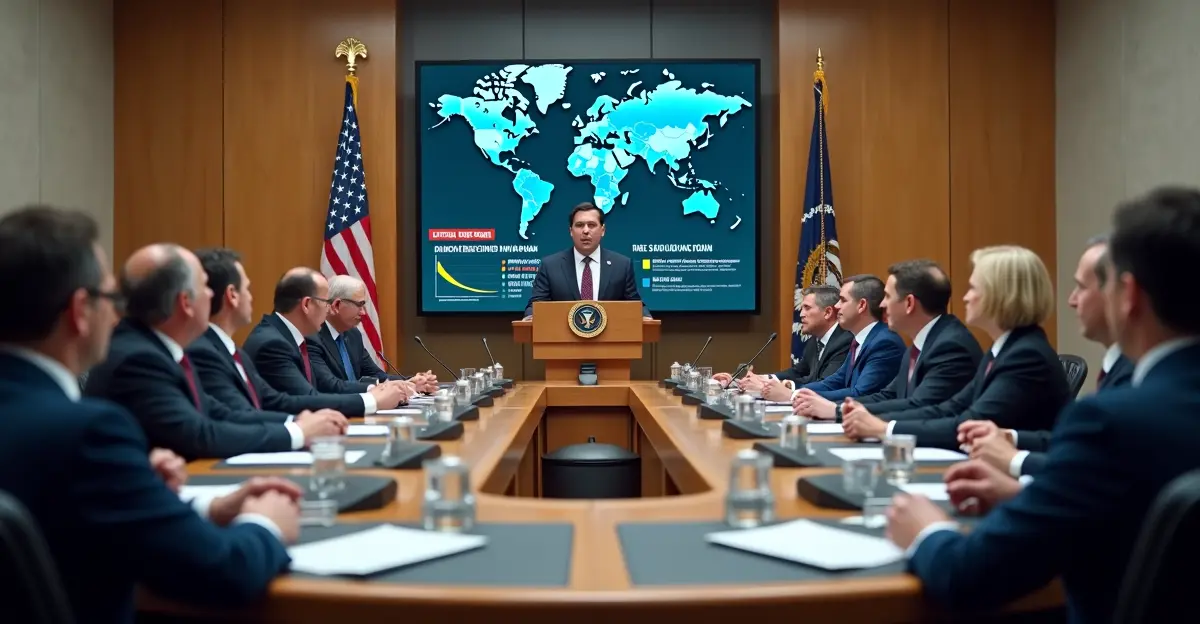
The February 2026 Critical Minerals Ministerial in Washington, D.C., marked a watershed moment in the global contest for lithium, rare earths, cobalt, and copper. With the launch of the Forum on Resource Geostrategic Engagement (FORGE) and over $30 billion in mobilized project finance, the United States is mounting its most aggressive challenge yet to China's stranglehold on critical mineral supply chains. As Beijing retains approximately 90% of rare earth refining and 65% of lithium processing capacity, the strategic choke point directly threatens the energy transition, AI infrastructure expansion, and defense production capacity across Western economies.
The Strategic Context: Why Critical Minerals Matter in 2026
Critical minerals—lithium, rare earth elements, cobalt, copper, and graphite—are the building blocks of modern technology. They power electric vehicle batteries, wind turbines, AI chips, military hardware, and robotics. The International Energy Agency's Global Critical Minerals Outlook 2025 projects that demand for lithium will increase fivefold by 2040, while rare earth demand rises 50–60%. Yet the supply chain remains dangerously concentrated. China controls 60–90% of global processing capacity for these materials, creating what experts call a "strategic vulnerability" for Western economies.
The energy transition supply chain risks have become a central concern for policymakers. The IEA warns that a sustained battery metals supply shock could increase battery pack prices by 40–50%, derailing EV adoption targets and renewable energy deployment.
FORGE: A New Framework for Mineral Security
At the February 4, 2026, ministerial, Secretary of State Marco Rubio and Vice President JD Vance announced FORGE as the successor to the Minerals Security Partnership. Unlike its predecessor, FORGE is designed as a preferential trade-and-investment zone with coordinated price floors to counter adversarial market manipulation. Vice President Vance described using adjustable tariffs and reference prices at each production stage to create stable investment conditions.
The ministerial produced 11 new bilateral critical minerals framework agreements with countries including Argentina, Morocco, Peru, the Philippines, the UAE, and the United Kingdom. This brings the total to 21 deals signed in just five months. FORGE, chaired by South Korea through June 2026, aims to link these agreements into a functioning plurilateral system covering two-thirds of the global economy. The U.S. government has mobilized over $30 billion in financing support, including EXIM's $10 billion Project Vault initiative to establish a domestic strategic reserve for critical minerals.
How FORGE Differs from the Minerals Security Partnership
The Minerals Security Partnership, launched in 2022, focused on diplomatic coordination and project facilitation. FORGE goes further by creating enforceable trade mechanisms. According to the Atlantic Council, the initiative reflects a strategy of "practicing statecraft through markets rather than around them." However, operational details and full membership remain unclear, raising questions about implementation.
China's Dominance: The Midstream Trap
China's leverage lies not in mining but in processing. As of May 2026, China produces approximately 61% of the world's mined rare earths—down from 80–90% a decade ago. But the decisive advantage is downstream: China controls an estimated 91% of global rare earth refining and processing capacity. For lithium, China processes about 65% of global supply, despite holding only a fraction of reserves.
This "midstream trap" means that even if Western nations ramp up mining, they remain dependent on Chinese refineries. The rare earth export controls 2026<!--/similar/> have already caused disruptions. In early 2026, China tightened export controls on rare earth elements, triggering supply chain breaks in the EV sector and sending defense stocks surging as nations scrambled to secure supplies for military applications.</p> <h2>The $500–700 Billion Investment Gap</h2> <p>The IEA estimates that the mining sector needs $500–600 billion in new capital investment between 2024 and 2040 to meet global energy transition targets. Other analyses push the figure to $700 billion when including refining and processing infrastructure. Yet investment momentum slowed in 2024, with real growth at just 2% after inflation. Geographic supply concentration has worsened: the top three refining nations' market share rose from 82% in 2020 to 86% in 2024.</p> <p>The <!--similar-->critical minerals investment gap is particularly acute for copper, which is essential for electrification and AI data centers. Copper demand is projected to grow 50% by 2040, but new mine development takes 10–15 years on average. The IEA explicitly endorses government intervention, including offtake agreements, floor prices, and direct financial support to de-risk mining investment.
Impact on Energy Transition and AI Infrastructure
The critical minerals crunch directly threatens two of the most transformative trends of the decade: the clean energy transition and AI infrastructure expansion. Electric vehicle batteries require lithium, cobalt, and graphite. Wind turbines need rare earth magnets. AI data centers consume enormous amounts of copper for wiring and cooling systems. Without secure supply chains, both sectors face cost inflation and deployment delays.
A 2025 IEA analysis warned that a supply shock could increase battery pack prices by 40–50%, potentially stalling EV adoption just as automakers are investing billions in electrification. Similarly, the AI infrastructure copper demand is straining global copper markets, with prices hovering near all-time highs in early 2026.
Expert Perspectives
"The critical minerals challenge is not about mining—it's about processing," said Dr. Sarah Ladislaw, a senior fellow at the Center for Strategic and International Studies. "Until Western nations build domestic refining capacity, China will retain its strategic choke point."
"FORGE represents a paradigm shift in how the U.S. approaches resource security," noted a senior State Department official who spoke on condition of anonymity. "By linking bilateral deals into a plurilateral framework with market mechanisms, we create incentives for investment that no single country can provide."
FAQ: Critical Minerals Geopolitics in 2026
What is FORGE?
FORGE (Forum on Resource Geostrategic Engagement) is a U.S.-led plurilateral framework launched in February 2026 to coordinate critical minerals trade and investment among allied nations. It includes price floors, adjustable tariffs, and preferential trade terms to counter China's market dominance.
Why does China control so much processing capacity?
China invested heavily in refining infrastructure over the past two decades, driven by industrial policy, low environmental standards, and strategic state planning. Western nations neglected downstream processing, creating a structural dependency that is difficult and expensive to reverse.
How much investment is needed for critical minerals?
The IEA estimates $500–600 billion is needed for mining alone by 2040. Including refining and processing, the figure rises to $700 billion. Current investment levels fall far short.
What are the risks of supply disruption?
A sustained supply shock could increase battery prices by 40–50%, delay EV adoption, raise defense production costs, and slow AI infrastructure deployment. China's export controls on rare earths in early 2026 have already caused disruptions.
Can the U.S. and allies reduce dependence on China?
Yes, but it will take a decade or more. FORGE and bilateral agreements are a start, but building domestic refining capacity, streamlining permitting, and securing financing remain major hurdles. The Western rare earth processing strategy is still in early stages.
Conclusion: The Race Is On
The February 2026 Critical Minerals Ministerial and the launch of FORGE represent a major pivot in U.S. strategy. With over $30 billion mobilized and 21 bilateral agreements signed, the foundation for a diversified supply chain is being laid. But China's decades-long head start in refining, the massive investment gap, and the slow pace of mine development mean that strategic vulnerabilities will persist for years. The race for lithium, rare earths, and copper is not just about resources—it is about the future of energy, technology, and national security.
Follow Discussion