


 Deutsch
 English
 Español
 Français
 Nederlands
 Português


 Share
Share




The Strategic Implications of Record Global Defense Spending in an Era of Great Power Competition
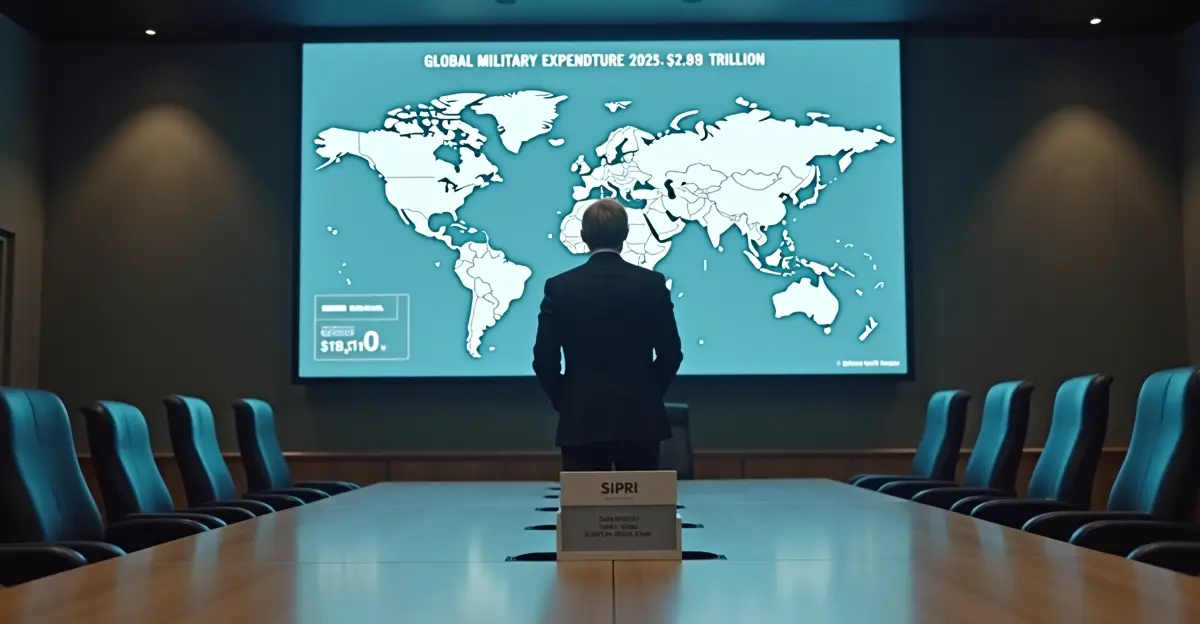
Global defense spending reached an unprecedented $2.3 trillion in 2024, marking an 8.1% year-over-year increase that represents a fundamental shift in global security paradigms. This record expenditure, driven by escalating geopolitical tensions and the transition from counterinsurgency operations to peer-adversary deterrence, signals a new era of military preparedness as nations prepare for potential conflicts between major powers rather than asymmetric warfare. The Stockholm International Peace Research Institute (SIPRI) reports that this surge represents the steepest annual increase since the end of the Cold War, with the global military burden rising to 2.5% of world GDP.
From Counterinsurgency to Peer Conflict: A Strategic Reorientation
The dramatic increase in defense spending reflects a profound strategic reorientation among major powers. For nearly two decades following the 9/11 attacks, Western military priorities focused primarily on counterterrorism and counterinsurgency operations in Afghanistan, Iraq, and other conflict zones. However, the Russia-Ukraine war that began in 2022, combined with rising US-China tensions over Taiwan and the South China Sea, has fundamentally altered threat perceptions. 'We are witnessing a paradigm shift from fighting insurgents to deterring peer adversaries,' explains defense analyst Dr. Sarah Chen. 'Nations are investing in capabilities designed for high-intensity conventional warfare against technologically advanced opponents.'
This strategic shift is most evident in procurement priorities. Countries are now prioritizing artillery systems, main battle tanks, air defense missiles, drones, and survivability upgrades over the light infantry and special operations equipment that dominated previous decades. The United States, for instance, has accelerated production of long-range precision weapons, while European nations are rebuilding artillery stockpiles depleted by donations to Ukraine.
Regional Spending Patterns: Europe's Rearmament and Asia's Rise
Europe's Defense Renaissance
Europe has experienced the most dramatic surge in defense spending, with a 17% increase in 2024 bringing total expenditure to $693 billion. This represents a historic reversal of post-Cold War defense cuts and reflects growing concerns about Russian aggression. Germany, once criticized for underspending on defense, increased its military budget by 28% to $88.5 billion, becoming Europe's largest spender. Eighteen NATO members now meet the alliance's 2% of GDP spending target, up from just 11 in 2023.
The European Union has launched ambitious initiatives like the ReArm Europe plan, which could mobilize up to €800 billion by 2030. According to the European Central Bank analysis, new defense measures announced since February 2025 will add 0.6% of GDP cumulatively over 2025-27, primarily driven by German investments. 'Europe is undergoing a defense renaissance not seen since the Cold War,' notes security expert Professor Mai'a Cross. 'This isn't just about spending more, but spending better through joint European efforts.'
Asia's Growing Military Footprint
Asia accounts for 22% of global defense spending, with China driving much of this growth. China's official defense budget reached $247 billion in 2025, though independent estimates suggest actual spending may range from $318-471 billion when accounting for research, development, and other military-related expenditures. The People's Liberation Army has transformed from an outdated regional force into an increasingly advanced global military power, with the PLA Navy now surpassing the U.S. Navy in number of ships.
Other Asian nations are responding to China's military modernization. Japan increased defense spending to 2% of GDP for the first time, while South Korea, Taiwan, and Australia have all announced significant defense budget increases. This regional arms race reflects growing concerns about territorial disputes, particularly in the South China Sea and around Taiwan.
Procurement Priorities: Shaping Military Capabilities for the 2030s
The current surge in defense spending is fundamentally reshaping military capabilities for the coming decade. Procurement priorities reveal several key trends:
- Artillery and Munitions: Nations are rebuilding artillery stockpiles and increasing production of precision-guided munitions, recognizing their critical role in conventional warfare as demonstrated in Ukraine.
- Air and Missile Defense: Investment in air defense systems has surged, with particular focus on countering drones, cruise missiles, and hypersonic weapons.
- Unmanned Systems: Drone warfare has moved from niche capability to central component of modern military strategy, with investments spanning surveillance drones to armed unmanned combat vehicles.
- Cyber and Space Capabilities: The new era of warfare increasingly extends to digital and orbital domains, with significant budget allocations for cyber defense and space-based surveillance systems.
- Survivability Upgrades: Armored vehicles, ships, and aircraft are receiving enhanced protection against modern anti-tank and anti-ship weapons.
Strategic Implications for Global Power Dynamics
The record defense spending has profound implications for global power dynamics. First, it accelerates the shift toward multipolarity, as rising powers like China and India increase their military capabilities relative to traditional Western powers. Second, it creates new patterns of alliance and competition, with nations forming defense partnerships based on shared threat perceptions rather than ideological alignment.
The economic implications are equally significant. Defense spending now represents a substantial portion of government budgets, potentially crowding out social spending and infrastructure investment. However, the ECB analysis suggests the macroeconomic impact could support real GDP growth by about 0.1 percentage points annually in 2026-27, though with limited inflation effects since defense spending doesn't directly affect consumer prices.
Diplomatic relations are also being reshaped by this military buildup. The United States has strengthened alliances in the Indo-Pacific through initiatives like AUKUS (Australia-UK-US) and expanded military cooperation with Japan and South Korea. Meanwhile, Russia's invasion of Ukraine has driven previously neutral European nations like Sweden and Finland to join NATO, fundamentally altering Europe's security architecture.
Expert Perspectives on the New Defense Landscape
Security analysts offer varying perspectives on this new era of defense spending. 'We're witnessing the most significant global military buildup since the Cold War,' says Dr. James Peterson of the International Institute for Strategic Studies. 'The key question is whether this investment translates into effective military capabilities or simply fuels an arms race.'
Other experts emphasize the technological dimension. 'Modern warfare is increasingly defined by technological superiority rather than sheer numbers,' notes defense technology analyst Maria Rodriguez. 'Investments in artificial intelligence, quantum computing, and hypersonic weapons will determine which nations maintain military advantage in the coming decades.'
Frequently Asked Questions
What is driving the record global defense spending?
The primary drivers are escalating geopolitical tensions, including the Russia-Ukraine war, rising US-China competition over Taiwan, Middle East volatility following the October 2023 Hamas attacks, and growing concerns about North Korea's nuclear program. Nations are shifting from counterinsurgency operations to preparing for potential peer conflicts.
Which countries are increasing defense spending the most?
Europe shows the most dramatic increases, with Germany up 28%, Poland increasing significantly, and multiple NATO members meeting the 2% GDP target. In Asia, China continues steady growth, while Japan and South Korea have announced major budget increases. The United States remains the world's largest spender at approximately $997 billion in 2024.
How does this defense spending impact global trade?
Increased defense spending influences global trade patterns through arms exports, technology transfers, and supply chain dependencies. It also creates economic dependencies as nations seek reliable suppliers for critical military technologies, potentially reshaping traditional trade relationships and creating new strategic partnerships.
What are the long-term implications of this military buildup?
The long-term implications include accelerated technological innovation in defense sectors, potential arms races in regions like Asia and the Middle East, strain on government budgets that could impact social spending, and increased risk of miscalculation or escalation in regional conflicts as nations deploy more advanced military capabilities.
How does drone warfare change defense priorities?
Drone warfare has revolutionized modern conflict, making air defense systems and counter-drone technologies critical priorities. Nations are investing heavily in both offensive drone capabilities and defensive systems to protect against drone swarms and unmanned attacks, fundamentally changing traditional force structures and procurement strategies.
Conclusion: Navigating a New Era of Military Competition
The record $2.3 trillion in global defense spending represents more than just a budgetary increase—it signals a fundamental transformation in how nations perceive security threats and prepare for potential conflicts. As the world transitions from an era dominated by counterinsurgency operations to one defined by great power competition, military investments will increasingly shape diplomatic relations, economic priorities, and global stability.
The coming decade will test whether this unprecedented military buildup enhances deterrence and stability or fuels dangerous arms races and escalation. What remains clear is that the strategic landscape of the 2030s is being shaped today by procurement decisions and defense investments that will determine military capabilities for years to come.


Follow Discussion