


 Deutsch
 English
 Español
 Français
 Nederlands
 Português


 Share
Share




The $2.7 Trillion Security Paradox: How Record Military Spending Undermines Global Stability
In a stark revelation that has sent shockwaves through international policy circles, the United Nations has reported that global military spending reached an unprecedented $2.7 trillion in 2024, marking a 9% increase - the steepest year-on-year rise since the Cold War. This massive expenditure, equivalent to $334 for every person on Earth, represents what experts are calling a 'security paradox' where increased military investment may actually be undermining long-term global stability by diverting critical resources from essential development needs. The UN report, released in late 2024, paints a troubling picture of global priorities at a time when sustainable development faces a $4 trillion annual financing gap.
What is the Military Spending Security Paradox?
The security paradox refers to the counterintuitive phenomenon where increased military spending and security measures can actually decrease overall stability. As nations arm themselves against perceived threats, they often trigger arms races, heighten geopolitical tensions, and divert resources from the very social investments that create durable peace. UN Secretary-General António Guterres starkly warned that 'the world is spending far more on waging war than in building peace', noting that the $2.7 trillion military expenditure dwarfs investments in development by a factor of 13. This massive allocation comes at a time when only one in five Sustainable Development Goal targets is on track, creating what analysts call a dangerous imbalance in global priorities.
Breaking Down the $2.7 Trillion: Who's Spending What?
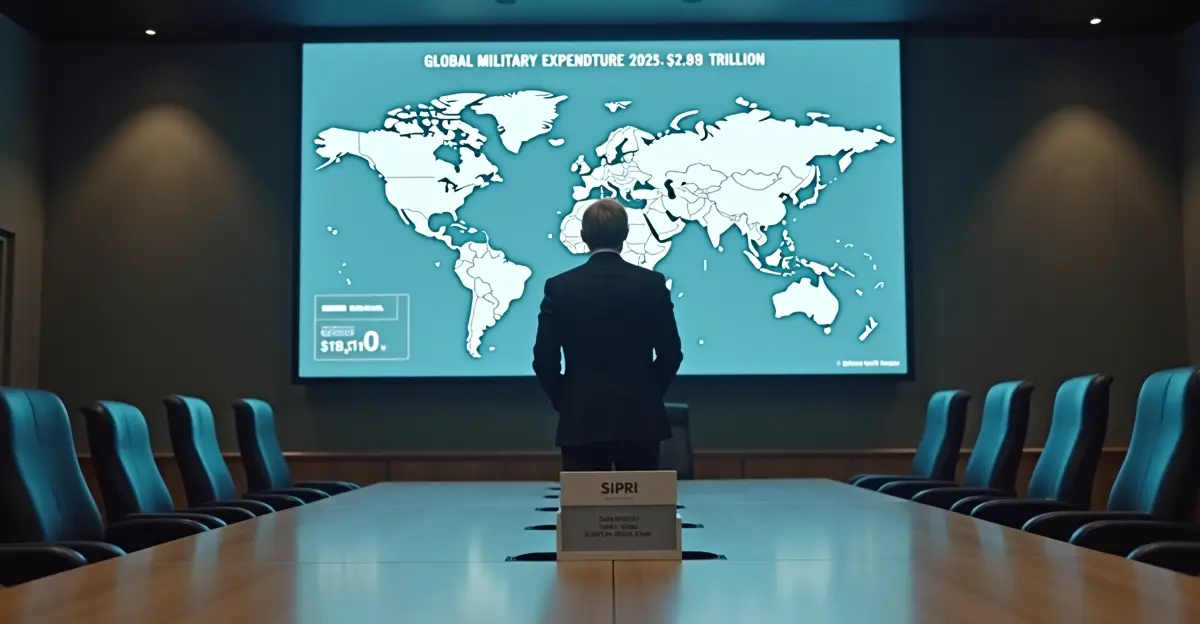
According to data from the Stockholm International Peace Research Institute (SIPRI), the 2024 military spending landscape reveals stark contrasts between nations and regions:
Top Military Spenders by Country
- United States: $997 billion (3.4% of GDP) - nearly 40% of global total
- China: $314 billion (1.7% of GDP)
- Russia: $149 billion (7.1% of GDP)
- Germany: $88.5 billion (1.9% of GDP)
- India: $86.1 billion (2.3% of GDP)
Regional Spending Patterns
For the second consecutive year, all five geographical regions saw increased military spending, reflecting heightened global tensions. Europe experienced the most dramatic rise at 17%, largely driven by the Russia-Ukraine war and NATO's commitment to increase defense spending to 5% of GDP. The Middle East saw significant increases due to the Gaza conflict and regional tensions, while Asia-Pacific spending grew steadily amid South China Sea tensions and strategic competition between major powers.
The Stark Opportunity Costs: What $2.7 Trillion Could Achieve
The UN report highlights devastating trade-offs between military spending and essential human needs. The $2.7 trillion military expenditure represents 750 times the UN's regular budget and 13 times the official development assistance from wealthy nations. Consider these comparisons:
| Military Spending Allocation | Equivalent Development Impact |
|---|---|
| Less than 4% ($93 billion) | Could end global hunger by 2030 |
| 10% ($285 billion) | Could fully vaccinate every child worldwide |
| Just $300 billion | Could eliminate extreme poverty globally |
| 1 year of global military spending | Equals 13 years of official development assistance |
According to development economists, redirecting even a fraction of military spending could fund education for all students in low-income countries, eliminate child malnutrition globally, and support comprehensive climate change adaptation programs. The UN notes that investments in education, clean energy, and healthcare create significantly more jobs than military spending, suggesting that current priorities may be undermining economic stability as well.
Geopolitical Consequences: Fueling the Arms Race Dynamic
The record military spending is creating what security analysts describe as a dangerous feedback loop. As one nation increases its military capabilities, neighboring states and strategic competitors feel compelled to respond in kind, leading to escalating arms races. This dynamic is particularly evident in Europe following Russia's invasion of Ukraine, where NATO countries have committed to unprecedented defense spending increases. However, as noted in analysis of NATO defense spending spree, this militarization creates a security paradox where increased armament by one side prompts similar responses from adversaries, potentially escalating tensions rather than enhancing security.
The SIPRI report reveals that global military expenditure has grown every year for a full decade, with a 37% increase from 2015-2024. The global military burden (share of world GDP) increased to 2.5%, while average military expenditure as a share of government spending rose to 7.1%. Many countries have already committed to further increases, suggesting continued growth in coming years despite the evident opportunity costs.
Expert Perspectives: A Fundamental Shift or Temporary Response?
Security analysts are divided on whether this spending surge represents a fundamental shift in global security paradigms or a temporary response to current conflicts. Some experts argue that we are witnessing a return to great power competition reminiscent of the Cold War era, with nations prioritizing military capabilities over cooperative security frameworks. Others suggest that the spending increases are primarily driven by specific conflicts - the Russia-Ukraine war, Gaza conflict, and tensions in the South China Sea - and may moderate once these crises are resolved.
However, the UN report emphasizes that excessive military spending often undermines peace by fueling arms races and diverting resources from the foundations of stability. 'We must rebalance our priorities,' stated Secretary-General Guterres. 'Investing in diplomacy, sustainable development, and human security creates more durable peace than any military buildup.' This perspective aligns with research showing that countries with higher social spending relative to military spending tend to experience greater long-term stability.
Future Outlook: Rebalancing Global Security Priorities
The UN report calls for several concrete actions to address the security paradox:
- Prioritize diplomacy and peaceful dispute resolution mechanisms
- Improve transparency in military spending and arms transfers
- Reinvigorate multilateral finance for sustainable development
- Advance a human-centered approach to security that addresses root causes of conflict
- Create better linkages between arms control and development initiatives
As the world grapples with interconnected crises - from climate change to pandemics to economic inequality - the allocation of $2.7 trillion to military purposes while development faces a $4 trillion funding gap represents what many analysts call a profound misalignment of global priorities. The coming years will reveal whether nations can break the cycle of the security paradox or whether escalating military spending will continue to undermine the very stability it purports to protect.
Frequently Asked Questions
What is the security paradox in military spending?
The security paradox refers to the phenomenon where increased military spending can actually decrease overall security by triggering arms races, heightening tensions, and diverting resources from social investments that create durable peace.
Which countries spend the most on military?
The United States leads with $997 billion (3.4% of GDP), followed by China ($314 billion), Russia ($149 billion), Germany ($88.5 billion), and India ($86.1 billion). Ukraine spends the highest percentage of GDP at 34% due to its ongoing war.
How does military spending compare to development funding?
Global military spending of $2.7 trillion is 13 times the official development assistance from wealthy nations and 750 times the UN's regular budget, creating a massive imbalance in global priorities.
What could be achieved by redirecting military spending?
Just 4% of military spending ($93 billion) could end global hunger, 10% ($285 billion) could vaccinate every child, and $300 billion could eliminate extreme poverty worldwide.
Is military spending increasing worldwide?
Yes, global military spending has increased every year for a decade, with a 9.4% rise in 2024 marking the steepest increase since the Cold War. All five geographical regions saw increased spending in 2024.


Follow Discussion