


 Deutsch
 English
 Español
 Français
 Nederlands
 Português


 Share
Share




Global Supply Chain Reconfiguration: From Efficiency to Resilience
The global supply chain landscape is undergoing its most significant transformation in decades, with 2024-2025 data revealing accelerated decoupling from China by Western economies and the emergence of new trade corridors along geopolitical lines. Recent McKinsey research shows that trade is fundamentally restructuring, moving from pure efficiency optimization toward resilience-driven models that prioritize geopolitical alignment over cost minimization. This seismic shift represents a departure from decades of hyper-globalization toward what experts term 'strategic globalization' – where supply chains are reconfigured to balance economic efficiency with national security and political considerations.
What is Supply Chain Reconfiguration?
Supply chain reconfiguration refers to the strategic restructuring of global production and distribution networks in response to geopolitical tensions, trade policies, and resilience concerns. Unlike traditional supply chain optimization focused solely on cost and efficiency, modern reconfiguration prioritizes risk mitigation, political alignment, and operational continuity. The COVID-19 pandemic disruptions exposed vulnerabilities in concentrated supply chains, accelerating a trend that was already emerging due to US-China trade tensions and Russia's invasion of Ukraine.
The Accelerating US-China Decoupling
McKinsey's 2025 update reveals that the United States has accelerated its trade shift away from China, with developing economies now accounting for the majority of China's imports and exports. According to the analysis, about 35% of US imports from China have favorable rearrangement ratios (below 0.1), indicating ample alternative global supply, while 5% face significant challenges with ratios above 1.0. "We're witnessing a fundamental reordering of global trade relationships," notes a McKinsey analyst. "The era of cost-first globalization is giving way to resilience-first strategic partnerships."
Mexico's Ascendance as America's Largest Trading Partner
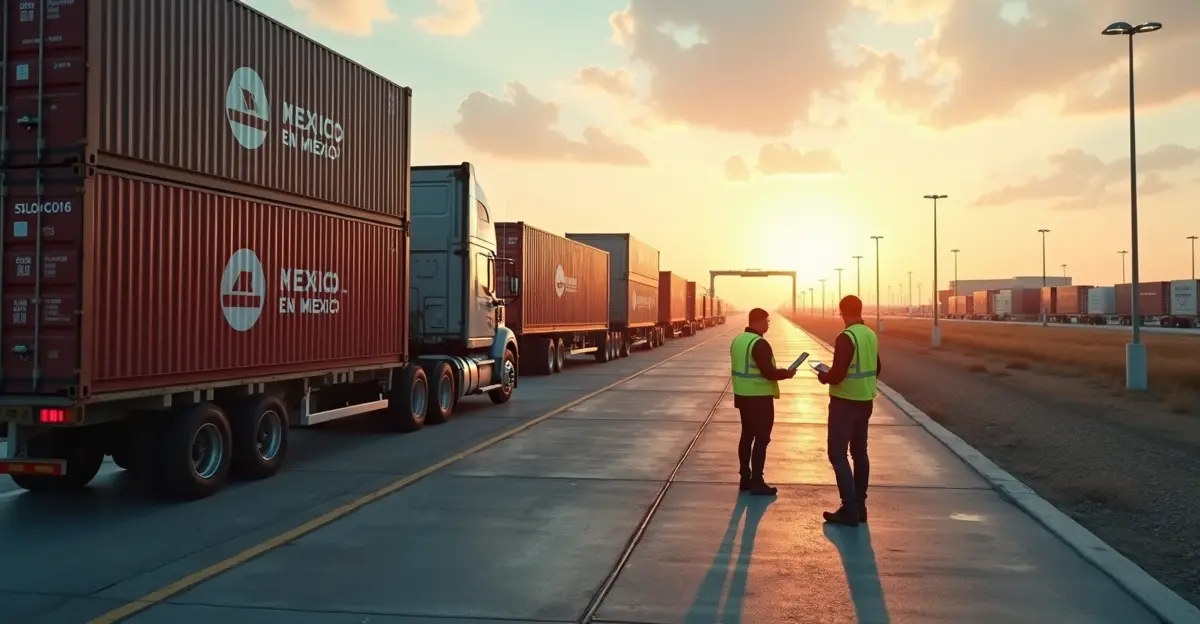
Mexico has emerged as the primary beneficiary of US supply chain diversification, with an 85% probability of becoming America's largest trading partner. The Proteus Group analysis identifies a $6 trillion shift in annual trade flows from global to regional channels, with Mexico positioned as a key 'friend-shoring' destination. Companies are accepting 10-25% higher costs for resilience through nearshoring and dual sourcing strategies.
Vietnam's Manufacturing Renaissance
Vietnam is experiencing a significant manufacturing reshoring surge in 2025, with foreign direct investment in manufacturing reaching $25.58 billion in 2024. The country's industrial production index grew 8.8% year-over-year in December 2024, with forecasts predicting 4.6% growth in 2025. Vietnam's exports to the U.S. reached $85.1 billion in the first seven months of 2025, with motor vehicle manufacturing growing 27.4% year-to-date.
Europe's Strategic Pivot and Energy Realignment
European economies have moved decisively away from Russia while strengthening connections with strategic partners like the United States. The continent is pursuing diversification through nearshoring initiatives like the €43 billion EU Chips Act for semiconductors and friendshoring with democratic allies such as Canada for raw materials. Europe's Green Deal initiatives are reshaping trade patterns, with the Carbon Border Adjustment Mechanism (CBAM) imposing tariffs on high-carbon imports and requiring secure access to critical raw materials for renewable energy.
The Four Plausible Global Outlooks
The World Economic Forum and Kearney outline four plausible global outlooks for supply chains from 2025-2027:
- Reformed: Supply chains rebalance in a rules-based multilateral world with regulatory convergence
- Fragmented: Supply chains scale selectively amid competing blocs and regulatory divergence
- Volatile: Supply chains adapt for endurance in uneven growth with softened tensions
- Degraded: Supply chains recoil from conflict in a world of fading multilateralism
Developing Economies as Bridge Partners
ASEAN, Brazil, and India are strengthening trade ties across geopolitical divides, positioning themselves as bridge partners between competing economic blocs. Brazil's trade travels farthest geographically due to significant trade with China, while large economies generally have lower import concentration than the global average. These developing economies are capitalizing on their neutral positioning to attract investment from multiple geopolitical camps.
Business Adaptation Strategies
Organizations are building adaptive, digitally enabled supply networks prioritizing diversification, agility, and strategic readiness. Key strategies include:
- Dual Sourcing: Maintaining multiple suppliers for critical components
- Regionalization: Shifting production closer to end markets
- Inventory Buffering: Increasing safety stock levels despite higher costs
- Digital Transformation: Implementing advanced analytics for risk monitoring
The semiconductor industry realignment exemplifies this trend, with companies establishing parallel supply chains in geopolitically aligned regions.
Economic and Competitive Implications
The reconfiguration carries significant implications for global trade patterns, manufacturing competitiveness, and economic security. Industrial real estate premiums in Northern Mexico are forecast to exceed 30% by 2027, reflecting intense demand for nearshoring facilities. Meanwhile, China trades more with geopolitically distant partners than any other economy, while Germany and the UK trade over shorter geopolitical distances due to European integration.
Expert Perspectives on the Transition
"Prolonged uncertainty should not cause decision paralysis," warns the World Economic Forum analysis. "Businesses must act to keep supply chains moving while building resilience across different potential futures." The Bank of America Institute's report on 'Reshoring vs. Friendshoring' examines how these strategies are driven by geopolitical tensions, pandemic disruptions, and national security concerns.
FAQ: Global Supply Chain Reconfiguration
What is 'friend-shoring'?
Friend-shoring involves shifting supply chains to politically aligned nations rather than the lowest-cost locations, prioritizing geopolitical security over pure economic efficiency.
How much are companies paying for resilience?
Companies are accepting 10-25% higher costs for resilience through nearshoring and dual sourcing, according to industry analyses.
Which countries are benefiting most from supply chain shifts?
Mexico, Vietnam, and India are positioned as primary beneficiaries, with Mexico having an 85% probability of becoming America's largest trading partner.
Is globalization ending?
No, but it's transforming from hyper-globalization to strategic globalization, where trade follows geopolitical alignment rather than pure efficiency.
What are the four future supply chain scenarios?
The World Economic Forum identifies Reformed, Fragmented, Volatile, and Degraded as plausible global outlooks for 2025-2027.
Future Outlook and Strategic Considerations
The supply chain reconfiguration represents a permanent structural shift in global trade. As geopolitical tensions persist, businesses must develop flexible strategies that can adapt to multiple potential futures. The key will be balancing the competing demands of efficiency, resilience, and sustainability while navigating an increasingly complex regulatory landscape. The critical minerals supply chains will be particularly important for the green energy transition, requiring careful geopolitical navigation.




Follow Discussion