


 Deutsch
 English
 Español
 Français
 Nederlands
 Português


 Share
Share




COP29's Climate Finance Breakthrough: Strategic Implications for Global Energy Transition and Geopolitics
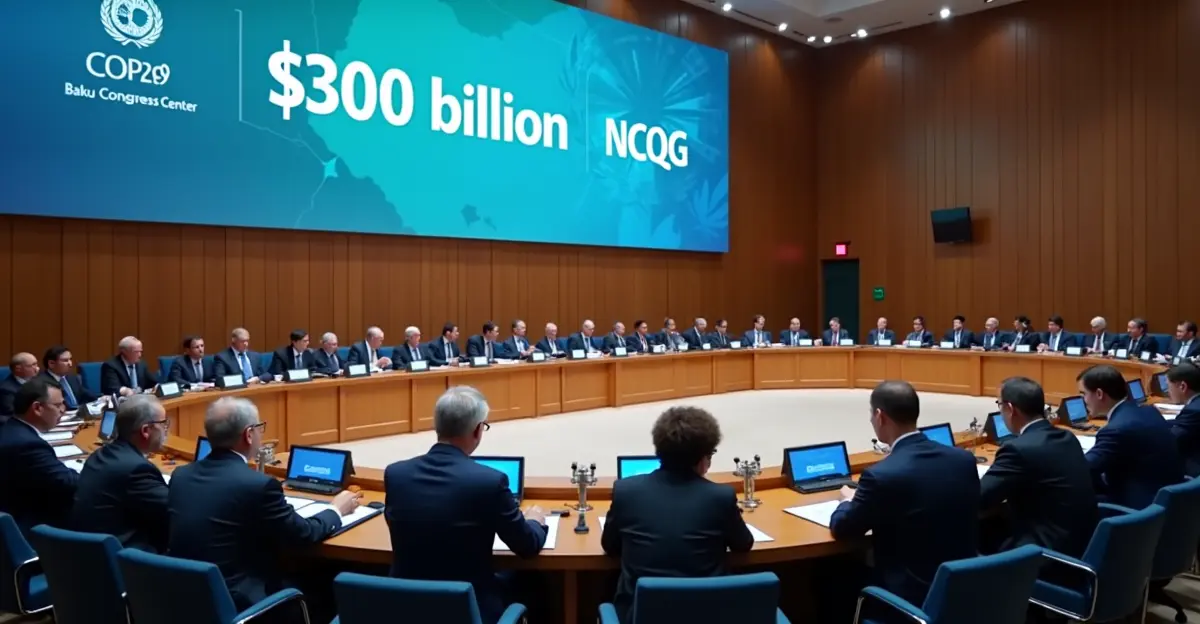
The landmark COP29 agreement to triple climate finance to $300 billion annually by 2035 represents the most significant climate funding breakthrough since the Paris Agreement, creating immediate strategic implications for global energy markets, geopolitical competition in green technology, and the emerging financial architecture for climate adaptation. Concluded in November 2024 in Baku, Azerbaijan, this historic framework will reshape global climate policy and energy transition investments for the next decade, with profound consequences for governments, financial institutions, and energy markets worldwide.
What is the COP29 Climate Finance Agreement?
The COP29 agreement establishes a New Collective Quantified Goal (NCQG) requiring developed nations to provide at least $300 billion annually to developing countries by 2035, tripling the previous $100 billion target. This framework aims to mobilize $1.3 trillion in total international climate finance from various sources including private investment, multilateral development banks, and public funds. The funding prioritizes three key areas: mitigation (45%), adaptation (35%), and loss and damage (20%), with specific allocations for critical technologies including green hydrogen ($45 billion), advanced nuclear ($30 billion), grid modernization ($60 billion), and energy storage ($40 billion).
Geopolitical Competition in Clean Energy Manufacturing
The COP29 financing framework intersects directly with intensifying industrial policy tensions between major economies, particularly the US-China-EU competition in clean energy manufacturing. As nations position themselves to benefit from the $300 billion annual funding, strategic battles are emerging around critical mineral access, semiconductor supply chains, and renewable technology dominance.
US-China Trade Tensions and Third-Country Impacts
US-China trade tensions are creating complex dynamics for developing nations seeking climate finance. According to Columbia University's Center on Global Energy Policy, third countries must navigate between competing supply chains, with Chinese manufacturers dominating solar panel production (over 80% global market share) and battery manufacturing, while US policies like the Inflation Reduction Act create alternative investment pathways. The US-China clean energy rivalry is forcing developing nations to make strategic choices about technology partnerships and financing sources.
EU's Clean Industrial Deal Response
The European Union has responded with its Clean Industrial Deal, a strategic plan aimed at preserving ambitious climate goals while boosting industrial competitiveness. The European Commission proposes support for industries facing high energy costs and investment barriers, with measures to accelerate renewable energy deployment and reduce power bills. Despite these efforts, energy-intensive industries remain concerned about immediate competitiveness needs, with chemical industry leaders warning of potential European industrial decline without stronger support mechanisms.
Article 6 Carbon Market Mechanisms: New Financial Instruments
COP29 marked a significant breakthrough for Article 6 carbon markets, with four key decisions that provide the final agreements needed to make these markets operational after nine years of negotiations since the Paris Agreement. These decisions cover Article 6.2 (international transferred mitigation outcomes/ITMOs), Article 6.4 (Paris Agreement Crediting Mechanism/PACM), and Article 6.8 (non-market approaches).
Creating New Financial Architecture
The Article 6 agreements establish authorization processes for ITMOs, define corresponding adjustments for emissions accounting, and create the PACM mechanism for emission reduction credit trading. These frameworks enable countries to trade surplus emission reductions to meet their climate commitments, while also allowing private sector participation in voluntary carbon markets. According to OCBC Bank's Global Markets Research, this represents a major step toward creating functional international carbon markets that can drive investment in clean energy and sustainable development projects worldwide.
Geopolitical Leverage Points
The new carbon market mechanisms create potential geopolitical leverage points, particularly around verification standards, credit quality criteria, and technology transfer requirements. Nations with advanced monitoring, reporting, and verification (MRV) capabilities may gain influence in setting global standards, while countries with large natural carbon sinks could develop new revenue streams. The global carbon pricing mechanisms emerging from COP29 will likely become tools of economic statecraft in coming years.
Strategic Implications for Global Energy Markets
The $300 billion annual commitment will accelerate renewable energy deployment but also create market distortions and competitive advantages. Developing nations receiving climate finance will gain preferential access to clean technology, potentially reshaping global manufacturing patterns and trade flows.
Renewable Energy Acceleration
With specific allocations for solar ($55 billion), wind ($50 billion), and grid infrastructure ($60 billion), the COP29 framework will dramatically accelerate renewable deployment in developing regions. This could help close the gap between China's massive clean energy installations (more solar and wind capacity in 2024 than the rest of the world combined) and other regions' deployment rates.
Critical Mineral Competition
The financing framework intensifies competition for critical minerals essential for clean energy technologies. Nations with significant reserves of lithium, cobalt, rare earth elements, and copper will gain strategic importance, potentially creating new dependencies similar to historical fossil fuel relationships. The critical minerals supply chain will become a central focus of climate diplomacy in the coming decade.
Implementation Challenges and Future Outlook
While the COP29 agreement represents a landmark achievement, significant implementation challenges remain. Developing nations have criticized the $300 billion target as "insultingly low" compared to their requested $1+ trillion, and experts note it falls short of the estimated $2.4 trillion annually needed for developing countries' climate needs.
Mobilizing Private Investment
The success of this framework will depend heavily on its ability to mobilize private investment alongside public funds. Multilateral development banks (MDBs) are key contributors, having committed to provide $120 billion in climate finance by 2030. However, reaching the full $1.3 trillion target will require innovative financial instruments and risk-sharing mechanisms to attract private capital at scale.
Baku-to-Belém Roadmap
The "Baku to Belém Roadmap" established at COP29 outlines the path forward to work toward the additional trillion dollars needed, with progress tracking through the Paris Agreement's transparency framework. As attention turns to COP30 in Brazil in 2025, the focus will shift to implementation mechanisms, accountability frameworks, and ensuring that commitments translate into actual funding flows.
Expert Perspectives on COP29 Outcomes
UN Climate Change Executive Secretary Simon Stiell called the finance goal "an insurance policy for humanity," emphasizing that commitments must quickly translate into actual funding. Meanwhile, UN Secretary-General António Guterres described the agreement as a "base to build on" though he had hoped for more ambitious outcomes. Climate finance experts warn that without robust implementation, the agreement risks becoming another unmet promise in the long history of climate negotiations.
Frequently Asked Questions (FAQ)
What is the COP29 climate finance agreement?
The COP29 agreement establishes a $300 billion annual climate finance target for developed nations to provide to developing countries by 2035, tripling the previous $100 billion goal and aiming to mobilize $1.3 trillion in total international climate finance.
How will the $300 billion be allocated?
Funding prioritizes mitigation (45%), adaptation (35%), and loss and damage (20%), with specific allocations for green hydrogen ($45B), advanced nuclear ($30B), grid modernization ($60B), energy storage ($40B), solar ($55B), and wind ($50B).
What are Article 6 carbon markets?
Article 6 of the Paris Agreement establishes rules for international carbon markets, allowing countries to trade emissions reductions. COP29 finalized key decisions making these markets operational after nine years of negotiations.
How does COP29 affect US-China-EU competition?
The financing framework intensifies clean energy manufacturing competition, with nations positioning themselves to benefit from climate finance while navigating trade tensions and supply chain dependencies.
Is $300 billion enough for climate needs?
No - developing countries requested over $1 trillion, and experts estimate $2.4 trillion annually is needed. The $300 billion represents progress but falls short of actual requirements.
Conclusion: A New Era of Climate Finance
The COP29 climate finance breakthrough marks the beginning of a new era in global climate policy, where financial flows will increasingly determine the pace and direction of the energy transition. While the $300 billion annual target represents significant progress, its true impact will depend on implementation effectiveness, private capital mobilization, and the ability to navigate complex geopolitical tensions. As the world moves toward COP30 in Brazil, the global climate governance architecture faces both unprecedented opportunities and formidable challenges in translating financial commitments into tangible climate action.


Follow Discussion