


 Deutsch
 English
 Español
 Français
 Nederlands
 Português


 Share
Share




The Strategic Calculus of Split-Shoring: How Global Businesses Are Redefining Supply Chain Resilience
In an era of unprecedented geopolitical uncertainty and supply chain volatility, a revolutionary manufacturing strategy called 'split-shoring' is emerging as the dominant approach for global businesses seeking to balance cost efficiency with geopolitical resilience. Recent Bain & Company research reveals that 81% of CEOs are now planning to bring supply chains closer to home, with 64% actively investing in reshoring, near-shoring, or split-shoring strategies—marking a significant acceleration from just two years ago when only 63% had such plans. This analytical examination explores how this hybrid approach addresses multiple strategic imperatives while fundamentally reshaping global trade patterns.
What is Split-Shoring?
Split-shoring represents a sophisticated hybrid supply chain strategy where companies maintain a balanced mix of offshore and domestic production to optimize for both cost efficiency and geopolitical resilience. Unlike traditional reshoring strategies that bring manufacturing entirely back home or conventional offshoring that relies on distant low-cost locations, split-shoring creates a diversified portfolio of production capabilities. This approach allows companies to maintain competitive pricing through continued access to cost-effective offshore manufacturing while building domestic capacity for strategic, high-value, or geopolitically sensitive components. The strategy requires advanced technological infrastructure for managing complex hybrid supply chains and represents a fundamental shift from the just-in-time models that dominated global manufacturing for decades.
Geopolitical Drivers and Policy Incentives
The acceleration of split-shoring strategies is primarily driven by escalating geopolitical tensions, particularly between the United States and China. According to recent data, 69% of companies are actively moving operations out of China in 2025, up from 55% in 2022, reflecting growing concerns about supply chain concentration risks. This trend coincides with significant policy incentives like the Inflation Reduction Act and CHIPS Act, which have created powerful economic motivations for domestic manufacturing investment.
US Policy Impact
The Inflation Reduction Act (IRA) and CHIPS Act are driving an unprecedented manufacturing construction boom in the United States, with 2025 construction spending on new manufacturing facilities more than doubling compared to 2022. Companies spent an average of $16.2 billion monthly building new production facilities, with the computer, electronics, and electrical manufacturing sectors accounting for 64% of all construction spending. These policies have created what industry analysts call a 'supercharged' environment for domestic manufacturing, particularly in strategic sectors like semiconductors, clean energy technologies, and electric vehicle supply chains.
Geopolitical Risk Management
Research analyzing 80 articles on geopolitical supply chain disruptions identifies six distinct types of threats and corresponding managerial decisions. Financial management, collaboration, resilience, and viable supply chain management emerge as effective strategies for dealing with all geopolitical disruptions. The US-China trade tensions have pushed supply chains to a breaking point, with data showing that U.S. firms in strategic industries maintain 29% fewer Chinese suppliers compared to non-strategic industries since 2017, reflecting a cautious approach to geopolitical risks.
Technological Infrastructure Requirements
Managing complex hybrid supply chains requires sophisticated technological infrastructure that can coordinate production across multiple continents while maintaining visibility and control. Artificial intelligence and automation technologies are becoming central to split-shoring success, with 89% of manufacturers planning AI integration in 2025.
AI-Powered Supply Chain Management
AI technologies are fundamentally transforming supply chain operations across multiple dimensions. Machine learning algorithms can predict disruptions, automate warehouse operations, and enable real-time tracking of goods across split-shoring networks. AI-powered predictive maintenance integrates with supply chain planning to enable more precise demand forecasting for spare parts, facilitating a shift from just-in-case to just-in-time inventory management even in geographically dispersed operations.
Digital Twins and Advanced Analytics
Customized, manufacturing-specific AI solutions are outperforming generic options by better understanding nuanced organizational processes. Digital twins create virtual replicas of physical supply chains, allowing companies to simulate disruptions, test alternative sourcing strategies, and optimize production allocation between domestic and offshore facilities. This technological infrastructure represents a significant investment but provides the visibility and control necessary for successful split-shoring implementation.
Case Studies and Implementation Examples
While specific company names are often protected for competitive reasons, industry analysis reveals clear patterns in split-shoring implementation across multiple sectors. The semiconductor industry provides particularly instructive examples, where companies maintain advanced chip design and fabrication in domestic facilities while outsourcing packaging and testing to cost-effective offshore locations.
Electronics Manufacturing
In electronics manufacturing, companies are increasingly splitting production between domestic facilities for high-value, proprietary components and offshore locations for standardized, labor-intensive assembly. This approach allows for protection of intellectual property while maintaining cost competitiveness for mass-market products. The trend is particularly pronounced in industries with high operating margins and modular supply chains, which are better positioned to adapt to global realignments.
Automotive Industry Transformation
The automotive sector demonstrates split-shoring in action, with electric vehicle manufacturers maintaining battery cell production and advanced powertrain development domestically while sourcing standardized components from diversified global suppliers. This strategy addresses both the strategic importance of battery technology and the cost pressures of competitive vehicle pricing.
Sustainability and Carbon Footprint Considerations
Split-shoring strategies align with corporate sustainability goals by potentially reducing carbon footprints through optimized logistics and reduced transportation distances. By maintaining domestic production for regional markets while using offshore facilities for global distribution, companies can minimize the environmental impact of their supply chains. This approach represents a significant evolution from the global supply chain models that dominated previous decades, where products might circle the globe multiple times during manufacturing.
Long-Term Implications for Global Trade
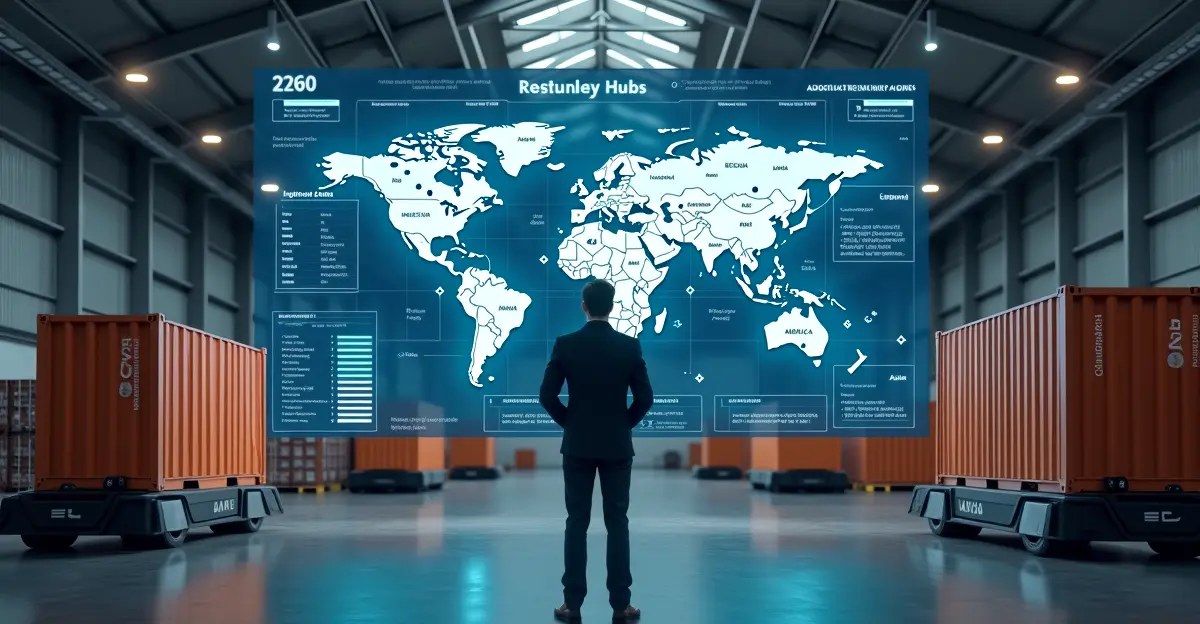
The widespread adoption of split-shoring strategies is fundamentally reshaping global trade patterns and regional economic development. As companies diversify their manufacturing footprints, we're witnessing the emergence of regional manufacturing hubs that serve specific geographic markets rather than global export platforms.
Regional Economic Development
This shift is creating new opportunities for economic development in regions that can offer the right mix of skilled labor, infrastructure, and policy support. States like Georgia, Ohio, and Arizona are competing for split-shoring projects with multi-billion-dollar incentive packages, recognizing the long-term economic benefits of becoming manufacturing hubs for strategic industries.
Strategic Competition Between Economic Blocs
The split-shoring trend is accelerating the formation of distinct economic blocs with integrated supply chains. The United States, European Union, and China are each developing more self-sufficient manufacturing ecosystems, with split-shoring serving as a bridge strategy during this transition period. This evolution has significant implications for global trade agreements and international economic relations.
Expert Perspectives and Industry Outlook
Supply chain experts emphasize that split-shoring represents a pragmatic middle ground in an increasingly polarized global economy. 'Companies are recognizing that binary choices between complete offshoring or full reshoring don't reflect the complexity of modern manufacturing,' explains one industry analyst. 'Split-shoring allows for strategic flexibility while managing multiple competing priorities.'
Despite the acceleration of split-shoring strategies, only 2% of companies have fully completed their reshoring plans, indicating this trend has much further to run. The ongoing evolution suggests that split-shoring will become the dominant supply chain strategy for multinational corporations in the coming decade, fundamentally reshaping how goods are produced and distributed globally.
Frequently Asked Questions
What exactly is split-shoring?
Split-shoring is a hybrid supply chain strategy where companies maintain both offshore and domestic production facilities to balance cost efficiency with geopolitical resilience and supply chain security.
How does split-shoring differ from reshoring?
While reshoring brings manufacturing entirely back to the home country, split-shoring maintains a diversified portfolio of production locations, combining domestic capacity with strategic offshore operations.
What technologies are essential for split-shoring success?
Successful split-shoring requires AI-powered supply chain management, digital twins for simulation, advanced analytics for production allocation, and real-time tracking systems across geographically dispersed facilities.
How do policies like the Inflation Reduction Act affect split-shoring?
The IRA and CHIPS Act provide powerful economic incentives for domestic manufacturing investment, making split-shoring more financially viable by offsetting some of the cost disadvantages of domestic production.
What industries are leading split-shoring adoption?
Semiconductors, electronics, automotive (particularly electric vehicles), clean energy technologies, and pharmaceuticals are at the forefront of split-shoring implementation due to their strategic importance and supply chain complexity.
How does split-shoring impact sustainability goals?
By optimizing production locations relative to end markets, split-shoring can reduce transportation distances and carbon footprints while supporting regional economic development and supply chain resilience.




Follow Discussion