


 Deutsch
 English
 Español
 Français
 Nederlands
 Português


 Share
Share




The Geopolitical Calculus Behind the UAE-US AI Campus
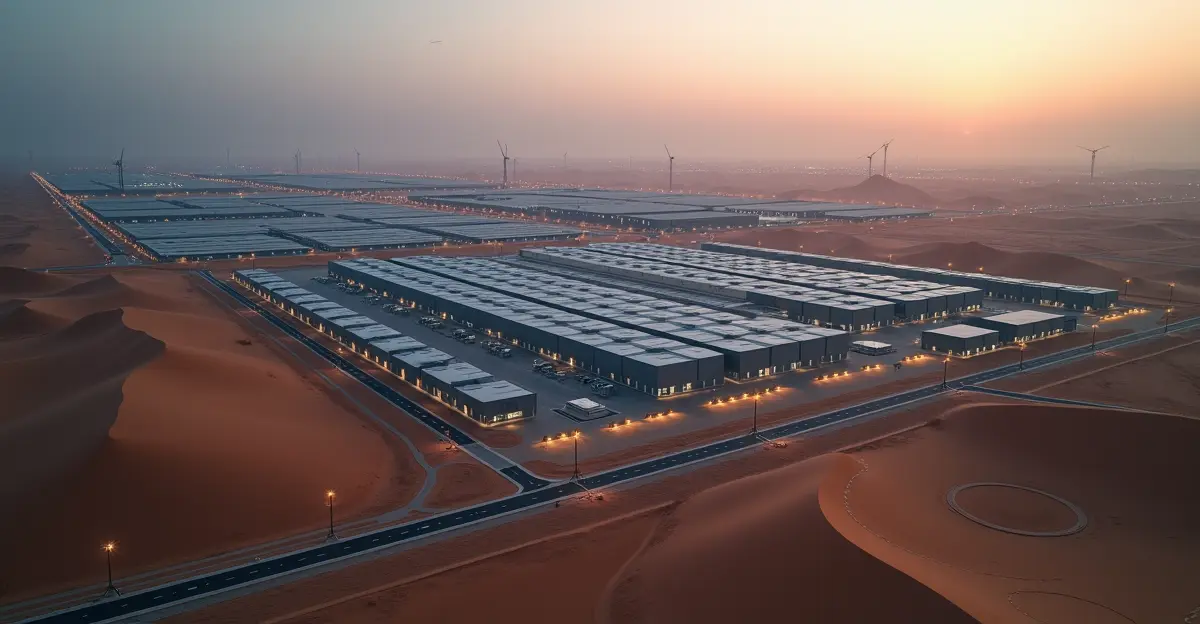
In May 2025, the United Arab Emirates and United States unveiled Phase 1 of a groundbreaking 5-gigawatt AI campus in Abu Dhabi, representing the largest artificial intelligence infrastructure project outside American territory. This monumental facility, spanning 10 square miles and built by Emirati firm G42 in partnership with undisclosed U.S. companies, marks a strategic realignment in global technology infrastructure that transforms the Middle East from an energy exporter to a digital infrastructure hub. The UAE AI Strategy 2031 has positioned the nation as an early mover in artificial intelligence, but this partnership elevates the geopolitical stakes significantly.
What is the UAE-US AI Acceleration Partnership?
The US-UAE AI Acceleration Partnership framework established in 2025 represents a comprehensive bilateral agreement designed to enhance cooperation in critical technologies. At its core is the 5GW AI technology cluster in Abu Dhabi, which will eventually provide low-latency services to nearly half of the global population within 3,200 kilometers of the UAE. According to official U.S. Embassy documentation, the campus leverages nuclear, solar, and gas power to minimize carbon emissions while including a science park for AI innovation. The partnership also streamlines UAE investment processes in U.S. digital infrastructure and establishes working groups to implement security protocols.
Strategic Counterbalance to Chinese AI Expansion
The Abu Dhabi campus serves as a deliberate counterweight to China's growing technological influence in the Middle East. In 2025, the U.S. Commerce Department approved 70,000 advanced AI chips for the UAE and Saudi Arabia, equivalent to 35,000 of Nvidia's most powerful Blackwell GB300 processors each. This approval followed both Gulf nations cutting ties with Chinese tech firms like Huawei and ByteDance. "This deal positions Gulf nations to serve AI computing needs across Asia and Africa while advancing major projects like Stargate UAE," notes analysis from Rest of World. The agreements include strict security measures to prevent technology diversion to China, reflecting Washington's strategy to isolate Beijing from advanced semiconductor access.
Energy Abundance Meets Computational Demand
Gulf states possess a unique advantage in the AI infrastructure race: abundant, affordable energy. AI data centers consume enormous amounts of electricity, with estimates suggesting a single large-scale facility can use as much power as a medium-sized city. The UAE's energy mix—combining nuclear from the Barakah plant, solar from massive desert arrays, and natural gas—provides reliable, cost-effective power essential for energy-intensive AI computations. This transforms the region's traditional hydrocarbon wealth into digital infrastructure advantage, creating what analysts call "energy-to-algorithm" transformation.
Geographic Positioning as Digital Crossroads
The UAE's location at the crossroads of Europe, Asia, and Africa gives it unparalleled geographic advantages for AI infrastructure. Seventeen submarine cables pass through nearby waters, carrying most data traffic between continents. The Abu Dhabi campus will serve as a regional computing hub for U.S. hyperscalers and large enterprises, offering latency-friendly services to markets from India to East Africa. However, this strategic positioning also creates vulnerabilities, as demonstrated during the 2026 U.S.-Iran conflict that simultaneously closed both the Strait of Hormuz and Red Sea to commercial traffic, threatening critical AI infrastructure.
Sovereign Wealth Funds Fueling AI Ambitions
Gulf sovereign wealth funds have become pivotal investors in global AI infrastructure. Saudi Arabia has allocated $40 billion for AI investments through its Public Investment Fund, while the UAE's Mubadala Investment Company has made strategic bets across the AI value chain. These funds enable Gulf states to:
- Partner with leading U.S. tech companies on equal financial footing
- Build world-class AI research institutions like Mohamed bin Zayed University of Artificial Intelligence
- Acquire advanced semiconductor manufacturing capabilities
- Develop comprehensive AI ecosystems rather than isolated projects
Security Protocols and Technological Sovereignty
The UAE-US partnership includes stringent security measures designed to address Washington's concerns about technology transfer. G42 operates within a Regulated Technology Environment (RTE), described as a "gold-standard compliance and security framework" ensuring high levels of protection, transparency, and governance. Enhanced Know-Your-Customer protocols govern compute resource access, while American companies will operate the data centers and offer U.S.-managed cloud services throughout the region. These arrangements create what foreign policy analysts describe as a modern "insurance policy" for Gulf state security, ensuring continued American protection through strategic technological dependencies.
Risks and Regulatory Challenges
Despite the ambitious vision, significant challenges remain. Data sovereignty concerns persist as U.S. companies maintain operational control over critical infrastructure. Regulatory frameworks in Gulf states continue evolving, with variations in data localization requirements and compliance standards. The concentration of AI infrastructure in geopolitically volatile regions creates physical security risks, as demonstrated by drone strikes on AWS data centers during regional conflicts. Additionally, the long-term implications for global AI governance remain uncertain as non-Western nations develop alternative frameworks.
Economic Transformation Projections
The economic impact of Gulf AI investments is substantial. AI is projected to contribute over $135 billion to Saudi Arabia's economy and $96 billion to the UAE's by 2030, according to analysis from Rest of World. These projections reflect a fundamental shift from hydrocarbon dependence to digital economy leadership. The UAE's early adoption of AI governance—including appointing the world's first Minister of Artificial Intelligence in 2017—has created institutional advantages that now bear fruit through international partnerships.
FAQ: UAE-US AI Campus and Gulf AI Strategy
What is the capacity of the Abu Dhabi AI campus?
The campus will eventually provide 5 gigawatts of power for AI data centers, with Phase 1 including a 1-gigawatt facility. This makes it the largest AI campus outside the United States.
How does this partnership counter Chinese AI influence?
The agreement includes strict security protocols preventing technology diversion to China and follows Gulf states cutting ties with Chinese tech firms. It positions the UAE as an alternative AI hub serving Asian and African markets with U.S.-managed infrastructure.
What are the energy sources for the AI campus?
The facility leverages nuclear power from the Barakah plant, solar energy from desert arrays, and natural gas to minimize carbon emissions while ensuring reliable, affordable electricity for energy-intensive computations.
How does this transform Gulf economies?
AI investments represent a strategic diversification from hydrocarbons to digital infrastructure, with projections showing AI contributing $96 billion to the UAE economy and $135 billion to Saudi Arabia's by 2030.
What security measures protect the technology?
The partnership operates within G42's Regulated Technology Environment with enhanced Know-Your-Customer protocols, U.S. company operational control, and measures to prevent unauthorized technology transfer.
Future Outlook and Global Implications
The UAE-US AI campus represents more than bilateral cooperation—it signals a fundamental reconfiguration of global AI infrastructure geography. As Gulf states leverage their energy abundance, sovereign wealth, and strategic positioning, they're creating technological dependencies that reshape geopolitical alignments. The success of this model will influence whether other resource-rich nations pursue similar digital transformation strategies, potentially creating a new category of "digital infrastructure states" in the global economy. The long-term implications for technological sovereignty, data governance, and international AI competition will unfold throughout the coming decade as these ambitious projects reach full operational capacity.
Sources
U.S. Embassy UAE announcement (May 2025), Rest of World analysis (2025-2026), Foreign Policy analysis (2026), Reuters coverage (2025), CNBC reporting (2025), UAE AI Strategy documentation, Cisco-G42 partnership announcements (2025).





Follow Discussion