


 Deutsch
 English
 Español
 Français
 Nederlands
 Português


 Share
Share




What Was the Planet Vulcan?
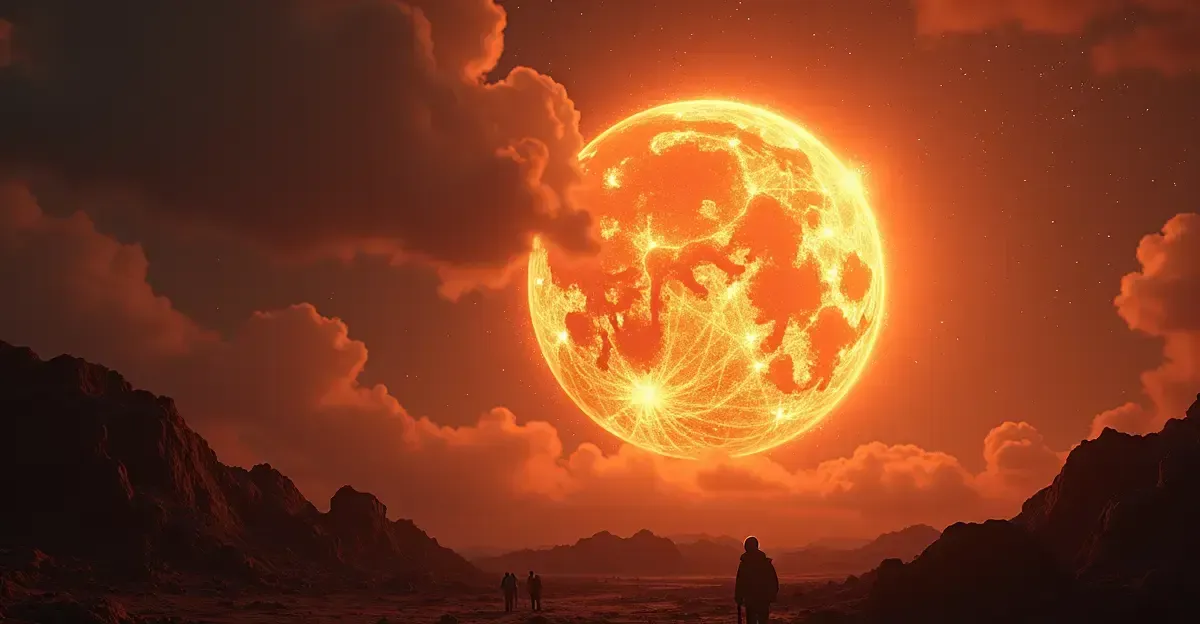
In the 19th century, astronomers believed a small planet named Vulcan orbited between Mercury and the Sun. Proposed by French mathematician Urbain Le Verrier in 1859, Vulcan was thought to explain peculiarities in Mercury's orbit that Newtonian physics could not account for. The planet was named after the Roman god of fire and forge, a fitting title for a world so close to the Sun. However, in 1915, Albert Einstein's general theory of relativity rendered Vulcan unnecessary, and the hypothetical planet was quietly removed from astronomical records.
The Search for Vulcan
Le Verrier's Prediction
Urbain Le Verrier had a stellar reputation. In 1846, he used mathematical calculations to predict the existence of Neptune, which was soon observed. When Mercury's orbit showed an unexplained advance in its perihelion—43 arcseconds per century more than Newton predicted—Le Verrier suspected another hidden planet. He calculated that a small planet between Mercury and the Sun could cause the disturbance.
The 1859 Observation
In December 1859, Le Verrier received a letter from French amateur astronomer Edmond Modeste Lescarbault, who claimed to have seen a dark disc crossing the Sun on March 26, 1859. Le Verrier accepted this as confirmation and named the new planet Vulcan. Lescarbault was awarded the Legion d'Honneur. But no reliable subsequent observations followed.
Later Searches
Astronomers worldwide searched for Vulcan during solar eclipses. On July 29, 1878, during a total eclipse visible in North America, two astronomers—Charles Watson and Lewis Swift—independently reported seeing a small object near the Sun. The New York Times declared Vulcan captured. However, other astronomers suggested the sightings were sunspots or background stars. The debate continued for decades.
Einstein's Solution: General Relativity
In November 1915, Albert Einstein presented his general theory of relativity to the Prussian Academy of Sciences. His theory described gravity as the curvature of spacetime caused by mass. When applied to Mercury, Einstein's equations perfectly accounted for the 43 arcseconds per century discrepancy—without any need for an extra planet. The Sun's massive gravity warps spacetime, and Mercury, being the closest planet, experiences this effect most strongly.
Einstein's theory was confirmed during the 1919 solar eclipse when Arthur Eddington measured starlight bending around the Sun exactly as predicted. Vulcan was no longer needed. The hypothetical planet Vulcan became a footnote in the history of science.
Could Vulcan Still Exist?
Modern space missions have thoroughly explored the inner solar system. NASA's Mariner 10 (1973) and Messenger (2010) studied Mercury in detail, and the ESA-JAXA mission BepiColombo, launched in 2018, is currently en route to arrive at Mercury in November 2026. According to Johannes Benkhoff, ESA's BepiColombo project scientist, the mission's cameras are focused on Mercury's surface, not the space around it. However, gravitational measurements could detect any undiscovered objects. Benkhoff told Quest magazine: 'If we find deviations in the gravity field, we will see whether something is floating around the planet—asteroids, perhaps.' He added: 'I believe in Einstein's general theory of relativity. By Einstein's theory, Vulcan was truly no longer needed. But... it would be very interesting to find something totally unexpected.'
No evidence of Vulcan has ever been found. The search for Planet Nine in the outer solar system continues, but the inner solar system is now well-mapped.
Vulcan in Popular Culture
Though the real Vulcan never existed, the name lived on in science fiction. In 1964, a British Doctor Who comic strip featured a planet Vulcan. The most famous appearance is in Star Trek (1965), where Vulcan is the homeworld of Mr. Spock, orbiting the star 40 Eridani A. Star Trek creator Gene Roddenberry likely borrowed the name from mythology rather than Le Verrier's lost planet.
FAQ
Why did astronomers believe in Vulcan?
Because Mercury's orbit advanced faster than Newtonian physics predicted. Le Verrier successfully used similar reasoning to discover Neptune, so the idea of another hidden planet seemed plausible.
When was Vulcan disproven?
In November 1915, Einstein's general relativity explained Mercury's orbit without Vulcan. The planet was gradually removed from textbooks.
Did anyone ever really see Vulcan?
Several observers reported seeing objects near the Sun, but these were likely sunspots, background stars, or optical illusions. No reliable evidence exists.
Is there a real planet Vulcan today?
No. The hypothetical planet Vulcan does not exist. However, an exoplanet orbiting 40 Eridani A (the fictional Vulcan's star) was discovered in 2018 but later retracted.
What caused Mercury's orbital anomaly?
The curvature of spacetime around the Sun, as described by Einstein's general relativity. Mercury's proximity to the Sun makes this effect measurable.

Follow Discussion