


 Deutsch
 English
 Español
 Français
 Nederlands
 Português


 Share
Share




New Humanitarian Airlift Corridor Addresses Critical Access Challenges
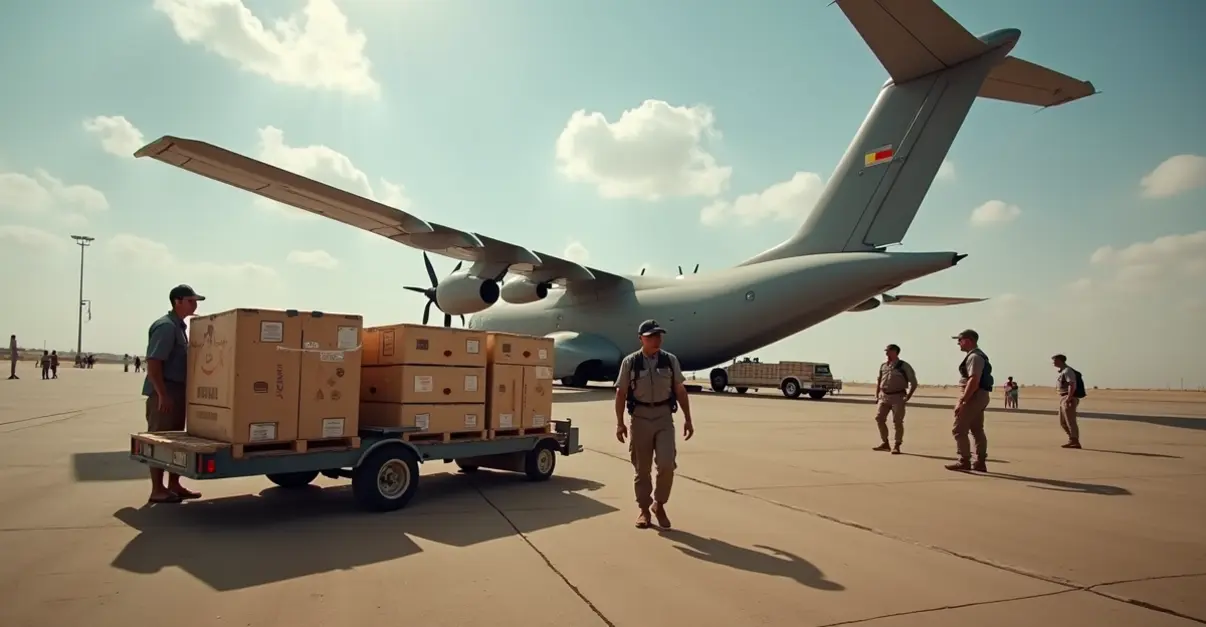
In response to escalating global humanitarian needs, a coordinated humanitarian airlift corridor has been established to facilitate aid delivery to conflict zones and disaster areas. The initiative, announced this week, represents a major breakthrough in international cooperation as humanitarian organizations face unprecedented challenges reaching vulnerable populations.
The corridor system addresses three critical components: coordination logistics, security clearances, and beneficiary targeting. 'This isn't just about flying planes—it's about creating a reliable system that ensures aid reaches those who need it most, when they need it most,' said Ella Popescu, the initiative's lead coordinator.
Logistics Coordination: A Complex Puzzle
The humanitarian supply chain crisis has intensified in 2025, with only 19% of the required $45.48 billion funded globally, representing a 40% decrease from last year. According to recent reports, humanitarian corridors face unprecedented challenges with 181 million people requiring assistance across 72 countries.
The new airlift corridor leverages the expertise of the Logistics Emergency Team (LET), a pioneering public-private partnership celebrating 20 years of operation. The LET partnership with major logistics companies like Agility, UPS, Maersk, and DP World provides pro bono support to the UN's Logistics Cluster led by the World Food Programme.
Security Clearances: Navigating Conflict Zones
Security negotiations have proven particularly challenging, with impasses between conflicting parties over humanitarian access routes. The corridor system includes standardized security protocols and pre-negotiated clearances with relevant authorities.
'We've learned from past experiences that security arrangements must be robust yet flexible enough to adapt to changing conflict dynamics,' explained a senior UN official involved in the negotiations. The system builds on the concept of humanitarian corridors as temporary demilitarized zones for safe aid transit.
Beneficiary Targeting: Precision in Aid Delivery
With severe funding constraints forcing humanitarian organizations to adopt 'hyperprioritization,' the corridor includes sophisticated beneficiary targeting mechanisms. These systems ensure that limited resources reach the most vulnerable populations first.
The United Nations Humanitarian Air Service (UNHAS), managed by the World Food Programme, plays a crucial role in the corridor's operations. UNHAS transported over 355,000 passengers and 4,925 metric tons of humanitarian cargo in 2024, reaching nearly 400 destinations worldwide.
Regional Implementation Challenges
In Sudan, where airspace remains largely closed, the 2025 Humanitarian Needs and Response Plan outlines critical logistics challenges requiring $83.5 million. The Logistics Cluster coordinates operations from Port Sudan and Chad, providing common storage facilities and supporting road transport services.
Similarly, in Haiti, UNHAS urgently requires $3.9 million to maintain operations as the only aviation support available to the humanitarian community, with over 5.4 million people facing acute food insecurity.
Future Outlook and Innovations
The corridor system incorporates innovative tools like EDUARDO, which uses Google flight data to identify available cargo capacity for humanitarian operations. Digitalization and private sector involvement are increasing, but these innovations must balance against the fundamental need for secure humanitarian corridors.
'What makes this corridor different is its integrated approach—we're not just creating flight paths, we're building an entire ecosystem for humanitarian response,' said Popescu. With over 305 million people requiring humanitarian aid globally, the initiative represents a critical step toward more effective crisis response.
The humanitarian community faces mounting pressure as climate-related disasters increase alongside persistent conflicts. The new airlift corridor offers a model for how sustained public-private collaboration can maximize impact in addressing complex humanitarian crises, though funding remains a significant challenge with UNHAS facing 50% less funding than last year.





Follow Discussion