


 Deutsch
 English
 Español
 Français
 Nederlands
 Português


 Share
Share




Resource nationalism 2026 has moved from threat to structural reality as China, Chile, Indonesia and Argentina tighten export controls and extraction terms on rare earths, lithium and copper. Washington, Brussels and Beijing now treat mining as industrial policy and national security. With the EU Critical Raw Materials Act taking full effect in 2026 and the US invoking the Defense Production Act, the critical minerals race is the decade's central geopolitical contest.
What Is Resource Nationalism in Critical Minerals?
Resource nationalism is the tendency of governments to assert state control over natural resources within their territory. In 2026 it means export licenses, processing mandates, output caps and state joint ventures, not simply royalties. For minerals essential to batteries, magnets and semiconductors, geology becomes leverage. This moves beyond tax frameworks into direct supply-chain control, making mining a geopolitical contest tied to the critical minerals supply chain.
China's Export Controls: The Chokepoint Tightens
China controls roughly 90% of rare earth processing, 60% of lithium and cobalt refining, and 80% of battery-grade graphite. In October 2025 Beijing broadened controls on seven heavy rare earths; in early 2026 it extended restrictions to processing technology. On June 22, 2026, MOFCOM blocked exports to 10 US companies, and by July 24 restricted shipments to 14 EU firms. The IEA warns full enforcement could threaten $6.5 trillion in downstream production. Gallium rose 123% to $2,100/kg, germanium 203% to $8,597/kg, and antimony exports fell 97%, creating a rare earth processing bottleneck.
Producer Nations Assert Control: Chile, Indonesia, Argentina
Chile has nationalized lithium through NovaAndino Litio and the SQM-Codelco joint venture. Indonesia's nickel export ban supplies over half of world nickel; the DRC imposed cobalt export caps in February 2025 and later quotas. Argentina is imposing new terms on lithium and copper, part of a Latin American wave toward lithium nationalization.
Washington and Brussels Race to De-risk
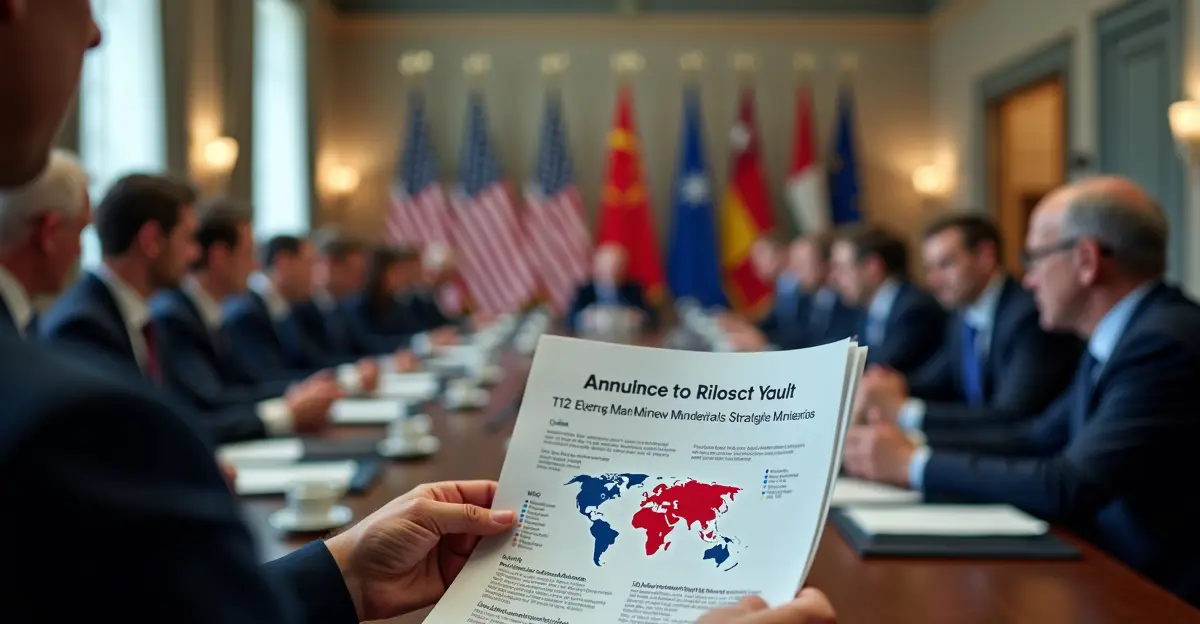
On February 4, 2026, the US hosted a 54-country Critical Minerals Ministerial and launched FORGE, chaired by South Korea, mobilizing over $30 billion and 21 bilateral deals. Washington expanded Project Vault, a $12 billion strategic reserve, and is using the Defense Production Act for domestic processing and stockpiling. The EU's Critical Raw Materials Act, fully in force in 2026, selected 60 Strategic Projects and targets 10% extraction, 40% processing and 25% recycling by 2030. Yet Europe still depends on China for 98% of rare earths and 97% of lithium; ReSourceEU's €3 billion covers 3% of its €100 billion need.
Impact on Defense, AI and Energy Transition
Gallium and germanium feed F-35 radar, SM-6 and Patriot missiles, and the B-21 bomber, while germanium is critical for Nvidia NVL72 AI racks. The Pentagon identified $2.41 billion in shortfalls across 69 materials. NdPr magnet prices rose 37%, lithium carbonate 67%, and some rare earths spiked 600%. Analysts see a 12-18 month diversification window, but full independence from Chinese processing could take 20-30 years, making defense procurement and recycling central.
Expert Perspectives
Legal and supply-chain analysts describe a shift from tariffs to absolute control. A denied license means no shipment at any price, notes one China trade specialist. Gibson Dunn adds that legal strategy is inseparable from business strategy as miners face expropriation and force-majeure disputes.
FAQ
What is resource nationalism 2026? Government export controls, state ownership and processing mandates over critical minerals such as rare earths, lithium and copper.
Which countries are imposing export controls? China restricts rare earths, gallium, germanium and antimony; Indonesia restricts nickel; Chile nationalizes lithium; Argentina and the DRC impose new terms and cobalt caps.
What are the EU CRMA targets? 10% domestic extraction, 40% processing and 25% recycling by 2030, backed by 60 Strategic Projects.
Why is the US using the Defense Production Act? To fund domestic mining, processing and reserves, reducing China dependence for defense and energy transition.
Conclusion
Resource nationalism 2026 is a structural redrawing of global power lines. Winners will build processing capacity, recycling loops and diversified alliances, not just hold geology.


Follow Discussion