


 Deutsch
 English
 Español
 Français
 Nederlands
 Português


 Share
Share




By mid-2026, the US-China technology decoupling has permanently bifurcated the global semiconductor industry into two parallel, incompatible ecosystems — one aligned with Washington and its allies, the other driven by Beijing's relentless push for self-sufficiency. This structural fracture, which the World Economic Forum's Global Risks Report 2026 now ranks as the top geoeconomic risk through 2028, is reshaping everything from military hardware roadmaps to consumer electronics pricing. With Nvidia's China market share collapsing from 95% to near zero, SMIC reaching 5nm production, and China mandating domestic compute for all AI models, global supply chains now require dual sourcing strategies that double costs and fragment technical standards.
The Decisive Escalation of Early 2026
The first half of 2026 saw a series of decisive policy moves that cemented the industry's split. In January 2026, President Donald Trump signed a Proclamation invoking Section 232 of the Trade Expansion Act, imposing a 25% tariff on advanced AI chips including Nvidia's H200 and AMD's MI325X bound for China. The White House fact sheet described the action as necessary to address national security concerns over semiconductor import dependence, though chips destined for US supply chain buildout were exempted. The Commerce Department simultaneously approved 10 Chinese firms — including Alibaba, Tencent, ByteDance, and JD.com — to purchase up to 75,000 H200 units each, but with conditions: a 25% surcharge, volume caps at 50% of US customer shipments, and mandatory independent third-party testing before export.
Yet Beijing's response was swift and decisive. China's State Council issued a mandate requiring that at least 80% of core technology — including AI accelerators — powering the nation's new 2 trillion yuan ($295 billion) unified AI computing grid come from domestic suppliers. This effectively locked out Nvidia and AMD from the world's largest new computing procurement program. By May 2026, Nvidia CEO Jensen Huang confirmed in an interview that the company's China AI accelerator market share had fallen from 95% to effectively zero. "The policy has already largely backfired," Huang stated, noting that China is the world's second-largest computer market. Nvidia took $4.5 billion in charges related to the H20 export ban alone, while its quarterly revenue hit a record $81.6 billion — driven entirely by non-China AI demand.
SMIC's 5nm Breakthrough: Engineering Against the Odds
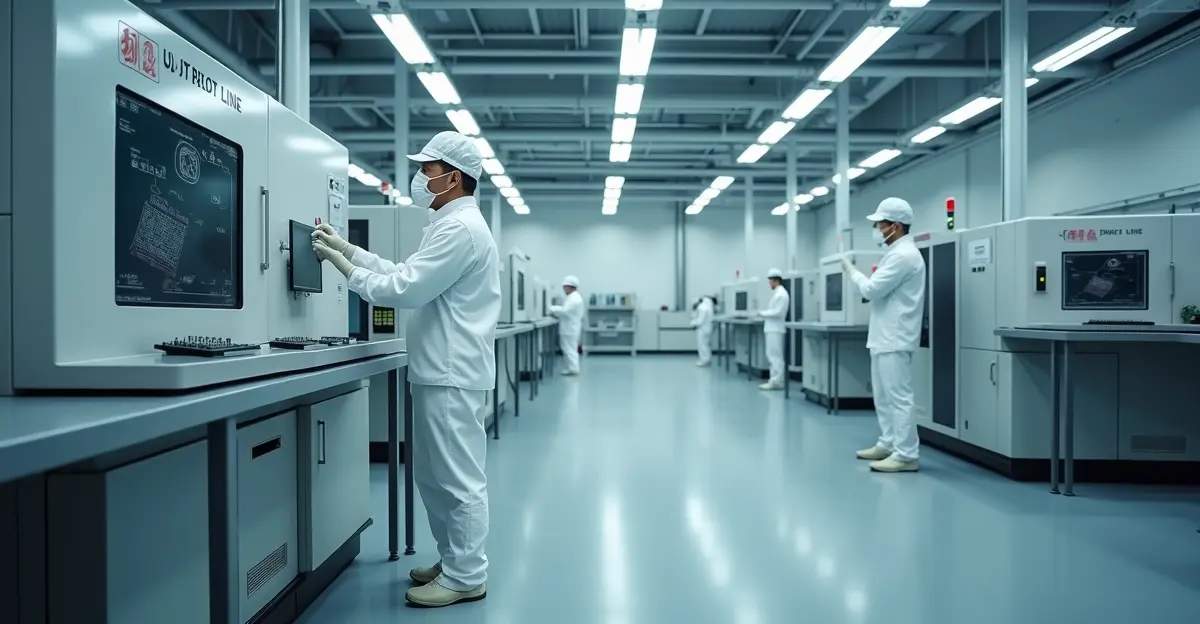
While Nvidia's China revenue vanished, Semiconductor Manufacturing International Corporation (SMIC) achieved what many analysts deemed impossible under US sanctions. By April 2026, SMIC had initiated pilot production of 5nm chips using older ASML NXT:1980Fi deep ultraviolet immersion (DUVi) lithography machines — a feat accomplished through multi-patterning techniques despite the EUV export ban. According to an April 2026 American Enterprise Institute report, SMIC's 5nm yields remain low at roughly 20-40%, but the company is scaling production for Huawei's Ascend AI chips. China acquired approximately 90 ArFi DUV machines worth $5-7 billion in 2024 before DUV restrictions took effect, providing a critical equipment base.
SMIC has transformed from a general-purpose foundry into China's national champion for strategic AI chip production. The company is now mass-producing Huawei's Ascend 910D series on its 7nm process while developing 5nm capability. This state-backed strategy is fueled by China's $47.5 billion 'Big Fund III' launched in May 2024, a $7.5 billion Tianjin fab investment, and a $5.79 billion subsidiary buyout in Beijing in January 2026. Key partnerships include exclusive foundry arrangements with Huawei, a 5nm AI inference chip collaboration with Alibaba, and domestic equipment supplier Yuliangsheng. Manufacturing is concentrated in Shanghai, Beijing, and Shenzhen, creating a sanction-proof, closed-loop ecosystem prioritizing national self-sufficiency over commercial competitiveness. SMIC maintains a stable 5-6% global foundry market share, but its strategic importance far exceeds that figure.
The US semiconductor export controls have thus created a paradoxical outcome: China's domestic chip ecosystem is accelerating faster than many Western analysts predicted. Huawei's AI chip revenue is projected to reach $12 billion in 2026, driven by the Ascend 950PR processor delivering up to 2 petaflops of FP4 performance with locally produced HBM memory. Huawei is on track to control 60% of China's AI chip market by year-end, alongside domestic players Cambricon, Moore Threads, and MetaX. The total Chinese AI accelerator market is estimated at $30-35 billion for 2026 — none of which goes to US companies.
The Bifurcated Ecosystem: Two Worlds, Two Standards
The most profound consequence of the semiconductor split is the emergence of two parallel technology ecosystems. In the Western bloc — the US, EU, Japan, South Korea, and Taiwan — Nvidia's CUDA platform remains the dominant AI software stack, with TSMC providing advanced fabrication at 3nm and below. In China, developers are rapidly shifting from CUDA to Huawei's CANN (Compute Architecture for Neural Networks) and MindSpore framework. Domestic AI clusters using Huawei chips now reach approximately 90% of the efficiency of Western counterparts running on Nvidia hardware, according to industry benchmarks.
This digital bipolarity in AI infrastructure extends beyond hardware. Chinese tech giants Baidu, Alibaba, and Tencent have abandoned Western open-source models in favor of proprietary architectures trained on domestic datasets. The 'Training Closure' trend means that AI models developed in China are increasingly incompatible with Western frameworks, creating a de facto standard split. For multinational corporations operating in both markets, this means maintaining dual AI development teams, dual software stacks, and dual supply chains — a cost burden that Deloitte's 2026 Semiconductor Industry Outlook estimates could add 30-50% to technology procurement budgets.
Global semiconductor sales are projected to hit a historic $975 billion in 2026, according to Deloitte, with 26% growth fueled by AI infrastructure demand. However, this masks a stark structural divergence: high-value AI chips drive roughly half of total revenue but represent less than 0.2% of unit volume. Memory revenue is forecast at ~$200 billion, with HBM3 and HBM4 demand causing consumer memory shortages and price surges of 40-80% for DRAM and NAND. The top 10 chip companies' combined market cap hit $9.5 trillion by December 2025, with the top three stocks accounting for 80% of that value — a concentration that the WEF warns creates systemic vulnerability.
Impact on Supply Chains and Pricing
The bifurcation has triggered a dual sourcing crisis across the global electronics industry. Landed costs for advanced chips have risen up to 35%, US tariffs on Chinese chips doubled to 50%, and lead times stretched from 12 to 52 weeks for constrained components. Key bottlenecks include advanced packaging (CoWoS and HBM), EDA software restrictions, and critical materials. The strategic response among multinationals is 'friendly shoring' — concentrating supply in allied nations while maintaining parallel Chinese supply chains for the domestic market.
For automotive, cloud, and consumer electronics companies, the cost of semiconductor dual sourcing is becoming unsustainable. A single fab construction from groundbreaking to commercial production now takes 36 to 60 months, with advanced node fabs (3nm/5nm) costing $18-25 billion. Most investment flows into AI-capable advanced nodes, leaving mature node capacity (28nm-65nm) constrained — creating critical supply gaps for MCUs, PMICs, and other legacy chips essential for automobiles and industrial equipment through 2026-2028.
Expert Perspectives and Geoeconomic Implications
The World Economic Forum's Global Risks Report 2026 identifies geoeconomic confrontation as the top risk most likely to trigger a material global crisis, cited by 18% of respondents. State-based armed conflict follows at 14%. The report notes that 50% of experts anticipate a turbulent or stormy outlook over the next two years, rising to 57% over 10 years. Only 1% expect a calm outlook. The semiconductor decoupling is the primary driver of this geoeconomic tension.
Ryan Fedasiuk and Julia Torres of the American Enterprise Institute, in their April 2026 report, warned that China's DUVi fleet can supply Huawei's domestic AI demand even without EUV access. They noted that a proposed House bill aims to close the loophole by targeting aperture size and overlay accuracy, but if it stalls, SMIC could complete its 5nm yield ramp by 2027. Meanwhile, Nvidia's Huang has publicly lobbied for policy reversal, arguing that export controls have accelerated China's self-sufficiency rather than prevented it.
The geopolitical risks of semiconductor decoupling extend beyond economics. Military hardware roadmaps on both sides are now being rewritten around domestic chip supply chains. The US Department of Defense is accelerating qualification of domestic fabs for critical systems, while China's People's Liberation Army is integrating Huawei's Ascend chips into next-generation command and control systems. This creates a self-reinforcing cycle: security concerns drive further decoupling, which deepens the technological divide, which increases security concerns.
FAQ
What caused the semiconductor industry to split in 2026?
The split was driven by escalating US export controls on advanced AI chips to China, beginning with Biden-era restrictions in October 2022 and culminating in Trump's 25% tariff on H200 chips in January 2026. China responded with mandates requiring domestic compute for AI models and a $295 billion national AI computing grid that locks out foreign chips.
How far behind is SMIC compared to TSMC?
SMIC has achieved 5nm pilot production using DUV lithography with multi-patterning, but yields remain low (20-40%). TSMC is mass-producing 3nm and developing 2nm. SMIC's chips lag approximately 3-4 generations behind leading-edge Western nodes, but the gap is narrowing faster than anticipated.
What does dual sourcing mean for consumer electronics prices?
Dual sourcing strategies — maintaining separate supply chains for Western and Chinese markets — are adding 30-50% to semiconductor procurement costs. These costs are passed to consumers through higher prices for smartphones, laptops, automobiles, and cloud services, with DRAM and NAND prices already up 40-80%.
Can the semiconductor industry ever reunite?
Most analysts consider reunification unlikely in the foreseeable future. The WEF ranks geoeconomic confrontation as the top risk through 2028, and both sides are investing heavily in self-sufficiency. The technical standards, software ecosystems, and supply chains have diverged to the point where re-integration would require unprecedented political and economic cooperation.
Which companies benefit from the split?
In the Western bloc, Nvidia, TSMC, ASML, and AMD benefit from concentrated AI demand. In China, Huawei, SMIC, Cambricon, and CXMT (memory) are the primary beneficiaries. However, the overall industry faces higher costs and reduced economies of scale, which may slow innovation in the long term.
Conclusion: A New Era of Technological Sovereignty
The semiconductor industry's bifurcation in 2026 marks the end of the globalized chip supply chain that powered the digital revolution. Two parallel ecosystems are now hardening, each with its own standards, suppliers, and strategic objectives. For multinational corporations, the era of 'one world, one supply chain' is over. The choice of which ecosystem to align with is no longer a business decision — it is a geopolitical commitment with profound implications for market access, technology development, and long-term competitiveness. As Deloitte's $975 billion projection and the WEF's risk ranking make clear, this structural fracture is the defining strategic inflection point for the global technology economy through the end of the decade.

Follow Discussion