


 Deutsch
 English
 Español
 Français
 Nederlands
 Português


 Share
Share




What is the Mysterious Farsi Radio Station?
A mysterious shortwave radio station broadcasting coded messages in Farsi has captivated intelligence agencies and radio enthusiasts worldwide since its emergence in February 2026. Known as V32 in monitoring circles, this numbers station transmits strings of Persian numbers followed by the word 'tavajjoh' (attention) repeated three times, representing a revival of Cold War-era spycraft techniques during the ongoing conflict between Iran, the United States, and Israel. The station began broadcasting just hours after US-Israeli airstrikes on Iranian targets, suggesting a direct connection to the escalating military tensions in the Middle East.
How Numbers Stations Work: The Ultimate Low-Tech Solution
Numbers stations represent one of the most secure communication methods ever devised by intelligence agencies. These shortwave radio broadcasts use one-time pad encryption, making them theoretically unbreakable even with modern computing power. The system works by having both the sender and receiver possess identical codebooks containing random number sequences. When a message needs to be sent, the broadcaster reads numbers that correspond to specific pages and positions in the shared codebook.
'It's the ultimate low-tech solution and therefore unhackable,' explains former AIVD intelligence officer Eric Schouten. 'A shortwave radio station can be received worldwide under normal conditions. All codes are audible to everyone, but they only have meaning for those who know what was agreed upon.'
Historical Precedents: From WWII to the Cold War
The most famous historical example occurred during World War II when the British used Radio London to broadcast the first line of a French poem to signal the beginning of the D-Day invasion to French resistance fighters. During the Cold War, both American and Soviet intelligence agencies operated numerous numbers stations, with some continuing to broadcast for decades without their messages being deciphered.
Today, the Russian military intelligence network still operates several numbers stations, including the famous UVB-76 'Buzzer' station that has transmitted since the 1970s. Similarly, the United States military uses shortwave radio to communicate with strategic assets like B-2 bombers operating in conflict zones, demonstrating the continued relevance of this technology.
The V32 Station: Technical Details and Theories
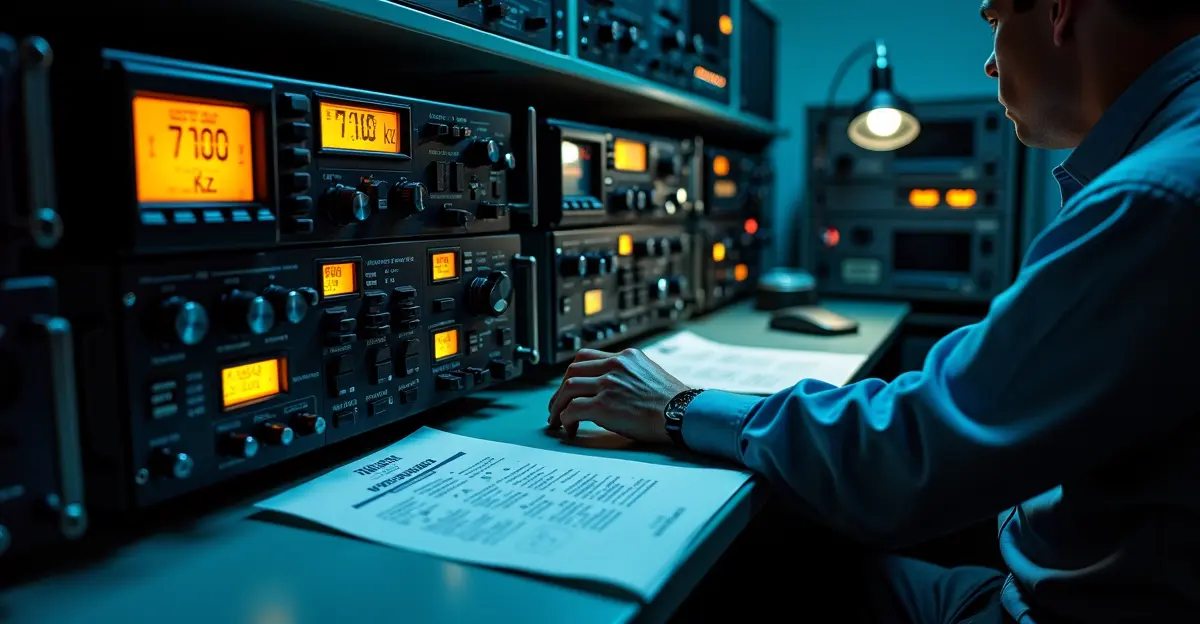
According to monitoring data from Priyom.org and Numbers-Stations.com, V32 operates on frequencies 7910 kHz and 7842 kHz, broadcasting twice daily at 02:00 and 18:00 UTC. Technical analysis suggests the station uses Harris Falcon III or AN/PRC-160 military-grade radios, indicating state sponsorship rather than amateur operation.
Three Competing Theories About V32's Origin
- Iranian Intelligence Communication: The station could be operated by Iran's Islamic Revolutionary Guard Corps (IRGC) to communicate with sleeper cells or agents abroad during the conflict.
- Western Intelligence Operation: Evidence of Iranian 'bubble jammer' interference suggests the station might be operated by US or Israeli intelligence to communicate with assets inside Iran.
- Psychological Warfare: Some experts suggest the broadcasts could be designed to sow paranoia within the Iranian regime about infiltrated agents.
Direction-finding analysis places the transmitter's origin in Southwest Germany, though some triangulation data points to the Red Sea region. The station's evolution from live operators to automated prerecorded messages suggests an organized intelligence operation adapting to operational needs.
Why Shortwave Radio Remains Relevant in 2026
Despite the digital age, shortwave radio offers unique advantages for clandestine communications. Radio waves in the 3-30 MHz range can be reflected by the ionosphere, allowing signals to travel thousands of miles beyond the horizon. This 'skip propagation' enables global reach from a single transmitter without relying on internet infrastructure that can be monitored or disrupted.
'I've been fascinated by this phenomenon my whole life,' says Schouten, founder of Dyami Security Intelligence. 'It's fascinating, a piece of mysticism. I grew up with it, listening to it since childhood. If you as a civilian don't know it exists and then suddenly come into contact with it, you think: wow.'
The Dutch Military Intelligence Service (MIVD) is responsible for monitoring such transmissions in the Netherlands, though experts acknowledge the near-impossibility of cracking properly implemented one-time pad encryption without the codebook.
Broader Implications for Modern Espionage
The emergence of V32 during the Iran conflict highlights how older technologies become operationally essential when modern digital infrastructure is compromised or monitored. With internet disruptions in conflict zones and sophisticated cyber surveillance capabilities, the simplicity and security of numbers stations offer reliable alternatives for sensitive communications.
This development also reflects broader trends in asymmetric warfare strategies employed by nations facing technologically superior adversaries. Iran has historically utilized unconventional methods including cyber attacks, proxy forces, and now potentially revived Cold War communication techniques to counter US and Israeli military advantages.
Frequently Asked Questions
What is a numbers station?
A numbers station is a shortwave radio station that broadcasts formatted numbers, believed to be used by intelligence agencies to communicate with spies using one-time pad encryption.
Why can't intelligence agencies crack these codes?
Properly implemented one-time pad encryption is mathematically unbreakable without the specific codebook used by both sender and receiver, as each encryption key is used only once.
How long has V32 been broadcasting?
V32 first appeared on February 28, 2026, coinciding with the beginning of US-Israeli military operations against Iran, and continues daily broadcasts as of March 2026.
Can ordinary people listen to these broadcasts?
Yes, anyone with a shortwave radio capable of receiving frequencies around 7910 kHz can hear the broadcasts, though the coded messages will be meaningless without the decryption key.
Are numbers stations still used today?
Yes, several nations including Russia, Cuba, and North Korea continue to operate numbers stations, with V32 representing the first new voice numbers station formally classified since 2016.

Follow Discussion