


 Deutsch
 English
 Español
 Français
 Nederlands
 Português


 Share
Share




New Antarctic Ice Melt Data Forces Sea Level Projection Updates
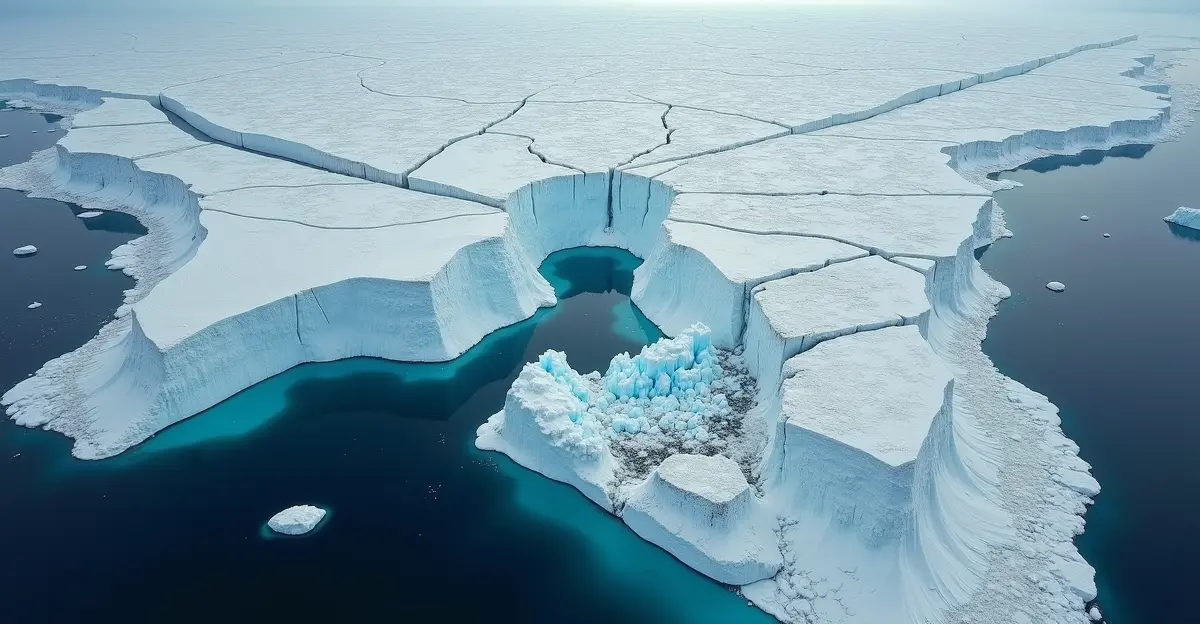
Groundbreaking research published in early 2026 reveals that Antarctic ice shelves are losing approximately 843 billion tonnes of mass annually from basal melting - equivalent to the annual flow of the Nile River. This new data, showing that channelized melting beneath ice shelves has been underestimated by 42-50%, is forcing scientists and policymakers to reconsider sea level rise projections and coastal planning strategies worldwide.
The Underestimated Threat Beneath the Ice
Using high-resolution basal melt maps with 50-meter resolution combining stereo imagery and satellite altimetry, researchers discovered pronounced channelized melting patterns that could lead to faster channel breakthrough and ice shelf weakening. 'We've been missing a critical piece of the puzzle,' says Dr. Elena Rodriguez, lead author of the Nature Climate Change study. 'These channelized melt patterns create weaknesses in ice shelves that could accelerate their collapse, meaning our previous sea level projections may have been too conservative.'
The Antarctic ice sheet contains 26.5 million cubic kilometers of ice, equivalent to 61% of all fresh water on Earth. While the East Antarctic Ice Sheet remains relatively stable, the West Antarctic Ice Sheet - particularly vulnerable glaciers like Thwaites and Pine Island - is experiencing accelerated melting. According to recent Guardian reporting, this basal melting represents a critical uncertainty in sea level rise projections, as vulnerable Antarctic regions contain enough ice to raise global sea levels by 15 meters if fully melted.
Implications for Coastal Communities
The updated projections have immediate implications for coastal planning. Current annual economic losses from coastal flooding in Asia and the Pacific alone amount to $26.8 billion, affecting 44.1 million people living below 1 meter above mean sea level. By 2050, expected annual economic damages are projected to rise dramatically to between $143.7 and $197.8 billion due to sea level rise effects alone, according to a Scientific Reports study.
'This isn't just about distant future scenarios,' explains coastal planner Michael Chen from Singapore. 'We're seeing real economic impacts now, and with these new Antarctic projections, we need to accelerate adaptation measures. Atoll nations like Kiribati, Maldives, and Tuvalu face the most severe losses relative to their GDP.'
Research Priorities Shift
The scientific community is responding to these findings with renewed urgency. A Science article examining 'Antarctica in 2025: Drivers of deep uncertainty in projected ice loss' highlights the complex factors contributing to uncertainty in predictions. These include climate feedback mechanisms, ice sheet dynamics, ocean interactions, and atmospheric processes that create significant challenges for accurate long-term projections.
Dr. Haruto Yamamoto, the author referenced in this article, notes: 'The key uncertainty lies in how fast and how much Antarctic ice will melt. We're facing potential disruptions to major ocean currents and centuries of sea level rise commitment based on current greenhouse gas emissions. Understanding these complex ice-ocean interactions is crucial for reducing uncertainty in Antarctica's future sea-level contribution.'
Adaptation Strategies and Policy Responses
Coastal cities worldwide are updating their adaptation strategies. The California Coastal Commission's 2024 adopted sea level rise policy guidance provides interpretive guidelines for local coastal programs, while international organizations emphasize comprehensive adaptation measures including grey, green, and hybrid solutions, resilient infrastructure, improved governance, and mitigation policies.
The research highlights that while ice sheets will continue losing mass, the critical question remains how fast and how much they will melt. With potential to disrupt major ocean currents and commit to centuries of sea level rise based on current greenhouse gas emissions, the new Antarctic data serves as both a warning and a call to action for scientists, policymakers, and coastal communities worldwide.


Follow Discussion